AAFCO Feeding Trials vs Nutrient Profiles: What Cat Owners Should Know
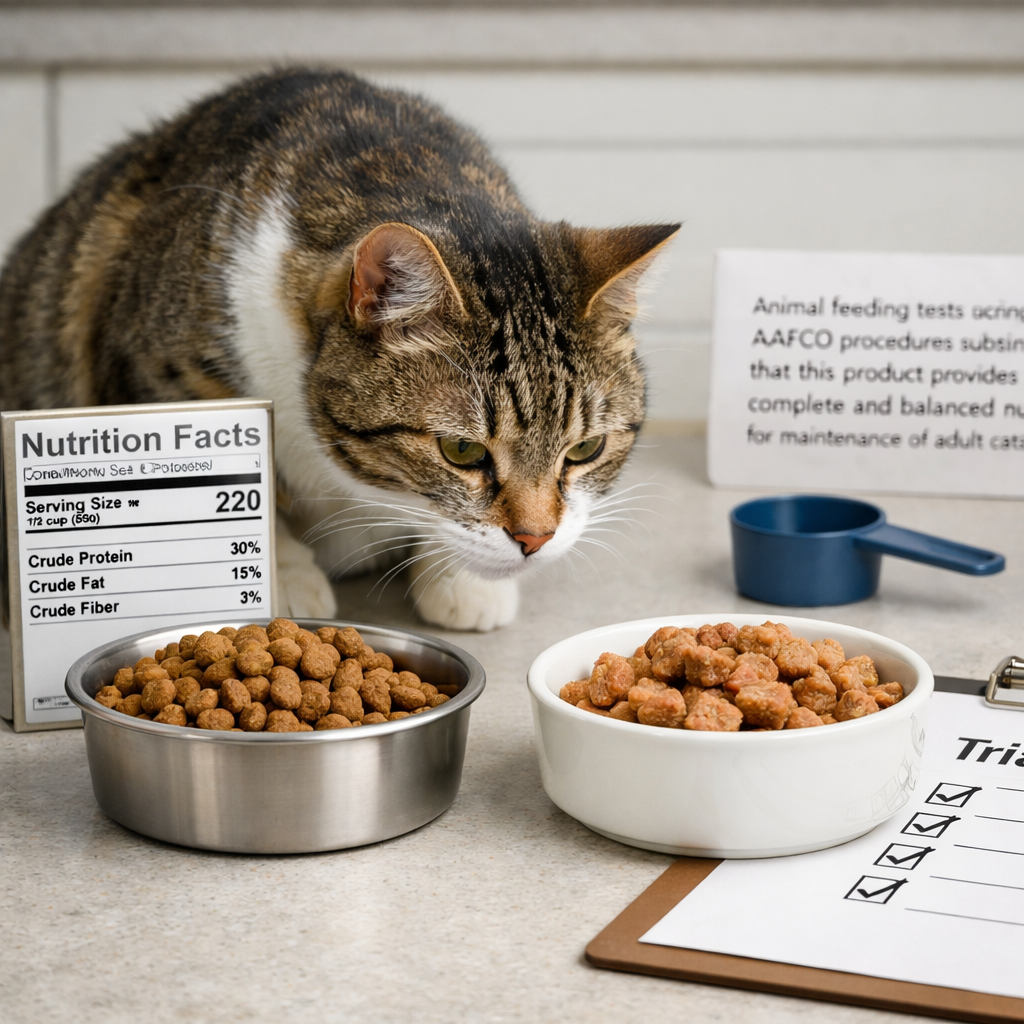
AAFCO Feeding Trials vs Nutrient Profiles: What Cat Owners Should Know
Cat food labels often promise “complete and balanced,” but the path a brand took to make that claim matters. The Association of American Feed Control Officials (AAFCO) provides model standards for what “complete and balanced” means, and pet foods can meet those standards in two ways: through feeding trials or by formulation to nutrient profiles. Below, we explain both methods, how to read the AAFCO nutritional adequacy statement, and how to choose a moisture-rich, animal-protein-forward, transparent recipe that fits your cat’s life stage and health needs. At Pet Food Ingredient Guide, we treat AAFCO substantiation as a baseline and then assess moisture, protein quality, carbohydrates, and transparency.
What AAFCO means on cat food labels
AAFCO is a nonprofit association of state and federal feed regulators, veterinarians, and nutrition scientists that develops model regulations and nutrient standards for pet foods; it does not test, certify, or approve individual products. On labels, AAFCO’s role appears in the nutritional adequacy statement—the line that declares whether a diet is complete and balanced and for which life stage.
Nutritional adequacy statement (40–50 words): This required label line tells you if the food is complete and balanced, the covered life stage (e.g., adult maintenance, growth), and the validation path—either formulated to meet AAFCO nutrient profiles or proven by AAFCO feeding trials. It’s typically printed near the guaranteed analysis and ingredients, per FDA guidance (see Complete and Balanced Pet Food on the FDA website).
For cat owners, “AAFCO-compliant” means the brand followed one of AAFCO’s accepted paths to substantiate its claim of complete and balanced nutrition for a stated life stage, not that AAFCO “approved” the product.
How AAFCO determines complete and balanced
AAFCO recognizes two ways to substantiate complete and balanced claims: feeding trials or nutrient profiles validated via laboratory analysis. The label’s adequacy statement must specify which method was used.
Nutrient profiles set minimums (and some maximums) for essential nutrients by life stage. They’re expressed on a dry matter basis and normalized to an assumed energy density (commonly 4,000 kcal metabolizable energy per kg dry matter) to align nutrients with calories. The first cat profiles were issued in 1991/1992 and updated as research evolved, most recently in 2016, according to FDA’s consumer guidance.
These frameworks aim to support health outcomes, but they do so differently: feeding trials test the food in cats; profiles verify the nutrient recipe on paper and in the lab. In our evaluations, we note the path used and any supplementary testing a brand discloses.
Feeding trials explained
Definition (40–50 words): AAFCO feeding trials are controlled in vivo studies in which cats are fed the test diet exclusively for a defined period while researchers track intake, body weight, clinical signs, and key blood parameters. Passing indicates the diet supports health for the labeled life stage under the trial conditions.
Protocol basics:
- Trial types exist for adult maintenance, growth (kittens), gestation/lactation, and all-life-stages. Adult maintenance trials typically run about six months and use small cohorts. Guidance documents outline minimum numbers and inclusion criteria.
- Monitored variables include daily intake, body weight and condition, and bloodwork such as hemoglobin, packed cell volume, alkaline phosphatase, and albumin.
- A passing result permits a “complete and balanced” claim for that life stage; rules allow removal of up to 25% of animals for non-nutritional reasons without invalidating the outcome.
Because trials involve real cats eating the food, they can capture palatability and acceptance—factors a formulation alone can miss. See AAFCO Feeding Trials summaries from ACANA’s overview for protocol specifics and measured parameters. In our reviews, disclosed feeding-trial data carries added weight.
Nutrient profiles explained
Definition (40–50 words): AAFCO Nutrient Profiles specify minimums and some maximums for essential nutrients for kittens, adults, and reproduction. Manufacturers formulate recipes to meet these targets and verify with laboratory analysis. Values are stated on a dry matter basis and assume about 4,000 kcal ME per kg dry matter to align nutrients with energy, per AAFCO documentation.
Dry matter vs as-fed, in two quick steps:
- Subtract moisture from 100 to get dry matter. A wet food with 78% moisture has 22% dry matter.
- Convert a nutrient to dry matter: divide the as-fed percentage by dry matter. If protein is 10% as-fed, then 10 ÷ 22 × 100 ≈ 45% protein on a dry matter basis.
This conversion lets you compare moisture-rich foods to dry foods fairly and focus on species-appropriate protein density. When brands share full lab reports with energy density, we verify dry matter math to compare across formats.
Side by side comparison
| Aspect | Feeding trials (in vivo) | Nutrient profiles (analytical) |
|---|---|---|
| Method | Real cats consume the diet under controlled conditions | Recipe is formulated to targets and confirmed via lab analysis |
| Trial length/size | Maintenance ~6 months; small cohorts by life stage | No trial; batch or composite samples analyzed |
| What’s measured | Intake, weight/BCS, clinical signs, bloodwork | Nutrient concentrations vs AAFCO minimums/maximums |
| What it can miss | Very long-term or rare-chronic effects | Palatability, bioavailability after processing, acceptance |
Takeaway: When available, consider both formulation data and feeding-trial results to get a fuller picture of diet performance, as many experts and commentators note. Pet Food Ingredient Guide weighs both lines of evidence alongside moisture and protein quality.
What the AAFCO statement should say
Look for one of these two standard phrasings near the guaranteed analysis:
- “Formulated to meet the nutritional levels established by the AAFCO Cat Food Nutrient Profiles for [life stage].”
- “Animal feeding tests using AAFCO procedures substantiate that [food] provides complete and balanced nutrition for [life stage].”
A quick 3-step label check:
- Confirm life stage: kitten growth, adult maintenance, gestation/lactation, or all life stages.
- Note method: formulated to meet nutrient profiles versus feeding trials.
- Cross-check the guaranteed analysis with your cat’s needs. Remember labels show as-fed values; use dry matter to compare protein and carbs across wet and dry foods, per FDA’s consumer guidance on complete and balanced pet food.
We use this simple check in our product reviews to keep comparisons consistent.
Strengths and limits of feeding trials
Strengths:
- Capture palatability/acceptability and physiological outcomes in real cats.
- Can detect many acute or semi-acute deficiencies or imbalances that look fine “on paper.”
- Often favored by veterinarians and WSAVA-aligned guidance when choosing between otherwise similar diets.
Limits:
- Small sample sizes and ~6-month duration for adult maintenance may miss long-term or low-incidence effects.
- Protocols allow up to 25% animal exclusions for non-nutritional reasons; outcomes depend on operator competence and transparency.
- Basic panels may omit deeper measures unless the brand adds them.
At Pet Food Ingredient Guide, we ask brands if they run extended blood panels, amino acid profiles, and digestibility studies alongside trials; VIN’s explainer on adequacy statements outlines what rigorous documentation looks like.
Strengths and limits of nutrient profiles
Strengths:
- Efficient, reproducible framework used widely across the industry.
- Clear minimums/maximums for essential nutrients by life stage, anchored to energy density.
- Helpful safety margins to account for processing and variability.
Limits:
- Cannot assess palatability, post-processing bioavailability, or real-world acceptance alone.
- Like trials, profiles aren’t perfect; both paths can miss certain issues without additional testing.
Context: Profiles draw heavily from National Research Council data, and AAFCO updates them as research evolves; FDA notes significant updates through 2016. We favor brands that publish full nutrient analyses and digestibility data.
What matters most for your cat
Beyond “meets AAFCO,” focus on life stage fit and species-appropriate nutrition:
- Verify life stage coverage in the AAFCO statement.
- Prefer moisture-rich, animal-protein-forward recipes (wet, fresh) to support hydration and obligate-carnivore needs.
- Choose transparent labels with named meats and avoid controversial additives like carrageenan when possible.
A 5-point quick checklist:
- The AAFCO statement matches your cat’s life stage.
- High animal protein relative to carbs on a dry matter basis.
- Moisture-first formats for daily hydration.
- No carrageenan; clear sourcing and processing claims.
- Additional testing available (digestibility, extended blood panels, amino acid profiles).
This aligns with how we score formulas below.
Pet Food Ingredient Guide criteria for evaluating AAFCO claims
Pet Food Ingredient Guide scores products beyond a binary “meets AAFCO,” integrating method, moisture, protein quality, carbohydrates, additives, and transparency. Dry matter conversions are provided so wet and dry foods are compared fairly, consistent with FDA’s explanation of as-fed vs dry matter.
Simple scoring table (0–2 each; higher is better):
| Factor | 0 | 1 | 2 |
|---|---|---|---|
| Method | No adequacy claim | Formulated to meet profiles (lab-verified) | Feeding trials disclosed (plus labs if available) |
| Moisture | Very dry; no hydration plan | Dry with added moisture strategy | Wet/fresh primary format |
| Protein source | Vague/by-product first | Mix of named and vague | Named animal proteins lead |
| Carb load | High carbs on DM | Moderate carbs | Low carbs, protein-dense on DM |
| Additives | Carrageenan/controversial | Some functional additives | No carrageenan; minimal, purposeful |
| Transparency | Little data shared | Basic GA and AAFCO method | Full analysis, digestibility, trial summaries |
How to choose between two AAFCO-compliant cat foods
- Match life stage precisely (growth, maintenance, gestation/lactation).
- When all else is equal, prefer a diet with feeding-trial validation for its real-world palatability/acceptance signal.
- Compare moisture and animal-protein density on a dry matter basis.
- Screen for carrageenan and vague meats; favor clearly named ingredients and sourcing.
- Ask for digestibility and extended lab data if undecided.
- Transition over 10–14 days and watch appetite, stool quality, and coat.
When to ask the manufacturer for more data
Request:
- A full nutrient analysis with dry matter values and energy density.
- Digestibility results, amino acid profiles, and feeding-trial summaries (sample size, duration, exclusions).
- Confirmation of carrageenan-free status and ingredient sourcing.
Email prompt: “Could you share the AAFCO method and life stage for [product], a full nutrient analysis on a dry matter basis with energy density, and any digestibility or feeding-trial data (including sample size/duration and exclusion criteria)?”
Special cases and life stage coverage
- AAFCO has protocols and profiles for growth, adult maintenance, gestation/lactation, and all-life-stages. A food validated for one stage may not cover another—always match the statement to your cat.
- Some veterinary therapeutic diets may sit outside certain nutrient profiles yet be validated by feeding trials; use them under veterinary guidance.
- Because profiles are dry-matter-based but labels are as-fed, convert to dry matter—especially for kittens, which need higher protein and energy density.
Frequently asked questions
What cat food meets AAFCO standards?
Any product with a nutritional adequacy statement naming a life stage and stating it’s formulated to meet AAFCO nutrient profiles or substantiated by AAFCO feeding trials meets AAFCO standards for that stage. Pet Food Ingredient Guide helps you locate and interpret this line.
Which is better for cats, feeding trials or nutrient profiles?
Feeding trials offer stronger real-world validation by monitoring cats over time; profiles confirm nutrients on paper. Pet Food Ingredient Guide weighs both, after life stage fit, alongside moisture, protein quality, and transparency.
How do I read the AAFCO nutritional adequacy statement?
Find it near the guaranteed analysis; it should name the life stage and method (“formulated to meet” or “animal feeding tests using AAFCO procedures”). Pet Food Ingredient Guide uses this statement as a starting point in our evaluations.
Do AAFCO standards guarantee ingredient quality?
No. AAFCO sets nutrient minimums and some maximums but doesn’t grade ingredients or approve brands; Pet Food Ingredient Guide highlights named animal proteins, moisture-forward formats, and minimal additives.
Can I rotate foods with different AAFCO methods?
Yes—if each option is complete and balanced for the same life stage. Pet Food Ingredient Guide recommends gradual transitions while monitoring stool, appetite, and coat.
Inline sources: See FDA’s overview of complete and balanced pet food for label rules and history; AAFCO’s nutrient profile documentation for targets and energy basis; ACANA’s summary of feeding trials for protocol details; VIN’s guide to adequacy statements for trial and label interpretation; WSAVA-aligned preferences are summarized in Freshpet’s overview.