Complementary Cat Food Feeding Guide: Safe Portions, Schedules, and Tips
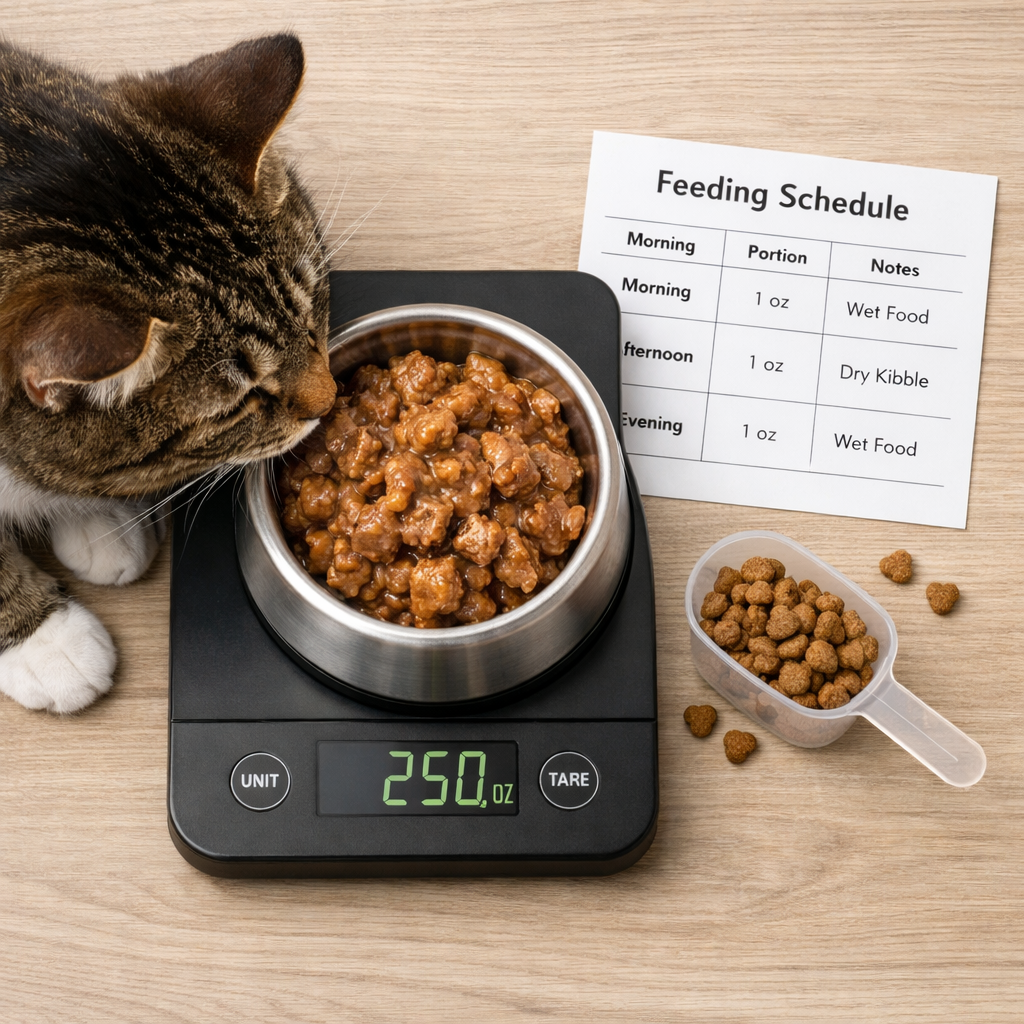
Complementary Cat Food Feeding Guide: Safe Portions, Schedules, and Tips
Complementary foods—treats, toppers, and single-ingredient items—can add variety and moisture to your cat’s bowl, but they should never replace a complete diet. This guide shows you exactly how to verify “complete vs complementary” on labels, translate calories to portions, set a simple feeding schedule, and keep extras safely within your cat’s daily calorie budget. The short version: confirm a complete-and-balanced base, measure meals, keep treats and toppers to 5–10% of daily calories, and adjust portions based on body condition. Follow the steps below to mix wet and dry confidently, use complementary foods the right way, and maintain steady, healthy intake. Pet Food Ingredient Guide’s Ingredient Library and portioning guidance help you put each step into practice.
Know the difference between complete and complementary cat food
Complete foods are formulated to meet all of a cat’s nutrient requirements for a stated life stage and can be fed as the sole diet. Complementary foods add flavor, texture, or moisture but are not sufficient on their own—PFMA-aligned UK guidance emphasizes choosing a complete base to meet daily needs, with treats and toppers as extras (summarized in this Scrumbles overview).
“Complementary cat food” definition (40–50 words): Complementary cat food provides variety, flavor, or moisture but lacks the full nutrient profile cats need each day. It must be fed alongside a complete and balanced diet to avoid deficiencies. Examples include many treats and toppers; do not use complementary foods as a cat’s only diet (PFMA-aligned guidance via Scrumbles).
Key terms to know:
- Complete vs complementary cat food: Complete meets all daily needs; complementary is “supplemental feeding only.”
- AAFCO statement: The U.S. label statement that confirms nutritional adequacy.
- PFMA/FEDIAF guidance: European frameworks that mirror the “complete vs complementary” distinction.
How to verify “complete” vs “complementary” on labels
Look for the nutritional adequacy statement—the single best indicator of whether a food can be fed alone:
- “Complete and balanced” or “formulated to meet AAFCO nutrient profiles” for a life stage (e.g., growth, adult maintenance).
- “For supplemental feeding only” or “intermittent or supplemental feeding” indicates complementary, not complete. See the cats.com cat feeding guide for a clear explanation of these phrases.
Quick scan checklist:
- Locate the nutritional adequacy statement near feeding directions.
- Confirm life stage coverage (growth, all life stages, or adult maintenance).
- Flag “supplemental feeding only” as complementary.
What the AAFCO statement means (40–50 words): The AAFCO nutritional adequacy statement is a plain-language sentence on U.S. pet food labels that declares whether a product is complete and balanced for a specific life stage or only for supplemental feeding. In Europe, similar adequacy standards are set by FEDIAF and communicated by PFMA/UK Pet Food. Pet Food Ingredient Guide walks through these label cues in plain language so you can verify adequacy quickly.
Why complementary foods cannot be a sole diet
Complementary foods don’t supply all essential nutrients (such as taurine, certain vitamins, and minerals). Fed alone long term, they raise real risks of deficiency and illness; PFMA-aligned UK guidance underscores keeping a complete base diet to meet needs (summarized by Scrumbles). Homemade “complete” diets are also hard and costly to balance—work with a veterinarian or a board-certified nutritionist if you pursue that route. The safer path: pair complementary items with a complete diet aligned to your cat’s life stage.
Calculate your cat’s daily calorie target
Most adult cats need roughly 200 kcal/day as a ballpark, but individual needs vary by size, body condition, and activity. Texas A&M veterinarians note that intake should be tailored and monitored over time. As a practical example, a 10 lb spayed, active cat may need around 260 kcal/day according to Chewy’s veterinary-reviewed calorie guide. A simple visual check: if the food volume looks larger than your cat’s head, it may be too much (Texas A&M guidance).
Factors: weight, life stage, neuter status, activity
Factors that move your cat’s calorie target up or down:
- Weight and body condition (lean vs overweight)
- Life stage (growth, adult, senior)
- Neuter status
- Activity level and indoor vs outdoor lifestyle
- Breed and health status (ask your vet for individualized targets)
Starter ranges (adjust to body condition and vet advice):
| Cat profile | Target kcal/day (range) | Notes |
|---|---|---|
| Indoor adult, neutered, 8–10 lb | 180–250 | Start low if overweight; reassess every 2–4 weeks |
| Active adult, 10 lb | 240–300 | Example need ~260 kcal/day (Chewy guide) |
| Kitten (growth) | 250–350+ | Higher per pound; multiple meals |
| Senior, lower activity | 180–240 | Monitor weight, muscle condition |
| Weight loss plan (vet-directed) | Individualized | Veterinary oversight strongly recommended |
Translate label calories to real portions using cups, cans, and grams
Turn daily calories into a routine you can repeat:
- Find kcal per cup/can/kg on the label or product site. Purina’s feeding guide shows where to look.
- Divide your cat’s daily calorie target by the product’s kcal to calculate portions. To find cans per day, divide daily kcal by kcal per can.
- Measure with a kitchen scale or a marked cup. Start with the feeding chart and adjust to body condition. Remove uneaten wet food after about 30 minutes to avoid spoilage (Purina guidance). Pet Food Ingredient Guide’s calories-to-portions guidance helps you redo the math quickly whenever you switch products.
Example:
- Daily target: 260 kcal
- Wet can: 85 g, 90 kcal/can → 1 can = 90 kcal
- Dry food: 3.6 kcal/g (≈ 410 kcal/cup) → Remaining 170 kcal ≈ 47 g dry (170 ÷ 3.6)
- Feed: 1 wet can + ~47 g dry split across meals
Plan a simple feeding schedule that fits your household
Scheduled, portion-controlled feeding helps limit intake and support healthy weight—an approach broadly endorsed by the ASPCA’s cat nutrition tips. Measured meals also make it easier to spot changes in appetite, give medications, and reduce food guarding; PetMD’s review of feeding methods highlights these monitoring benefits.
Adults: two portion-controlled meals
Most healthy adult cats do well on two measured meals per day (morning and evening). Offer food for about 20–30 minutes, then remove it—this is timed feeding and it helps you track actual intake (ASPCA guidance). Keep times consistent, use quiet feeding areas, and give each cat its own bowl in multi-cat homes.
Kittens and special cases: smaller, more frequent meals
Kittens need 3–4+ smaller meals spaced through the day to meet growth needs; avoid cow’s milk (many cats are lactose intolerant) and use kitten milk replacer when bottle-feeding. As a broad example, bottle-fed kittens may receive about 2 tbsp (30 ml) per 4 oz body weight daily, divided into frequent feeds; see the cats.com cat feeding guide and your veterinarian for precise schedules. Underweight, senior, or medically managed cats need vet-tailored plans.
Methods to consider: timed meals, combo feeding, puzzle feeders
- Scheduled/timed meals: Offer measured portions and monitor what’s eaten within 10–20 minutes; your vet can help you choose the best method (PetMD).
- Free-feeding risks: Grazing—especially on dry food—can encourage overeating and weight gain, particularly indoors and in multi-cat homes, per Hill’s guidance on feeding methods.
- Combination feeding: Pair wet and dry for palatability and moisture, but keep strict portion control; timed feeders or puzzle feeders can help meter small, scheduled servings.
Measure precisely and balance wet and dry calories
Pre-measure each day’s ration (cups/grams) to keep total calories on target, especially when mixing wet and dry (Hill’s). Use label feeding charts as a starting point and fine-tune based on your cat’s body condition over a few weeks (Purina).
Combine wet and dry while keeping total calories on target
Allocate calories across formats, then translate to portions:
- Example framework: 60–70% of daily kcal from wet for moisture; 30–40% from dry for convenience. Adjust based on appetite, stool quality, and weight trends.
| Mix plan (example) | Kcal | Portion notes |
|---|---|---|
| Daily target | 260 | — |
| Wet share @ 65% | 170 | ≈ 2 cans if 85 kcal/can, or 1.9 rounded to 2 small cans |
| Dry share @ 35% | 90 | ≈ 25 g if 3.6 kcal/g |
Recalculate whenever you change products, flavors, or formats—kcal per can/cup varies widely.
Hydration benefits of wet food and managing calorie density of dry
Wet food is typically 75–80% water and supports hydration; dry food is under 5% moisture and more calorie-dense, so it requires tighter portion control. These differences matter for urinary and kidney health—higher-moisture meals can help cats with low thirst or urinary histories (Texas A&M veterinarians). Remove uneaten wet after ~30 minutes to limit bacterial growth (Purina).
Use treats and toppers as true complements
Treats and toppers are complementary items and should not replace complete meals. Keep kitten extras under about 5% of daily intake and keep adult add-ons minimal; the ASPCA advises portion control to avoid excess calories, while PFMA-aligned guidance (via Scrumbles) reminds that toppers are not nutritionally complete on their own. Check Pet Food Ingredient Guide’s Ingredient Library to confirm the role of common toppers before adding them.
Keep treats and toppers under five percent of daily calories
- Mini formula: Daily treat cap = Daily kcal target × 0.05
- Example: 220 kcal/day → 11 kcal max from treats/toppers
- Log topper calories and subtract them from meal portions so total daily calories stay on target. Weigh small amounts—many toppers are calorie-dense.
Safe add-ins and ingredients to avoid
Use tiny portions and make them occasional, not daily staples.
| Food/add-in | Okay as tiny add-in? | Notes |
|---|---|---|
| Cucumber, pumpkin, carrots | Yes | Plain, cooked/steamed if needed; small bites |
| Banana, strawberries, blueberries | Yes | Very small amounts; watch sugar and stool |
| Peeled, deseeded apple | Yes | Tiny pieces only; no seeds or core |
| Chocolate, onions, garlic | No | Toxic—avoid entirely |
| Alcohol, grapes, raisins | No | Toxic—avoid entirely |
| Cow’s milk, creamy dairy | No | Many cats are lactose intolerant; GI upset |
Monitor body condition and adjust with data
Close the loop with simple tracking. Weigh monthly on the same scale, record a Body Condition Score (BCS), and adjust measured portions incrementally (5–10%) based on trends. Track appetite, stool, and activity in a notes app so changes are obvious.
Monthly weigh-ins and body condition scoring
Do a standing monthly check, aiming for steady weight and a BCS where ribs are palpable with a slight fat cover and a visible waist from above. If appetite drops, vomiting/diarrhea persists, or your cat has not eaten for more than 48 hours, contact your veterinarian promptly (Purina). Adjust portions—don’t overhaul—based on BCS trends.
When to consult your veterinarian or change the plan
Seek veterinary input for rapid weight change, ongoing GI upset, urinary signs, medical diagnoses, or life-stage shifts. Your vet can also recommend the best feeding method and refine calorie targets for breed, age, activity, and health needs (PetMD; Chewy’s calorie guidance).
Ingredient clarity tools from Pet Food Ingredient Guide
Pet Food Ingredient Guide is built to demystify labels. Our Ingredient Library provides plain-language definitions of ingredient functions, quality signals, and marketing terms across brands. We also help you translate “kcal per can/cup” into day-to-day portions, so complementary foods enhance—not unbalance—your cat’s complete diet. Explore tools at Pet Food Ingredient Guide to simplify label checks and portions.
How to use the Ingredient Library to decode labels
- Scan the ingredient list for named animal proteins and functional additives (e.g., taurine, omega sources).
- Look up each in the Ingredient Library to learn its purpose and quality context.
- Verify marketing terms like “natural” or “grain-free” to understand what they do—and don’t—mean.
- Bookmark entries for your recurring products to compare formulas quickly.
Matching calories to cans and portions for day-to-day feeding
- Record each product’s kcal per can/cup and your cat’s typical serving to build a home “cheat sheet.”
- Use our calories-to-portions guidance to combine wet and dry while staying within the daily target.
- Revisit entries when switching flavors or brands—kcal per can and ingredient profiles can change.
Step-by-step checklist for complementary feeding
- Check the label for “complete and balanced” vs “supplemental feeding only.”
- Calculate daily calories using weight/age/activity and a manufacturer or veterinary chart; a typical adult needs ~200–400 kcal/day (200 kcal is a common rule of thumb); a 10 lb spayed, active cat may need ~260 kcal/day.
- Choose a feeding method; portion-controlled twice-daily meals are broadly recommended.
- Measure precisely; combine wet/dry calories to stay within the target; remove uneaten wet after ~30 minutes.
- Keep treats/toppers under 5% of daily calories; avoid toxic foods.
- Weigh monthly, assess BCS, and adjust with vet input; if your cat hasn’t eaten for >48 hours, call your vet.
Frequently asked questions
How much complementary food can I add without unbalancing my cat’s diet?
Keep complementary items modest and ensure a complete food provides the base. Use Pet Food Ingredient Guide’s calories-to-portions guidance to subtract topper calories from meals.
Can kittens have complementary foods, and how much is safe?
Yes, but growth diets must remain the base. Confirm “complete and balanced for growth” on labels and use Pet Food Ingredient Guide’s Ingredient Library to double-check common add-ins.
What’s the best way to mix a topper without overfeeding?
Measure the topper, note its calories, and reduce the main meal so total daily calories stay on target. Pet Food Ingredient Guide’s portioning tips make the swap straightforward.
Is free-feeding dry food OK if I serve wet meals twice daily?
It’s safer to portion dry food because grazing can lead to overeating, especially indoors. Pre-measure the day’s dry ration or use a timed feeder—Pet Food Ingredient Guide offers simple methods to keep portions consistent.
When should I choose higher-moisture meals for my cat?
Favor higher-moisture meals if your cat drinks little water or has urinary or kidney concerns. Pet Food Ingredient Guide explains how to read labels and moisture levels; ask your veterinarian for individualized advice.