Complementary Cat Food vs Complete: Smart Feeding Ratios and Tips
Complementary Cat Food vs Complete: Smart Feeding Ratios and Tips
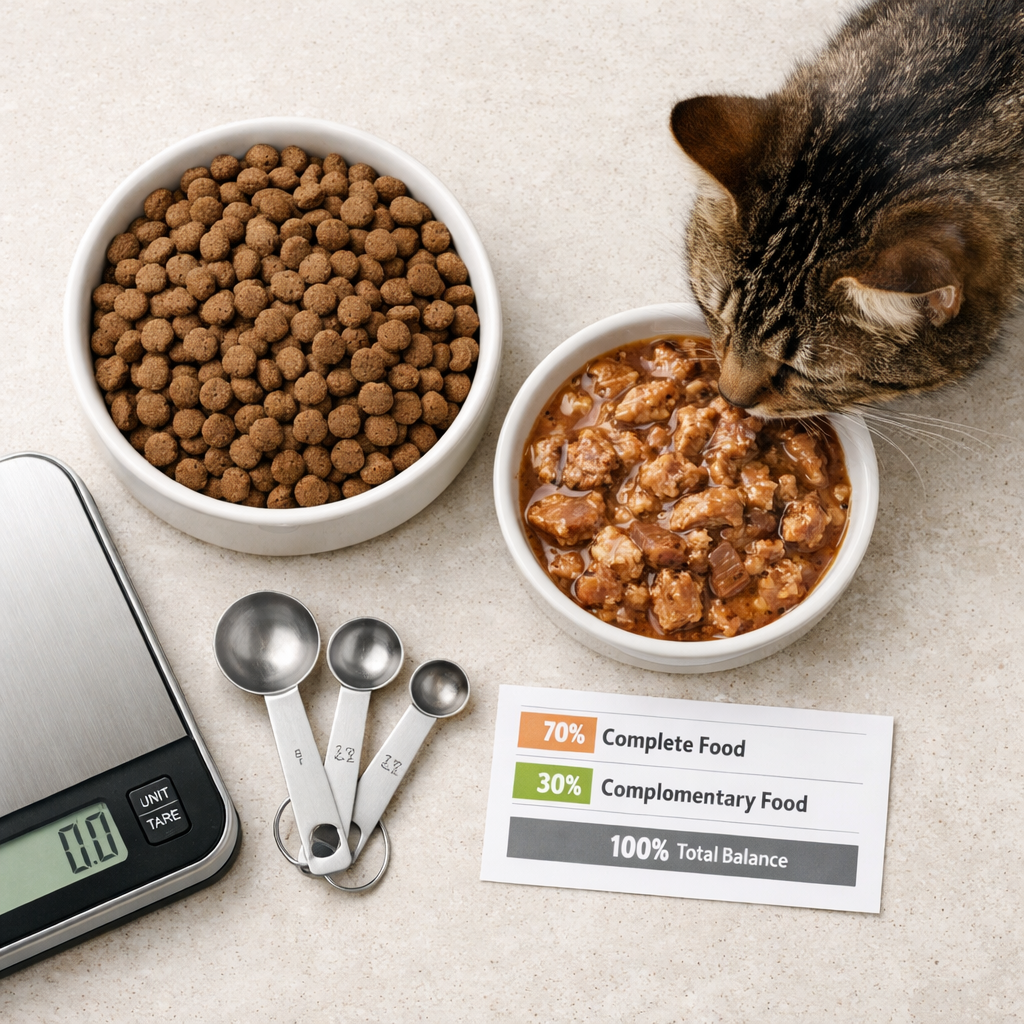
Feeding toppers, broths, and treats can make meals more enticing—but the safest approach is to keep complementary items small and build every bowl on a complete base. In practice, aim for 90–100% of daily calories from a complete cat food and no more than 10% from complementary items. Below, you’ll find clear definitions, label cues, and calorie math to portion mixed meals with confidence.
Complete cat food: A formulated diet that supplies all essential nutrients—adequate protein, taurine, fats, vitamins, minerals, and energy—to meet recognized standards such as the AAFCO or FEDIAF nutrient profiles for a stated life stage, and it can be fed as the sole ration (AAFCO/FEDIAF standards).
Complementary cat food: A product intended for intermittent or supplementary feeding that does not provide all essential nutrients on its own; it’s typically used as treats, toppers, broths, or add‑ons to boost moisture, flavor, or texture alongside a complete base diet (intermittent or supplementary feeding).
Complete vs complementary at a glance
| Complete | Complementary | |
|---|---|---|
| Sufficiency | Provides all essential nutrients for the labeled life stage; can be fed as the sole diet. | Not nutritionally complete; must be paired with a complete base. |
| Label wording | “Complete and balanced” or “complete for [life stage]” with a nutrient adequacy statement (AAFCO/FEDIAF). | “Intermittent or supplemental feeding only” or “complementary.” |
| Best use | Main diet (wet, dry, or a mix). | Toppers, treats, broths, short-term appetite boost. |
| Examples | Complete wet cans/pouches, complete dry kibble, balanced raw formulas labeled complete. | Broths/gravy pouches, plain tuna/chicken in gravy, freeze‑dried meat bites, lickable treats. |
| Risk if fed alone | Low (assuming product suits the cat and is fed per directions). | High—deficiency or imbalance over time (e.g., taurine, vitamins, minerals). |
- Check the front or back panel: packaging explicitly states whether a product is complete or complementary (label cue).
- Complete foods can be the main diet; complementary items should not be fed alone.
- Keep complementary calories small to preserve nutrient balance.
What complete cat food means
“Complete and balanced” indicates a diet formulated to meet all essential nutrient requirements for a stated life stage based on AAFCO or FEDIAF standards. These foods provide protein, taurine, fats, vitamins, minerals, and energy in appropriate amounts and can be fed as the primary ration. Labels often read “complete for growth,” “complete for adult maintenance,” or “complete for all life stages” (the latter typically covers growth and reproduction needs as well).
Even with a complete cat food, individual cats vary. Ingredient digestibility, energy needs, and health status mean you may still fine‑tune portions and formats (wet vs dry) based on your cat’s response (individual response can vary).
What complementary cat food means
Complementary foods enhance palatability, texture, and hydration, but they are intended for intermittent or short‑term feeding only and must be paired with a complete base. Common types include wet toppers, lickable treats, broths, plain chicken or tuna with gravy, and some raw/freeze‑dried bites and treats. The benefit is sensory—flavor, aroma, moisture—while the core risk is nutritional: these products may be rich in some nutrients (e.g., protein) yet lack essential vitamins and minerals, so they cannot replace a complete diet.
When to use each type
- Make a complete cat food (wet, dry, or a mixed feeding plan) the daily foundation.
- Use complementary foods intentionally: a spoon of broth for moisture, a sprinkle of freeze‑dried meat for aroma, or short‑term toppers for picky eaters or during transitions.
- Follow veterinary guidance for any therapeutic diet; some are labeled for intermittent feeding and should be used only as prescribed.
Smart feeding ratios
Rule of thumb: target 90–100% of daily calories from a complete food and keep complementary cat food at or under 10% of daily calories. This preserves the nutrient balance set by the complete formulation while still delivering variety and hydration. Many veterinarians also favor wet or mixed feeding for better moisture intake, especially in cats prone to urinary issues (wet/mixed feeding for hydration).
Rotate among suitable complete diets if desired, and seek professional input before adding raw or substantial homemade components.
Daily calorie math for mixed meals
- Estimate daily calories. Use the Pet Food Ingredient Guide calculator, your vet’s recommendation, or typical ranges (often ~180–250 kcal/day for many healthy indoor cats).
- Allocate 90–100% to complete food; ≤10% to complementary items.
- Convert calories to grams/ounces using the product’s calorie density (kcal per can, pouch, or per gram).
- Subtract topper calories from the day’s complete portion to avoid overfeeding and dilution of nutrients.
Example: If a cat needs 220 kcal/day, allow ≤22 kcal from complementary items; the remaining ~198–220 kcal should come from complete food—consistent with the “intermittent only” purpose of complementary products.
Portioning examples for wet and dry
- All‑wet complete base: 2 pouches at ~85 kcal each = 170 kcal plus 28 g dry complete at ~1.8 kcal/g = 50 kcal, total ~220 kcal. Add ≤22 kcal of broth topper by removing ~22 kcal from the base.
- Dry‑led base: 60 g dry complete (~2.5 kcal/g = 150 kcal) + 70 g wet complete (~1 kcal/g = 70 kcal) = 220 kcal. Sprinkle ≤10 kcal complementary freeze‑dried bits; reduce dry by ~4 g to offset.
- Wet‑only base: 3 × 75 kcal cans = 225 kcal. Add a 5 kcal broth and remove ~5 kcal of wet (about a teaspoon) to stay on target.
Wet foods inherently deliver more moisture than dry, which supports hydration for many cats.
Weekly adjustment schedule
- Days 1–2: Introduce toppers at ~5% of calories; monitor stool and appetite.
- Days 3–4: If normal, move to ≤10%; adjust the base portion down to maintain total daily calories.
- Days 5–7: Track weight trend, stool quality, coat/energy. If appetite drops, weight shifts meaningfully, or lethargy appears, revert to a complete‑only base and consult your veterinarian.
Label checks that matter
- Find the nutrient adequacy statement: “complete and balanced,” “complete for [life stage],” or “intermittent or supplemental feeding only.” Products will also state “complete” or “complementary” on packaging.
- Prefer products that demonstrate adequacy through feeding trials when available (as defined by AAFCO protocols).
- Reality check: “Complete” is a sound baseline, but ingredient quality and digestibility still vary—observe your cat and adjust as needed. Pet Food Ingredient Guide explains how to find and interpret these statements step by step.
Risks of overusing complementary foods
Complementary foods should not be fed as the sole diet; long‑term reliance risks nutrient deficiencies and imbalances, including taurine shortfalls that can affect heart and vision health (deficiency risk explained). Complements may be high in some nutrients (e.g., protein or fat) yet lack others essential for balance (e.g., certain vitamins, minerals, fatty acids).
Practical ways to add complements safely
Use complements at ≤10% of daily calories:
- Spoon a small amount of complementary broth or gravy over complete wet food.
- Sprinkle a few freeze‑dried meat bits on complete kibble.
- Add a bite or two of plain chicken or tuna in gravy to a complete base.
Always subtract topper calories from the base portion, and favor wet formats when hydration is a goal.
Monitoring outcomes and when to seek veterinary guidance
Monitor weekly: weight stability, stool quality, appetite, energy, and coat/skin. If appetite changes, weight shifts, lethargy, vomiting, or abnormal stools persist, revert to a complete‑only plan and seek veterinary review. “Complete” labels are a starting point—individual responses vary and may require vet‑guided adjustments.
Bottom line recommendation
Build every bowl on a complete cat food for 90–100% of daily calories, and use complementary foods sparingly—≤10%—for palatability, enrichment, and hydration. Count topper, broth, and treat calories toward the day’s total, adjust the base portion accordingly, and partner with your veterinarian for personalized ratios or any raw/homemade inclusions.
Frequently asked questions
How much complementary cat food can I feed per day?
Keep complementary foods at ≤10% of daily calories and the remaining 90–100% from a complete diet. Use the Pet Food Ingredient Guide calculator and subtract topper calories from the base to stay on target.
Can kittens have complementary foods and how should ratios differ?
Yes—keep complements minimal and ensure nearly all calories come from a complete food formulated for growth/all life stages. See Pet Food Ingredient Guide for label cues that confirm growth adequacy.
How do I transition to a mixed feeding plan without stomach upset?
Introduce toppers at ~5% of calories for 2–3 days, then move to ≤10% if stools and appetite remain normal; reduce the base to offset topper calories and monitor weight weekly. See Pet Food Ingredient Guide for transition tips.
Do broths, toppers and treats count toward daily calories?
Yes—count every topper, broth, and treat toward daily calories and reduce the base portion by the same calories. Use the Pet Food Ingredient Guide calculator to tally them.
What signs suggest my mix is unbalanced?
Watch for appetite changes, weight loss or gain, dull coat, lethargy, vomiting, or abnormal stools; if these persist, revert to a complete‑only base and consult your veterinarian. Pet Food Ingredient Guide explains what to track during diet changes.