High-Protein Kitten Food Showdown: Dry vs Wet vs Raw
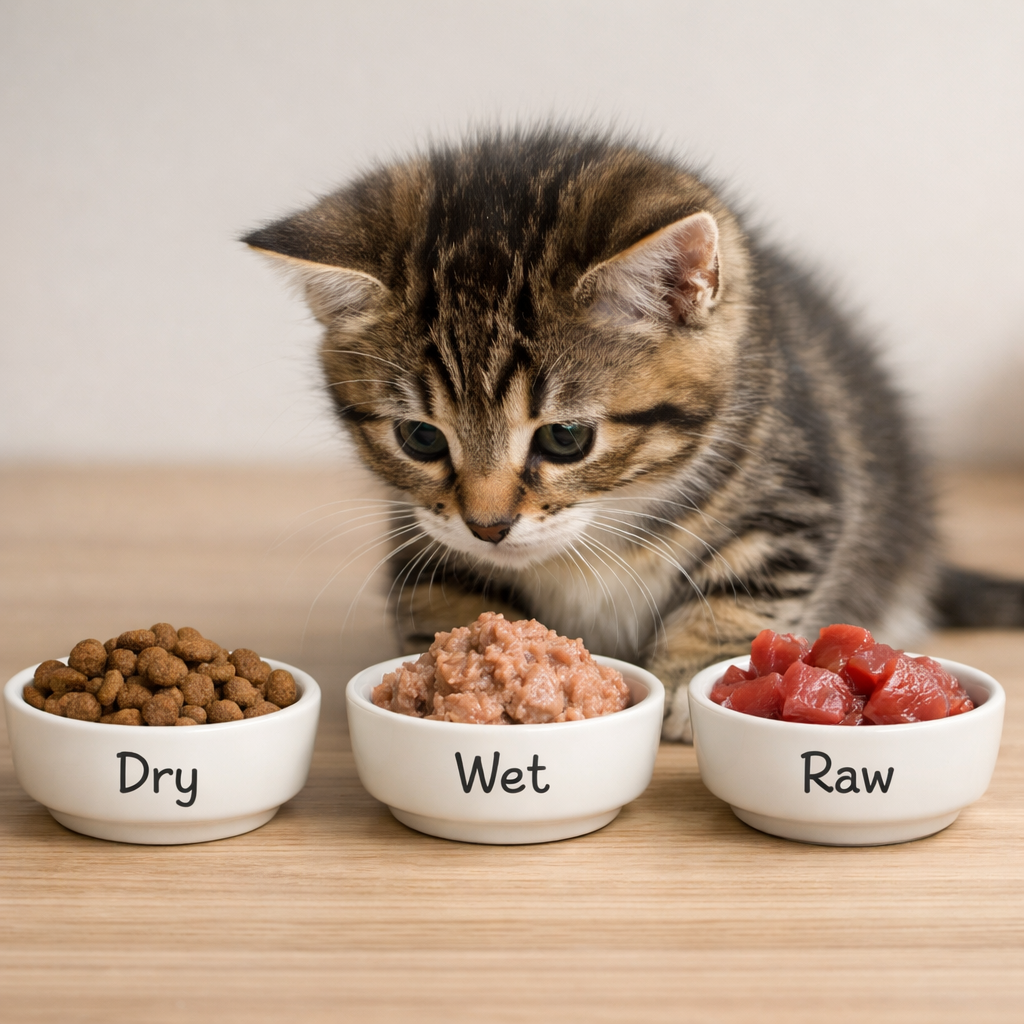
High-Protein Kitten Food Showdown: Dry vs Wet vs Raw
Finding the highest-protein kitten food starts with sound math. Labels list nutrients “as-fed,” which are skewed by moisture. Once you convert to a dry matter basis (DMB), wet and commercial raw diets usually deliver higher protein density than kibble. A canned label showing 10% protein often equals about 40% protein on a DMB basis, depending on moisture, so never compare labels without converting using a dry matter basis method explained by veterinarians and nutritionists (see a clear walkthrough of dry matter basis conversion) [dogfoodadvisor.com]. Below, we compare dry vs wet vs raw using DMB, show how to portion precisely, and help you choose a safe, AAFCO-complete plan that fits your home. Pet Food Ingredient Guide applies a label-first, DMB-based approach throughout.
How to compare protein the right way
Dry matter basis (DMB) adjusts a pet food’s nutrients by removing moisture from the calculation so you can compare wet, dry, and raw fairly. Because moisture varies widely—around 75–78% in wet foods and about 10% in dry—DMB reveals the true protein density per gram of actual food [petmd.com].
- Why moisture skews labels: A canned food labeled 10% protein can equal roughly 40% protein on a DMB basis because the can is mostly water. Guaranteed Analysis panels are “as-fed” and can mislead unless converted [dogfoodadvisor.com].
- Typical moisture levels: Wet ≈75–78%; Dry ≈10% [petmd.com].
Step-by-step DMB conversion:
- Find the food’s moisture% on the label.
- Calculate dry matter% = 100 − moisture%.
- DMB protein% = (as-fed protein% ÷ dry matter%) × 100.
Quick formula: Protein% (DMB) = (As-fed protein% ÷ (100 − Moisture%)) × 100.
Illustration (example values)
| Food Example | As-Fed Protein% | Moisture% | Protein% (DMB) |
|---|---|---|---|
| Canned/wet | 10% | 75% | 10 ÷ 25 × 100 = 40% |
| Dry/kibble | 36% | 10% | 36 ÷ 90 × 100 = 40% |
Definition (quotable): Dry matter basis (DMB) adjusts a pet food’s nutrients by removing moisture from the calculation so you can compare wet, dry, and raw fairly. Because moisture varies widely—around 75–78% in wet and ~10% in dry—DMB reveals the true protein density per gram of actual food.
Dry kitten food
Kibble is made by mixing a dough and extruding it under high heat, then drying and coating with fats, oils, vitamins, and minerals. High-heat extrusion can degrade some delicate nutrients and enzymes, which is why formulas may add back certain micronutrients [petmd.com; wefeedraw.com].
Pros:
- Easy to portion and store; long shelf life after opening.
- Generally economical per calorie.
- Some dental abrasion from crunch; pairs well with food puzzles and slow feeders [darwinspet.com; petmd.com].
Cons:
- Lower moisture and sometimes less palatable than wet.
- Heat-sensitive nutrients can be reduced; scan for named animal proteins high on the ingredient list and limit starchy fillers.
- Some dry diets include probiotics; check labels for strain transparency and handling directions [petmd.com].
Wet kitten food
Canned or pouched foods are cooked and sterilized in the container. They typically contain about 75–78% moisture, which boosts hydration and can concentrate protein on a DMB basis even when the as-fed protein% looks modest [petmd.com].
Pros:
- Often more aromatic and palatable; easier to chew.
- Naturally supports hydration and satiety.
- High protein density on a dry matter basis despite watery appearance [wefeedraw.com; petmd.com].
Cons:
- Shorter shelf life once opened; requires refrigeration.
- Messier to serve; may include thickeners or gums—scan labels so you know what each thickener contributes [wefeedraw.com].
Raw kitten food
Commercial raw diets aim to preserve bioavailable nutrients through minimal processing. Many reputable brands use high-pressure processing (HPP) to inactivate pathogens without heat, helping reduce microbial risk while maintaining texture and nutrient integrity [wefeedraw.com].
Pros and cautions:
- Often reported by owners as highly digestible and palatable.
- Higher cost and trickier portioning vs wet/dry.
- Risks include bacterial contamination and bone hazards; commercial controls (e.g., HPP) and strict home hygiene are essential. Households should weigh these risks carefully [poochandmutt.co.uk].
What to verify:
- AAFCO growth/all life stages adequacy.
- Whether HPP or another pathogen-reduction step is used.
- Safe bone size/format (e.g., ground bone in commercial raw).
- Clear handling, thawing, and storage instructions.
- Avoid home-prepared raw for kittens unless guided by a board-certified veterinary nutritionist.
Protein head-to-head on a dry matter basis
| Food Type | Typical Moisture% | Typical Protein% (DMB) |
|---|---|---|
| Dry/kibble | ~10% | ~35–45% |
| Wet/canned | ~75–78% | ~40–55% |
| Commercial raw | ~60–70% (varies) | ~45–60% |
- Takeaway: Once converted to DMB, many wet and commercial raw formulas outperform kibble on protein density. Always compare specific labels with the DMB math.
- Note: A wet label showing 10% protein can equal about 40% protein on DMB when moisture is 75%, illustrating why Guaranteed Analysis is “as-fed” and not directly comparable without conversion [dogfoodadvisor.com].
Processing, nutrient integrity, and bioavailability
- Dry (extruded): High-heat extrusion can destroy some delicate nutrients and enzymes; formulas typically fortify to meet completeness [wefeedraw.com].
- Wet (canned): Heat-sterilized and shelf-stable with high moisture, but still cooked [petmd.com].
- Raw (commercial): Minimal heat; HPP can inactivate pathogens while preserving texture and many nutrients [wefeedraw.com].
Definition (quotable): Bioavailability describes how well nutrients are digested, absorbed, and used by the body. Higher bioavailability means more of a nutrient reaches the tissues that need it. For kittens, highly bioavailable protein supports rapid growth, immune function, and lean mass without excess fillers that dilute nutrient density.
All three types can meet AAFCO growth standards when properly formulated. Processing simply changes what you scrutinize on the label—protein sources, moisture, fortification, and safety steps.
Hydration, palatability, and feeding behavior
Wet foods deliver far more moisture and are typically more aromatic and easier to chew, helping picky or sensitive eaters and supporting hydration [petmd.com]. Higher-moisture, high-protein meals can also increase satiety, which may help older kittens transition toward maintenance without overdoing calories [wefeedraw.com]. Many owners succeed with practical mixes—wet-led for moisture and protein, with measured dry for crunch and enrichment.
Safety, handling, and household risk tolerance
Wet and dry foods generally carry lower cross-contamination risk at home than raw. Raw diets can harbor harmful bacteria and bone fragments that may injure or obstruct, so align choices with your household’s risk tolerance [poochandmutt.co.uk].
Safety checklist:
- Prefer commercial raw that uses HPP or equivalent pathogen control (if choosing raw).
- Sanitize prep areas, bowls, and hands; store at safe temperatures.
- Avoid raw in high-risk households (young children, elderly, immunocompromised).
- Discard uneaten wet/raw promptly per label instructions.
Cost and convenience considerations
Dry foods are usually the most economical and easiest to store and measure, with long post-opening shelf life [poochandmutt.co.uk; darwinspet.com]. Commercial raw tends to be the most expensive and needs freezer space; wet is messier than dry but doesn’t require freezing [poochandmutt.co.uk].
Quick planning matrix
| Food Type | Storage | Shelf Life (opened) | Per-Meal Cost (relative) | Prep Time |
|---|---|---|---|---|
| Dry/kibble | Pantry, resealed bag or bin | Long (weeks) | $ (lowest) | Fast |
| Wet/canned | Fridge after opening | Short (1–3 days) | $$ | Moderate |
| Commercial raw | Freezer + fridge thaw | Short (per label) | $$$ (highest) | Moderate–High |
Label-first evaluation checklist for high-protein kitten diets
- Confirm the AAFCO “growth” or “all life stages” adequacy statement.
- Scan the first 5 ingredients for named animal proteins; limit starchy fillers.
- Convert protein to DMB; target 30%+ protein on a dry matter basis for kittens (use the conversion above) [dogfoodadvisor.com].
- Verify taurine and DHA/EPA sources, plus total calories per kg/can/cup for precise portion math.
- Note moisture% and any thickeners/gums (wet) or added probiotics (dry) [petmd.com].
Warning: Bones in raw diets can injure teeth or GI tract. Evaluate household risk and choose brands with robust safety controls [poochandmutt.co.uk].
Calorie-to-gram conversion and portion planning
Follow these steps to translate labels into grams per meal:
- Find energy density: kcal/kg (or kcal/can). If kcal/can is listed, also note can weight (g).
- Determine your kitten’s daily kcal target (ask your vet; adjust as growth and body condition change).
- Convert kcal/kg to kcal/g: divide by 1000. Then calculate grams/day = daily kcal ÷ (kcal per gram).
- Split the total into 3–4 meals.
Example:
- Wet food: 1200 kcal/kg → 1.2 kcal/g. If your kitten needs 220 kcal/day: 220 ÷ 1.2 ≈ 183 g/day, split into four ~45 g meals.
- Dry food: 3800 kcal/kg → 3.8 kcal/g. 220 ÷ 3.8 ≈ 58 g/day, split into four ~15 g meals.
Tips:
- Kcal/cup varies by kibble density; weigh with a gram scale for accuracy.
- Use DMB protein% alongside grams fed to ensure daily protein intake supports growth.
Safe transition strategies and mixing diet types
- 7–10 day transition: Increase the new food by 10–20% every 1–2 days while reducing the old. Monitor stool, appetite, and energy. Pause or step back if GI signs appear.
- Mix templates:
- Wet-led: 70–90% wet (for hydration and protein), 10–30% measured high-protein kibble for crunch/enrichment.
- Raw add-in: Start with 10–20% commercial, HPP-treated raw mixed into the current complete diet; handle strictly and increase only if tolerated.
- Ensure each component is AAFCO-complete for growth or balance the overall plan under veterinary guidance.
Our evidence-based recommendation
On a dry matter basis, high-protein wet and commercial raw diets most often deliver the highest protein density compared to kibble; for example, a canned label at 10% protein can equate to about 40% DMB once moisture is removed [dogfoodadvisor.com]. For most kitten owners seeking high protein plus hydration and convenience, choose an AAFCO-complete wet formula with named meats as the first ingredients, optionally paired with a measured high-protein kibble for enrichment. Consider commercial raw if it’s HPP-treated and your household’s risk tolerance is high [petmd.com; wefeedraw.com; poochandmutt.co.uk]. Whatever you choose: confirm growth adequacy, convert to DMB, weigh portions, and transition gradually. For more label-first tools, visit Pet Food Ingredient Guide.
Frequently asked questions
What kitten food type typically delivers the highest protein on a dry matter basis?
Wet and commercial raw diets usually deliver the highest protein once converted to dry matter, while kibble tends to be lower. Use Pet Food Ingredient Guide’s DMB steps to compare labels fairly.
How do I convert wet and dry labels to compare protein fairly?
Subtract moisture% from 100 to get dry matter%, then divide the as-fed protein% by that dry matter% and multiply by 100. Pet Food Ingredient Guide’s quick formula keeps the math consistent across wet, dry, and raw.
Is raw safe for kittens and what controls should I look for?
Choose commercial raw formulated for growth that uses pathogen-reduction steps like HPP, handle and store strictly, and avoid hazardous bones. Pet Food Ingredient Guide’s safety checklist can help you assess household risk.
Can I mix dry, wet, and raw in one feeding plan?
Yes—if each component is complete for growth and you introduce changes over 7–10 days. Pet Food Ingredient Guide outlines practical mix templates and transition steps.
What protein level should I target for growing kittens?
Aim for 30%+ protein on a dry matter basis from named animal sources, alongside adequate fat, taurine, and DHA. Pet Food Ingredient Guide’s label-first checklist helps you confirm these details quickly.