How Much Wet Cat Food Per Day: Vet-Reviewed Feeding Guide
How Much Wet Cat Food Per Day: Vet-Reviewed Feeding Guide
Most healthy adult cats land around 200–300 kcal per day, with many 10‑pound adults thriving at roughly 250–280 kcal daily—often about three 3‑oz cans, depending on brand calories and your cat’s body condition. The exact amount hinges on calorie density (kcal per can), life stage, and whether you mix wet and dry. A quick start: check your cat’s body condition, set an ideal weight target, estimate calories, then convert that to cans or ounces. You’ll find all the math, examples, and schedule tips below so you can portion wet food confidently and adjust week by week based on results, not guesswork (for label math and portioning steps, see Pet Food Ingredient Guide; for typical ranges and examples, see Whisker’s feeding guide).
Start with your cat’s weight and body condition
Start with what you can see and feel, not just the scale. The Body Condition Score (BCS) is a 1–9 scale that judges fat coverage over ribs, the waist from above, and the abdominal tuck from the side. A score of 4–5/9 is ideal. Crucially, calorie needs and wet food amounts should be based on your cat’s ideal weight if they’re overweight—otherwise you’ll keep maintaining excess weight.
Secondary anchors to keep in mind as you calculate: ideal cat weight, cat calorie needs, and translating to a precise wet cat food amount.
Use a body condition score to set an ideal target
Use this quick BCS check:
- Ribs: easily felt with a thin fat layer vs. hard to feel under padding
- Waist (top view): visible inward curve vs. straight or bulging
- Abdominal tuck (side view): clear upward tuck vs. flat/sagging abdomen
Weigh your cat. If overweight, use the estimated ideal weight (from your BCS impression or your veterinarian’s guidance) for calorie math.
BCS-based action guide:
- BCS 1–3 (too thin): increase calories gradually; vet input recommended
- BCS 4–5 (ideal): maintain current calories; monitor weekly
- BCS 6–9 (overweight): reduce calories gradually; aim for a vet-supported plan
When to get a vet’s assessment before changing food
Check with your vet before making changes if there’s rapid weight change, chronic vomiting/diarrhea, diabetes, kidney disease, urinary issues, or if your senior cat is starting weight loss or gain. Medical conditions can change both calorie and moisture targets, so feeding should be vet-directed in these cases.
Calculate daily calories for your cat
Most adult cats need around 200–300 kcal/day. A practical rule of thumb is 20–33 kcal per pound per day; 25 kcal/lb suits many moderately active, indoor adults. You’ll fine-tune from there by monitoring weight, BCS, and appetite.
Quick rule of thumb kcal per pound
- 8 lb adult: about 8 × 25 ≈ 200 kcal/day
- 10 lb adult: about 10 × 25 ≈ 250 kcal/day; some need closer to 280 kcal/day
- After spay/neuter, metabolism often drops—reduce about 10–15% if weight creeps up (Stella & Chewy’s vet-reviewed guide).
For a more active cat, try the higher end (28–30 kcal/lb); for a sedentary indoor cat, try the lower end (22–25 kcal/lb).
Alternative vet formula RER and activity factors
Resting Energy Requirement (RER) is the baseline calories a resting cat needs to keep vital functions going. It’s commonly estimated as 70 × (body weight in kg)^0.75, then multiplied by a life-stage/activity factor to get daily calories. See PetMD’s calorie calculator for details.
How to use it:
- Compute RER. Example: 10 lb (4.5 kg) cat → RER ≈ 70 × 4.5^0.75 ≈ 216 kcal.
- Multiply by a factor:
- Indoor/maintain: ~1.2–1.4 → ~260–300 kcal/day
- Active: ~1.5–1.6 → ~325–345 kcal/day
Convert calories to wet food cans or ounces
Once you have a daily calorie target, convert it to cans or ounces using the label’s kcal per can (or per 100 g). As a general frame of reference, adult cats eating only wet food often land around 7–11 oz per day, which typically supplies about 200–300 kcal (Nala’s wet food guide). Pet Food Ingredient Guide emphasizes converting with the label’s stated kcal, then fine-tuning weekly based on weight and BCS.
Read the label for kcal per can or per 100 g
Check the “calorie content” panel for kcal per can, per pouch, per serving, or per 100 g. Feeding charts on packaging are starting points, but brand guides and calorie densities vary widely, so always use the stated kcal to do your math (for a quick walkthrough, see Pet Food Ingredient Guide; see Purina’s feeding guide for how labels present calories).
Example math for common can sizes and pouch formats
- For a 10 lb cat: daily target 250–280 kcal.
- If a 3‑oz can has ~90 kcal → about 2.8–3.1 cans/day (≈9–9.5 oz).
- If a 5.5‑oz can has ~180 kcal → 250 kcal/day ≈ 1.4 cans; round to 1.5 cans split across meals.
Quick conversion table (examples)
| Can size | Example kcal per can | Daily target (kcal) | Cans/day | Approx oz/day |
|---|---|---|---|---|
| 3 oz | 70 | 250 | 3.6 | 10.8 |
| 3 oz | 90 | 250 | 2.8 | 8.4 |
| 3 oz | 100 | 250 | 2.5 | 7.5 |
| 5.5 oz | 150 | 250 | 1.7 | 9.4 |
| 5.5 oz | 180 | 250 | 1.4 | 7.7 |
Pouch pointers (2.5–3 oz formats; always use the pouch’s stated kcal):
- 2.5 oz, ~70 kcal: 250 kcal/day → ~3.6 pouches
- 3 oz, ~80 kcal: 250 kcal/day → ~3.1 pouches
- 3 oz, ~100 kcal: 250 kcal/day → 2.5 pouches
If mixing wet and dry, split by calories not volume
Ounces and cups are not calorie-equivalent. Always add calories from both. Example: 250 kcal/day target → 125 kcal wet + 125 kcal dry. If your dry food is 400 kcal/cup, 125 kcal ≈ 0.31 cup; if your wet can is 90 kcal, 125 kcal ≈ 1.4 cans—then round to practical meal sizes.
Plan the daily feeding schedule
Portion control beats free-feeding for weight management; grazing access to unlimited food is linked with weight gain. Choose a routine you can repeat daily, and split the total wet amount across meals for steady energy and better satiety.
How many meals per day and ideal timing
Feed at least two meals per day, no more than 12 hours apart; three to four small meals often suit feline metabolisms well. Example schedules: 7 am & 7 pm; or 7 am, 1 pm, 7 pm. Wet food can be fed daily as a main meal, not just as a topper.
Portioning, storage and food safety for wet food
- Refrigerate opened cans/pouches promptly; cover tightly. Warm to room temp before serving if preferred.
- Discard uneaten wet food after 30–60 minutes to avoid spoilage.
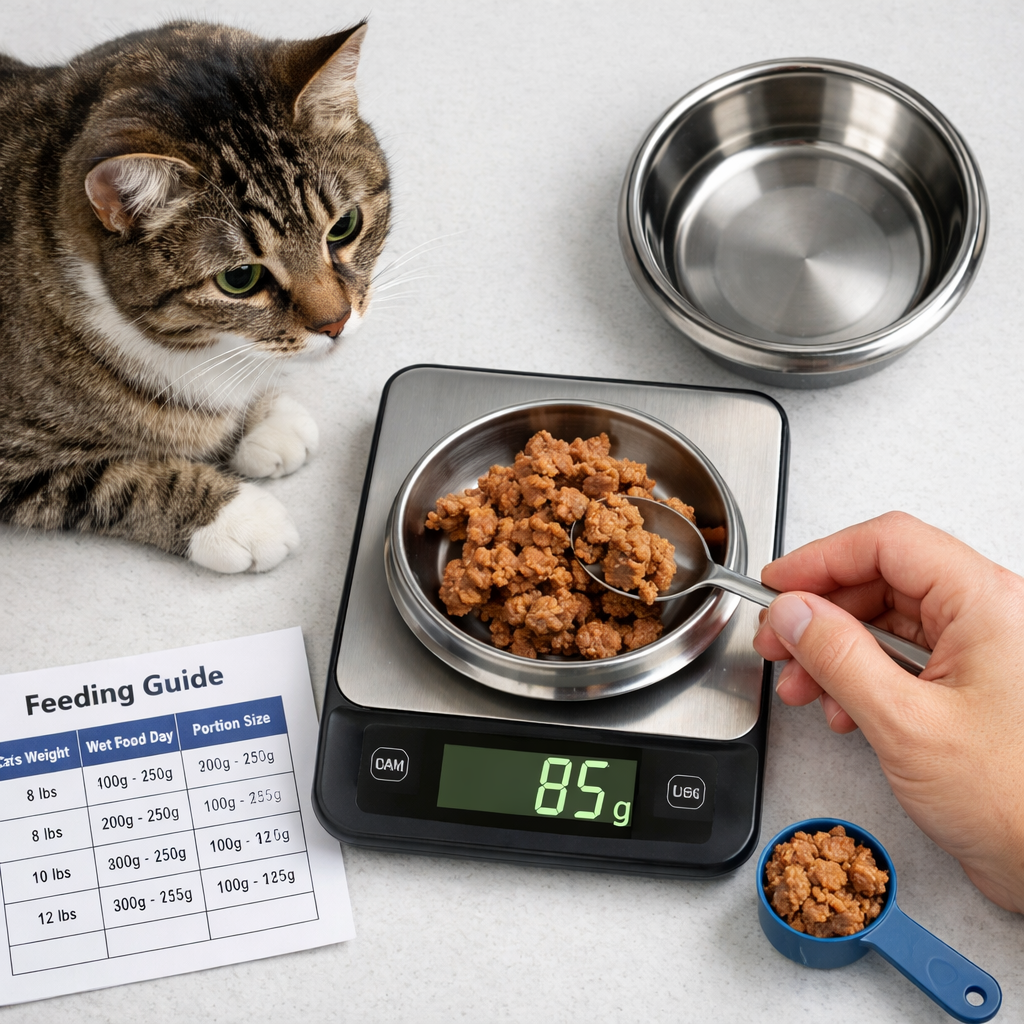
- Use a kitchen scale or marked scoop for consistency; avoid heaping spoon “guesstimates.”
Serving tips to improve acceptance
Wet food’s aroma and soft texture can entice picky or ill cats. Serve at room temperature, mix thoroughly, or rotate textures within the same nutritional profile. If switching foods, transition over 7–10 days (25/75 → 50/50 → 75/25 → 100%) to avoid GI upset.
Hydration strategy with wet food
Wet food meaningfully boosts moisture intake—helpful because many cats won’t drink much on their own. It’s a simple way to improve hydration alongside fresh water access throughout the day.
Raise dietary moisture with wet meals
Wet food is less calorie-dense and higher in water, supporting hydration and satiety—especially useful for seniors with a low thirst drive or cats prone to urinary issues. Mixed feeders should aim for at least one wet meal daily; cats with urinary concerns may benefit from more per your vet’s advice.
Add water correctly to wet food
Add 1–2 teaspoons of warm water per meal and mix to a pâté/soup consistency. Increase gradually based on acceptance. Prepare fresh each meal; don’t leave watered food standing, which can reduce aroma and invite spoilage.
Optimize the drinking setup at home
- Offer multiple water stations away from food and litter.
- Use wide ceramic or stainless bowls (or a quiet fountain) and refresh daily.
- Place bowls in low-traffic, quiet spots; some cats prefer flowing water.
Monitor and adjust weekly
Close the loop with small, deliberate tweaks. Weigh weekly on the same scale at the same time of day, and recheck BCS. Use data—not appetite alone—to guide changes.
Track weight, body condition and appetite
Keep a simple log: weight, BCS notes (ribs/waist/tuck), appetite/leftovers, stool quality, and energy. Monthly top-view photos help visualize progress.
Signs to increase, decrease or maintain portions
- Increase if ribs are prominent, energy dips, or weight drops >1–2% per week unintentionally.
- Decrease if ribs are hard to feel, waistline fades, or weight rises steadily.
- Maintain if weight/BCS and energy are stable for 2–4 weeks.
Special adjustments by life stage and health
Medical conditions require individualized, vet-directed feeding plans. When in doubt, pause adjustments and call your veterinarian.
Kittens, pregnant or nursing cats
- Kittens under 6 months: about 1–2 cans daily (3‑oz size), split into 3–4 meals; adjust to growth and appetite.
- Kittens 4–6 months: usually 2–3 cans daily in 2–3 meals. Pregnant/nursing queens have sharply elevated needs—feed to appetite with your vet’s guidance and weigh kittens routinely.
Neutered, indoor or senior cats
After spay/neuter, appetite may rise while metabolism drops; consider reducing food about 10–15% if weight climbs. Seniors often drink less—wet food supports hydration and may aid kidney and urinary health.
Overweight or underweight cats
- Overweight: reduce portions by 5–10% and recheck every 2 weeks; avoid crash diets.
- Underweight: increase 5–10%, favor higher-protein wet options; call your vet if appetite remains poor.
Medical conditions that require vet-directed feeding
For kidney disease, diabetes, GI disorders, urinary issues, or rapid unexplained weight change, get a veterinary plan before changing calories or moisture strategy.
Ingredient and label essentials for wet food
Pick a complete, balanced formula that matches your cat’s life stage, confirm calories per can, and then portion precisely. For more on reading labels and nutrients, see Pet Food Ingredient Guide.
Complete and balanced for life stage
Choose products labeled “complete and balanced” for kitten, adult maintenance, or all life stages—and match to your cat’s current stage. Treats or toppers can’t fix an incomplete base diet.
Protein, fat, carbs and moisture at a glance
Moisture content is the percentage of water in the food; higher moisture lowers calorie density and can help hydration and urinary health while supporting satiety. Compared with kibble, wet food is typically less calorie-dense, which can aid weight management when portions are measured.
Treats and toppers within 10 percent of calories
Keep treats at or below 10% of daily calories and trim main meals accordingly (see PetMD’s how-much-to-feed overview). Count topper calories—and sodium—where listed.
When to call your veterinarian
Call your vet before major changes if your cat has chronic disease, is a senior with new weight shifts, or you’re unsure how to set an ideal target safely.
Red flags in weight, thirst, urination or appetite
Contact your vet for sudden weight loss/gain, increased thirst/urination, persistent vomiting/diarrhea, refusal to eat for >24 hours, or lethargy.
Sudden changes or chronic conditions that need a plan
Unexplained appetite changes, recurrent urinary signs, or diabetes/kidney concerns require diagnostics and a tailored feeding strategy, often with specific wet formulations.
Frequently asked questions
How much wet food should a 10 pound cat eat per day?
Many 10 lb adult cats need about 250–280 kcal/day, which often equals roughly 8–10 oz of wet food (about three 3‑oz cans), depending on the brand’s calorie density. Confirm by checking kcal per can and converting as outlined in Pet Food Ingredient Guide.
How many times a day should I feed wet food?
Feed at least two meals daily, ideally three to four smaller meals to support satiety and weight control. For simple portioning steps, follow the guidance in Pet Food Ingredient Guide.
How long can wet cat food sit out?
Discard any uneaten wet food after 30–60 minutes to prevent spoilage, and refrigerate leftovers promptly. Cover opened cans and follow the storage tips above from Pet Food Ingredient Guide.
What is the best wet to dry ratio if I feed both?
Split by calories, not volume—e.g., for a 250 kcal/day target, feed around 125 kcal from wet and 125 kcal from dry, then adjust to weight and activity. Use the label’s kcal to split as described in Pet Food Ingredient Guide.
Will wet food help my cat drink less water and stay hydrated?
Yes—wet food adds moisture many cats won’t drink on their own and supports urinary health, but always offer fresh water. See Pet Food Ingredient Guide’s hydration tips above for setting up bowls and fountains.