How to Buy Limited Ingredient Wet Cat Food Online and In-Store
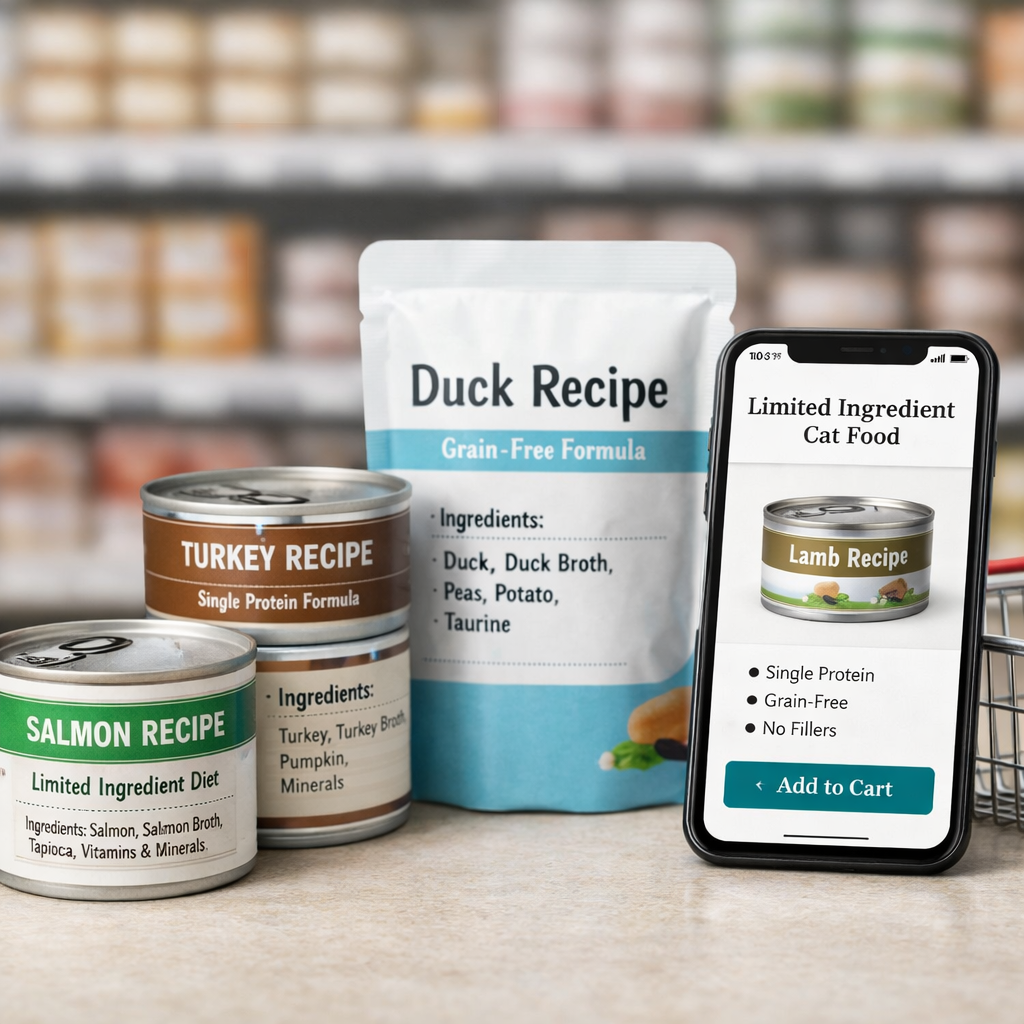
How to Buy Limited Ingredient Wet Cat Food Online and In-Store
Finding limited ingredient wet cat food that truly fits your cat’s needs starts with where you buy and how you read the label. Shop trusted retailers (online or local) that store food well and allow returns, then verify a single named protein, AAFCO “complete & balanced” status, and moisture that supports hydration. This guide walks you through label-first shortcuts, retailer checks, and safe transitions so you can buy with confidence—without relying on marketing claims. For deeper label how‑tos, see Pet Food Ingredient Guide’s label resources.
What limited ingredient wet cat food means
“Limited ingredient wet cat food uses simplified recipes—typically one named animal protein and one carbohydrate—to reduce potential triggers and support sensitive digestion; the term isn’t FDA‑regulated, so verify single proteins on labels and avoid vague ingredients.” This reflects the practical definition used in PetMD’s overview of limited-ingredient diets.
Single‑protein approaches often use novel protein cat food options such as duck, rabbit, or venison. Many true LIDs pair one protein with one carbohydrate like pumpkin or sweet potato.
High‑moisture wet food supports hydration, which is beneficial for kidney and urinary health. Bone broth–based recipes can add fluids, collagen, and minerals that may boost palatability and moisture intake, as noted in a wet-food hydration article.
When to involve your veterinarian
Consult your veterinarian before switching if you suspect a food allergy, inflammatory bowel disease, chronic vomiting/diarrhea, or if you’re starting an elimination diet. For diagnosis, many vets prefer hydrolyzed diets due to tighter manufacturing controls and lower cross‑reactivity risk, per PetMD’s overview of limited-ingredient diets.
A hydrolyzed diet is a prescription food in which proteins are broken into very small fragments so the immune system is less likely to recognize them as allergens. This helps during diagnostic elimination trials by reducing the chance that residual protein structures will trigger a reaction.
Over‑the‑counter LIDs may help maintenance after a diagnosis. Use veterinary oversight to interpret responses and to manage careful reintroductions.
Label-first criteria to shortlist products
- Confirm a single, clearly named animal protein (e.g., “duck,” “rabbit,” “lamb”). Skip vague terms like “animal digest,” “meat by‑product,” or generic “poultry.”
- If a carbohydrate is present, prefer a single, simple source (pumpkin, sweet potato).
- Verify an AAFCO nutritional adequacy statement if you plan to feed long‑term.
- Watch for long ingredient lists in “LID” lines and unnecessary fillers (peas/legumes) that complicate elimination, as flagged in Koha’s limited-ingredient explainer.
- For suspected fish or poultry sensitivities, avoid fish oils, fish broth, poultry broths, or flavorings hidden lower on the list.
- Look for sourcing or batch‑testing details on brand pages to reduce contamination risk, following Pet Food Ingredient Guide’s manufacturing quality‑control insights.
Verify complete and balanced nutrition
Find the AAFCO statement on the label or product page. “Complete and balanced” for adult or all life stages indicates it’s appropriate as a main diet.
Scan the guaranteed analysis for protein, fat, fiber, moisture, and confirm taurine is present. Align targets with your cat’s life stage and health; for example, one review measured a popular LID at around 41% protein and 27% fat on a dry‑matter basis—useful as a comparison baseline in Cats.com’s LID roundup.
If the label says “for intermittent or supplemental feeding,” use it only as a topper unless your vet directs otherwise.
Compare formats, textures, and moisture
Texture and gravy matter for acceptance. Pâté tends to be uniform and easy to portion; shredded/minced styles can be more aromatic. Broth or gravy can increase moisture and help picky cats. Slightly warming wet food can enhance aroma, a tip echoed in Joyfull Pet’s LID guide.
Bone‑broth–based LIDs can boost fluids and amino acids while supporting urinary health via higher water intake, as discussed in a wet-food hydration article.
Example label snapshots (for learning, not endorsements):
| Moisture % (as‑fed) | Texture | Protein source (single) | Carbohydrate source | AAFCO status |
|---|---|---|---|---|
| 78–82% | Pâté | Duck | Pumpkin | Complete & balanced (adult) |
| 80–84% | Shredded | Rabbit | None added | Complete & balanced (all life stages) |
| 82–85% | Broth‑rich | Venison | Sweet potato | Intermittent/supplemental |
How to evaluate products online
Confirm “single‑protein” claims by opening all photos and scanning the full ingredient list—don’t rely on the flavor name. Prefer product pages that describe traceable sourcing, lot coding, and any third‑party or batch testing to mitigate cross‑contact, aligning with Pet Food Ingredient Guide’s manufacturing quality‑control insights. Use Pet Food Ingredient Guide’s label checklists to quickly confirm protein sources, AAFCO status, and potential hidden additives.
Compare sellers:
- Marketplaces (Amazon, Walmart): broad selection; verify the seller is the brand or an authorized retailer; check storage notes and return policies.
- Pet specialists (Chewy): robust filters, subscriptions, and generally clear AAFCO statements.
- Brand sites: best for freshness windows, lot-code help, and direct support.
True single‑protein examples to study: lamb‑only recipes that include organs and bone as the same species, or salmon‑only formulas that avoid mixed fish oils—see Cats.com’s LID roundup for illustrative products.
Online vs in‑store at a glance:
| Where to buy | Strengths | What to double‑check |
|---|---|---|
| Online | Selection, filters, subscriptions | Seller authorization, storage/ship temps, returns |
| In‑store | Hands‑on label check, lot codes | Date codes, can integrity, staff knowledge |
How to evaluate products in-store
Start at the ingredient panel. Look for one named protein near the top and, if present, a single simple carb. Then find the AAFCO statement and guaranteed analysis; note moisture%.
Watch for marketing inflation—some “L.I.D.” lines still have long lists or multiple proteins. Verify actual simplicity, a common pitfall highlighted in Koha’s limited-ingredient explainer.
Ask staff about sourcing transparency, lot‑code systems, and storage conditions (cool, dry, first‑in/first‑out). Favor brands that publish quality controls or testing summaries, in line with Pet Food Ingredient Guide’s manufacturing quality‑control insights. Bringing Pet Food Ingredient Guide’s in‑store label checklist or snapping ingredient panels for later review can keep choices consistent.
Buy small first and check palatability
Start with single‑serve cans or a small multi‑pack. Over the first week, track appetite, stool quality, vomiting, and skin itch.
If your cat hesitates, slightly warm the food, add water, or use a simple topper. Single‑protein freeze‑dried treats (e.g., minnows) can boost interest without complicating ingredients when used sparingly, as noted in a single-protein treat guide.
If using the LID only as a topper, make sure the base diet is complete and balanced.
Transition plan to avoid digestive upset
Use this 7‑day schedule: Days 1–2 = 25% new/75% old; Days 3–4 = 50/50; Days 5–6 = 75/25; Day 7 = 100%. Slow down if stools soften or appetite dips, a tip echoed in Joyfull Pet’s LID guide.
Change one variable at a time (diet, treats, supplements) so reactions are traceable.
If issues arise:
- Mild soft stool → hold at current mix 48 hours → improve? continue; no? step back one stage.
- Vomiting/diarrhea → stop new food → rehydrate → call your vet if symptoms persist or if your cat is lethargic.
Calorie-to-gram meal conversions
- Find kcal per can and net can weight (g).
- Compute kcal/g = kcal per can ÷ grams per can.
- Daily grams = your cat’s target kcal/day ÷ kcal/g. Split across meals.
Example: A 85 g can has 95 kcal. 95 ÷ 85 = 1.12 kcal/g. A 200 kcal/day target equals ~179 g/day (200 ÷ 1.12), or about two cans plus a small portion. Weigh portions with a kitchen scale for consistency. Use dry‑matter basis to compare nutrients across moisture levels, but kcal/gram for feeding amounts.
Monitor results and iterate with reintroductions
Track stool quality, vomiting frequency, itch/skin changes, and appetite for 2–4 weeks in a simple log.
For suspected allergies, reintroduce one old ingredient at a time under veterinary guidance to confirm triggers, as outlined in elimination-diet basics and PetMD’s overview of limited-ingredient diets.
If there’s no improvement, reassess for hidden proteins or cross‑contact and consider a prescription hydrolyzed diet under your vet’s direction.
Budgeting and sourcing tips
Compare price per ounce across retailers and consider subscriptions for savings. Some LID canned foods benchmark around $0.50/oz, useful for budgeting context in Cats.com’s LID roundup.
Mix strategies: feed a complete LID wet base and use simple, palatable toppers sparingly—always screen for allergens.
Prefer sellers with solid return policies and visible storage/handling standards, and prioritize brands sharing traceability and third‑party testing practices, per Pet Food Ingredient Guide’s manufacturing quality‑control insights.
Red flags and marketing claims to question
“Limited ingredient” isn’t a regulated term—inspect the full ingredient list and confirm one clearly named protein, as emphasized in PetMD’s overview of limited-ingredient diets.
Beware long “LID” formulas and unnecessary peas/legumes that complicate elimination, a point raised in Koha’s limited-ingredient explainer.
Avoid vague proteins (“animal digest,” “meat by‑product”), and if it’s your cat’s main diet, ensure the label includes an AAFCO “complete & balanced” statement; higher moisture supports hydration per a wet-food hydration article.
Frequently asked questions
What is a limited ingredient wet cat food and who benefits
It’s a simplified wet recipe using one named protein and often one carbohydrate to reduce potential triggers. Cats with suspected food sensitivities or GI issues may benefit, especially during vet‑guided elimination trials; Pet Food Ingredient Guide offers label tips to get started.
Should I choose over-the-counter LID or a prescription hydrolyzed diet
Use an OTC LID for maintenance once triggers are known. For diagnostic elimination, veterinarians often prefer prescription hydrolyzed diets because stricter manufacturing and hydrolyzed proteins lower cross‑reactivity risk.
How can I confirm a single protein and avoid hidden ingredients
Read the full ingredient panel, not just the flavor name. Look for one clearly named protein and skip formulas listing fish, poultry broths, or generic flavorings if those are suspected triggers; Pet Food Ingredient Guide’s label checklists can help you spot these.
How do I compare nutrition across cans with different moisture
Use dry‑matter basis for protein/fat comparisons and kcal/gram to portion meals. Always check the AAFCO statement to confirm the food is complete and balanced for your cat’s life stage.
Where is the safest place to buy limited ingredient wet cat food
Buy from reputable retailers or brand sites with clear return policies and transparent quality controls. Pet Food Ingredient Guide’s buying checklists can help you vet labels, batch information, and storage practices.