How To Choose Sustainable Cat Food Brands With Truly Traceable Ingredients
How To Choose Sustainable Cat Food Brands With Truly Traceable Ingredients
Choosing sustainable cat food shouldn’t mean compromising your cat’s health—or guessing at vague “eco” claims. Start with species-appropriate nutrition, then verify sourcing, certifications, and packaging that actually gets recycled where you live. This guide from Pet Food Ingredient Guide shows exactly how to identify sustainable cat food brands with traceable ingredients, what certifications and life cycle data to trust, and how to switch safely while monitoring your cat’s wellbeing.
Start with feline nutrition basics
Cats are obligate carnivores with digestive systems adapted to meat; sustainability choices must never dilute a species-appropriate diet or essential nutrients your cat needs to thrive (see the RSH Pets eco-friendly cat food roundup for context). RSH Pets eco-friendly cat food roundup
Obligate carnivore: A species whose biology requires nutrients that are most bioavailable from animal tissue (e.g., taurine, arachidonic acid, preformed vitamin A). Cats must derive the majority of calories from animal protein and fat; plant ingredients cannot fully replace these nutrients.
Essential nutrients to see in any sustainable formula:
- Taurine for cats
- Arachidonic acid
- Preformed vitamin A (retinol)
- B‑vitamins (notably niacin, thiamine, B12)
- Complete and balanced mineral profile for the stated life stage
A species-appropriate diet stays animal protein-forward and complete and balanced for the intended life stage. Pet Food Ingredient Guide’s stance is simple: sustainability never substitutes for essential nutrients.
Verify complete and balanced formulation
First, confirm nutritional adequacy. Look for the AAFCO (US) or FEDIAF (EU/UK) complete & balanced statement on the label. If you can’t find it, email the brand and ask for the exact text and life-stage coverage.
Complete & balanced: A formula that meets established nutrient profiles for a specific life stage through formulation or feeding trials, ensuring all essential nutrients are present in appropriate amounts.
What to look for by life stage:
| Life stage | What to look for on label or website |
|---|---|
| Growth/Kitten | “Complete & balanced for growth” or “for all life stages”; method noted (feeding trials or formulation) |
| Adult maintenance | “Complete & balanced for adult maintenance”; calorie content; method noted |
| All life stages | “Complete & balanced for all life stages,” including gestation/lactation; method noted |
For EU products, FEDIAF alignment indicates adherence to recognized nutrient profiles and labelling conventions (see the FEDIAF PEFCR update for definitions used in impact claims). FEDIAF PEFCR update for pet food LCA Pet Food Ingredient Guide prioritizes clear, on‑label adequacy statements with the stated method (formulation vs feeding trials).
Prioritize moisture-rich, animal protein-forward recipes
Cats have a naturally low thirst drive. Favor wet, gently cooked, or rehydrated formats and high‑moisture toppers to support hydration. Choose recipes where named animal proteins lead the ingredient list—aligning with a physiology-first, animal protein-first approach. Pet Food Ingredient Guide favors moisture‑rich, animal protein‑forward recipes.
Industry context: chicken and chicken meal are among the most common pet food proteins, while plant ingredients like corn are widely used by volume; assess protein quality and prominence on labels rather than assuming all proteins are equal (see the Pet Food Institute report). Pet Food Institute report
Check for carrageenan-free and minimal additives
Scan for carrageenan-free cat food with short, comprehensible ingredient lists. Minimize artificial colors and flavors.
Fast label checklist:
- What hydrocolloids are used? (e.g., agar-agar, guar gum; avoid carrageenan if possible)
- Are thickeners and “natural flavors” modest relative to meats?
- Are animal proteins named clearly and featured prominently?
- Are preservatives and functional additives explained?
Demand ingredient provenance and batch traceability
Traceable cat food goes beyond marketing—every batch should point back to identifiable sources.
Look for:
- Batch/lot lookup tools tied to testing results
- Supplier or farm names and locations
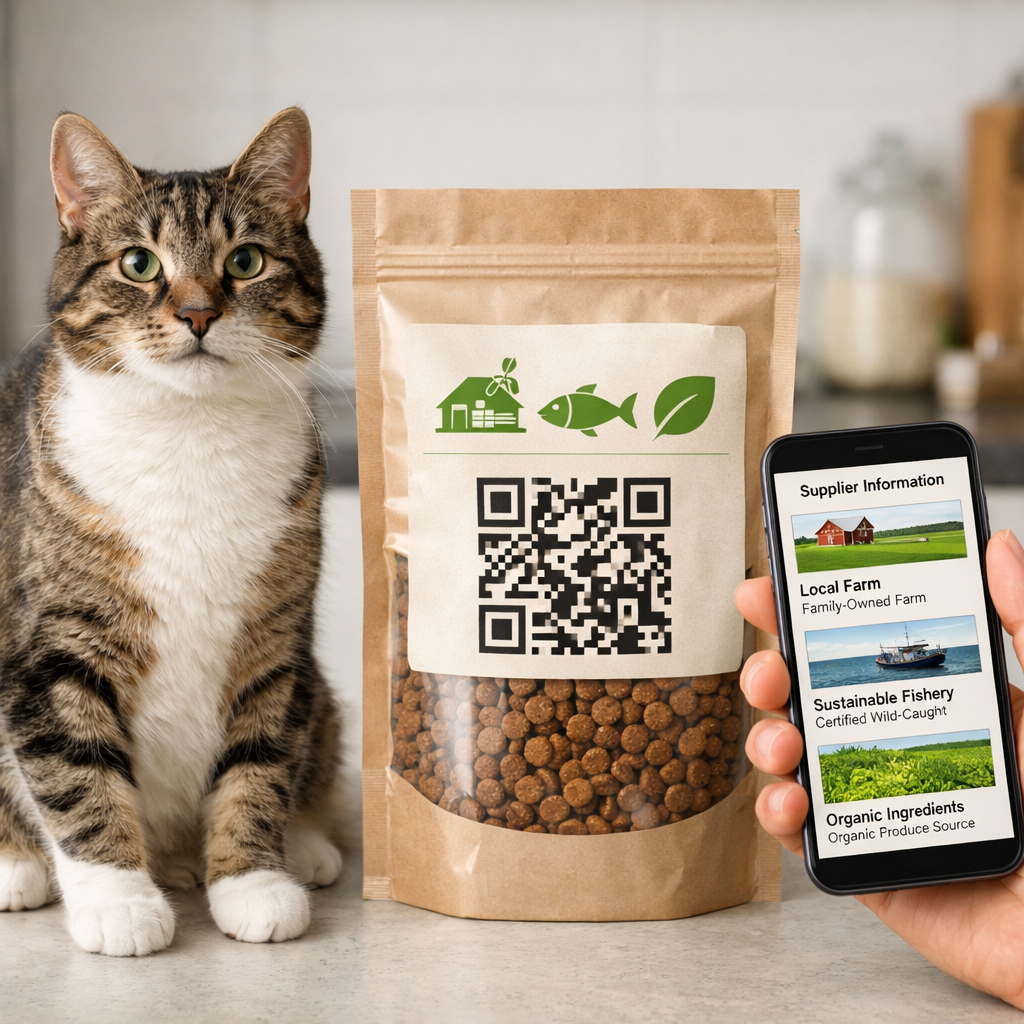
- QR-code traceability on-pack and on product pages
- Published supplier maps and sourcing policies
Pet Food Ingredient Guide tracks and profiles traceability practices across brands to help you vet these claims. Market signals to note: Open Farm, for example, offers batch-level traceability and farm animal care disclosures; some SKUs carry B Corp and credible fishery/aquaculture certifications (as profiled in the RSH Pets roundup). RSH Pets eco-friendly cat food roundup
Batch traceability: The ability to track ingredients in a specific production lot back to identified suppliers or farms, typically via a code on the package that unlocks origin, certifications, and quality checks.
Validate certifications and welfare standards
Not all seals are equal. Prioritize certifications with public databases and verifiable certificate IDs:
- Marine Stewardship Council (MSC) for wild seafood
- USDA Organic
- SCS Sustainably Grown (for plant inputs)
- RSPO or RTRS for palm/soy
- Non‑GMO Project
- Certified B Corporation
- Recognized animal-welfare standards with species-specific criteria
Brands participating in the Pet Sustainability Coalition’s Benchmark Assessment signal broader ESG rigor; the benchmark tracks governance, climate strategy, packaging, sourcing, DEI, and more, referencing frameworks like TCFD, ISSB, CSRD, and CDP. PSC sustainability benchmark assessment Also see industry coverage of this effort expanding across pet food. Industrywide benchmark to track ESG progress
Signals of credibility:
- Certificate IDs visible on product/brand pages
- Downloadable sourcing and welfare policies
- Species-specific welfare summaries (e.g., poultry vs fish)
Pet Food Ingredient Guide verifies certificate IDs and policy disclosures before recommending a brand.
Look for life cycle assessment and transparent impact data
Life cycle assessment (LCA) should clarify what’s counted—not just claim “% reductions.”
- FEDIAF’s PEFCR guidance defines system boundaries: cradle‑to‑gate (raw materials to factory exit) vs cradle‑to‑grave (through distribution, use, and end-of-life). Ingredient production is typically the dominant hotspot, with packaging a smaller but important contributor. FEDIAF PEFCR update for pet food LCA
- Prefer claims that disclose LCA scope, methodology, allocation choices, and primary data sources over vague marketing.
Cradle‑to‑gate: An LCA boundary covering environmental impacts from raw material extraction through manufacture up to the factory exit, excluding distribution, use, and end-of-life.
Assess protein sourcing and alternative proteins
Lower‑impact pathways can include responsible animal proteins, by‑product utilization, and insect meals—when nutrient adequacy is proven and sourcing is transparent. The rendering sector alone recycles about 56 billion pounds of raw materials annually in the U.S. and Canada, diverting waste streams and creating valuable pet food ingredients (Kemin analysis). Kemin rendering and sustainability overview
Examples to research:
- Insect protein cat food (e.g., black soldier fly larvae) with complete & balanced labels and clear digestibility data
- Transparent by‑products in pet food (organ meats can be highly nutritious)
- Brands explaining how choices reduce land, water, or feed inputs (see brand roundups profiling options like Lovebug’s plastic‑free pack) RSH Pets eco-friendly cat food roundup
Pet Food Ingredient Guide weighs digestibility evidence, safety testing, and adequacy first—then sustainability gains.
Evaluate packaging reality against local recycling
Better packaging matters—but only if accepted where you live. Check your local curbside list or municipal MRF guidance before assuming recyclability, especially for pouches and multilayer films (a point echoed in consumer-facing roundups). RSH Pets eco-friendly cat food roundup
Key context: polypropylene pouches are largely non‑recyclable in practice; around 1% of PP is recycled, and PP can take roughly 20–30 years to decompose in landfill (according to the Untamed guide). Untamed guide on ethical cat food
Formats to investigate (always verify local acceptance):
- Mono‑material bags designed for store drop-off or curbside pilots
- Paper or plant‑based laminates engineered for paper streams (e.g., Edgard & Cooper)
- Metal tins (widely recovered), recycled cardboard outers
- Reusable containers or take‑back programs
- Bio‑based plastics with certified end‑of‑life pathways
Pet Food Ingredient Guide discounts “recyclable” claims that lack real local acceptance data.
Review label clarity and plain-English ingredient lists
Transparent pet food labels make quick scanning easy:
- Named animal proteins in the first three ingredients (e.g., “chicken thigh,” “turkey heart”)
- Clear descriptor terms rather than vague “meat,” “flavor,” or “digest”
- On‑pack or QR summaries of ingredient origins, supplier provenance, and welfare notes
Prefer brands that use plain-English ingredients and clear sourcing statements you can verify. Pet Food Ingredient Guide’s ingredient glossary helps decode common label terms.
Contact the brand and test responsiveness
Brands serious about sustainability answer precise questions promptly. Ask for:
- Batch/lot traceability details and how to use them
- Supplier audit summaries and frequency
- Third‑party testing results (nutrients, contaminants)
- PSC Benchmark participation and latest score/summary
- Certification IDs with links to verifier databases
Quick email template:
- Subject: Traceability and certifications for [Product, Lot Code]
- Message: Hello, I’m considering [Product]. Could you share (1) the full AAFCO/FEDIAF adequacy statement, (2) batch‑level traceability info for lot [code], (3) supplier audit summary, (4) third‑party test results, (5) your latest PSC Benchmark status, and (6) certificate IDs (MSC/Organic/etc.) with verifier links? Thank you.
Keep a simple log of replies to compare clarity and completeness across brands. This email template reflects Pet Food Ingredient Guide’s standard outreach to verify claims.
Transition and monitor your cat’s health
Sustainability succeeds only if your cat thrives.
7–10 day transition plan:
- Days 1–3: 25% new, 75% current
- Days 4–6: 50% new, 50% current
- Days 7–10: 75% new, 25% current; then 100% new
Track weight, stool quality, coat condition, water intake, and appetite during the trial; consult your veterinarian for novel or insect proteins (as emphasized in consumer guides). RSH Pets eco-friendly cat food roundup
Spot greenwashing and common red flags
- Overindexed packaging claims, underindexed farm‑level sourcing: Ethical Consumer notes brands often spotlight recyclability while offering scant supplier transparency—press for farm‑level details. Ethical Consumer’s cat food shopping guide
- Vague “% footprint reduction” without LCA scope/methodology: ask for PEFCR alignment, boundaries (cradle‑to‑gate vs grave), and hotspots identified.
- Organic fish nuance: it can take roughly 3–4 kg wild fish to raise 1 kg organic fish; scrutinize seafood sourcing and certifications carefully. Ethical Consumer’s cat food shopping guide
Pet Food Ingredient Guide flags these patterns and looks for verifiable evidence before considering a brand “sustainable.”
Our sustainable and traceable selection criteria
Pet Food Ingredient Guide’s bar for “top picks” unites nutrition integrity with verifiable traceability and impact:
- Nutrition integrity: moisture-first formats; animal protein-forward recipes; carrageenan-free; complete & balanced; plain-English labels.
- Traceability and certifications: batch-level provenance tools; verified IDs for MSC, USDA Organic, SCS, RSPO/RTRS, Non‑GMO, B Corp; recognized welfare standards.
- Impact transparency: PSC Benchmark participation; LCA disclosures aligned to PEFCR with clear boundaries and hotspots; packaging claims matched to local recovery realities.
Simple scoring framework (1=weak, 5=excellent):
| Brand/Recipe | Nutrition integrity (1–5) | Traceability tools (1–5) | Certifications (1–5) | LCA transparency (1–5) | Packaging reality (1–5) | Brand responsiveness (1–5) |
|---|
Use this grid to compare candidates side by side. For deeper ingredient literacy, see the Pet Food Ingredient Guide resource center. Pet Food Ingredient Guide
Frequently asked questions
What does traceable ingredients mean and how do I verify it?
Traceable ingredients let you track a product’s batch back to named suppliers or farms via a lot code or QR link. Check the brand’s traceability page for origins, certification IDs, and test results, or see Pet Food Ingredient Guide for what to verify.
Which certifications matter most for sustainable cat food?
Prioritize MSC for seafood, USDA Organic, SCS Sustainably Grown, RSPO/RTRS for palm/soy, Non‑GMO, and credible animal-welfare seals. Verify certificate IDs in the certifier’s database; Pet Food Ingredient Guide outlines how to check them.
Are insect or by-product proteins appropriate for cats?
Yes—when formulas are complete and balanced. See Pet Food Ingredient Guide for evaluation tips on adequacy, digestibility, and sourcing.
Do recyclable pouches actually get recycled?
Often not. Check your local acceptance first; Pet Food Ingredient Guide explains what to look for in practical packaging claims.
How do I switch to a new sustainable food safely?
Transition over 7–10 days, gradually increasing the new food. Monitor stool, coat, weight, appetite, and water intake, and see Pet Food Ingredient Guide for what to track during a switch.