How to Choose Wet Food for Weaning Kittens, Step-by-Step
How to Choose Wet Food for Weaning Kittens, Step-by-Step
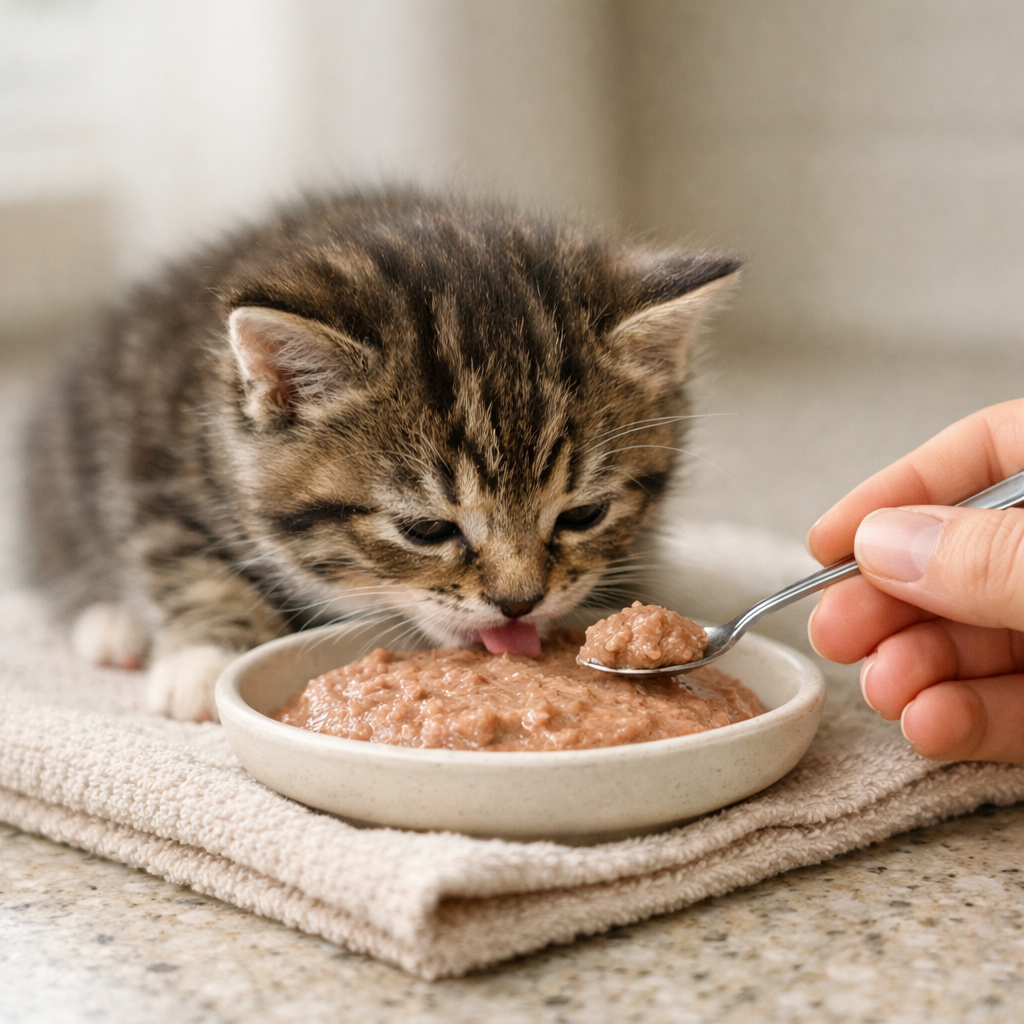
A smooth weaning plan starts with the right wet food and a simple setup. Around 4 weeks old (sometimes as early as 3), kittens begin tasting solids while still nursing or bottle-feeding. The best wet food for weaning kittens is a complete and balanced, kitten-designated pâté or mousse that’s easy to lap, with clear feeding directions you can translate into small, fresh, frequent meals. Below is a practical, label-first, step-by-step guide to choosing wisely and transitioning safely, with math-driven portions and weekly check-ins to keep growth on track. At Pet Food Ingredient Guide, we take a label-first, math-driven approach so you can verify portions and progress.
Confirm kitten readiness
Most kittens are ready to start weaning around 4 weeks, when tiny baby teeth begin erupting and they’re coordinated enough to lap; some eager kittens may show interest at 3 weeks. Baby teeth emerging around 4 weeks help enable handling soft solids [source: https://www.petmd.com/cat/general-health/weaning-kittens]. Avoid rushing weaning—starting too early can cause stress and set back feeding skills [source: https://www.petmd.com/cat/general-health/weaning-kittens].
Readiness checklist:
- Mobile, curious, and mouthing/licking objects.
- Visible baby teeth at about 4 weeks.
- Can maintain body temperature after cleanup post-meal (no chills after drying).
Verify complete and balanced kitten formula
Choose only wet foods that explicitly state they meet kitten growth requirements. Look for the AAFCO statement on the label confirming the recipe is complete and balanced for growth/kitten life stage. Pet Food Ingredient Guide prioritizes a clear AAFCO growth statement before marketing terms or flavor names.
Definition: AAFCO Complete and Balanced Statement (40–50 words) The AAFCO statement is a single line on pet food packaging that shows the diet meets nutrient profiles or feeding trial standards for a specific life stage, such as growth/kitten. When fed as directed, it supplies required macro- and micronutrients to support normal development without the need for additional supplements.
Wet kitten foods are typically formulated with higher calories, fat, and protein than adult foods to fuel rapid growth and development [source: https://www.earthbornholisticpetfood.com/blog/pet-nutrition/how-to-choose-the-best-kitten-food/].
Read the label for nutrients and texture
Scan the guaranteed analysis for protein, fat, and moisture, then confirm texture on the front/back panel (paté, mousse, loaf, minced). Wet food helps hydration during weaning—young kittens get much of their water intake from moist foods while learning to drink [source: https://www.adventureden.ca/4-steps-to-choose-the-best-kitten-wet-food-for-your-pet/].
Quick label-read checklist:
- Life stage: AAFCO statement for growth/kitten.
- Texture: paté/mousse or smooth loaf to start.
- Crude protein and fat minimums on an as-fed basis.
- DHA mentioned (in ingredients or claims).
- Feeding directions (grams or cans/day by weight).
Protein, fat, moisture, and DHA targets
For quick screening, look for wet kitten foods with:
- Protein ≥10% as-fed.
- Fat ≥3% as-fed. Because wet food is ~75–82% moisture, these as-fed minimums reflect solid nutrient density appropriate for weaning kittens [source: https://www.earthbornholisticpetfood.com/blog/pet-nutrition/how-to-choose-the-best-kitten-food/]. That moisture also supports hydration during transition [source: https://www.adventureden.ca/4-steps-to-choose-the-best-kitten-wet-food-for-your-pet/].
What is DHA? (40–50 words) DHA (docosahexaenoic acid) is an omega-3 fatty acid essential for brain and vision development in growing kittens. It’s commonly supplied via fish oil or marine ingredients. You may not see a DHA percentage on labels; instead, look for “fish oil,” “salmon oil,” or similar in the ingredients.
Ingredient list and quality signals
- Prefer animal-first proteins (e.g., chicken, turkey, salmon) and a clear fat source.
- Confirm the recipe is designated for kittens/growth and look for a DHA source (fish oil).
- Avoid cow’s milk in weaning foods; most kittens can’t digest lactose, causing GI upset [source: https://www.petmd.com/cat/general-health/weaning-kittens].
Example ingredient snapshots (hypothetical)
| Option | First ingredients | Fat source | DHA source noted | By-product language | Life stage | Notes |
|---|---|---|---|---|---|---|
| Good | Poultry, poultry by-products | Animal fat | None listed | Ambiguous “by-products” | All life stages | Meets basics; unclear DHA; ambiguous species terms. |
| Better | Chicken, chicken liver, broth | Chicken fat | Fish oil in ingredients | Species named | Kitten/growth | Animal-first with DHA source; kitten-designated. |
| Best | Turkey, turkey liver, salmon | Salmon oil + chicken fat | Salmon oil highlighted | None or clearly named | Kitten/growth | High-quality animal proteins, clear DHA, precise life-stage claim. |
Paté and mousse textures for early lapping
Start with ultra-smooth textures—pâté, mousse, or smooth loaf—so first-time lappers can push food with their tongues without chewing. These work well for mixing into kitten gruel and early independent lapping. Over time, introduce varied textures (minced/shreds, then softened kibble) to build acceptance of both wet and dry kitten food [source: http://www.kittenlady.org/weaning].
Texture progression:
- Mousse/pâté (thin gruel)
- Pâté with less dilution
- Minced/shreds (if tolerated)
- Softened kibble alongside wet
Set up feeding tools and safe handling
Essentials:
- Shallow, low-lip dishes so tiny faces can reach food easily [source: http://www.kittenlady.org/weaning].
- Soft/baby spoons; small feeding syringes if needed.
- Digital kitchen scale (for kittens and portions).
- Clean water bowl; paper towels/soft cloths for cleanup.
Keep portions small to limit waste. Keep unopened cans sealed until use; store opened wet food covered in the refrigerator, and don’t leave wet meals out long.
Bowls, spoons, temperatures, and storage
- Use shallow saucers/low-lip plates to improve access [source: http://www.kittenlady.org/weaning].
- Warm food to near body temperature by gently warming the mixture and stirring well (avoid hot spots).
- Refrigerate opened wet food up to ~24 hours and discard any portion left out more than ~2 hours [source: https://www.earthbornholisticpetfood.com/blog/pet-nutrition/how-to-choose-the-best-kitten-food/].
- In the first days, refresh offered food every 3–4 hours so it’s always appealing.
Hygiene and food safety time limits
- Safety window: ≤2 hours at room temperature; then discard [source: https://www.earthbornholisticpetfood.com/blog/pet-nutrition/how-to-choose-the-best-kitten-food/].
- Wash dishes and spoons after each meal. If you use a syringe, angle the tip at the side of the mouth between teeth and go slowly to prevent aspiration [source: https://bestfriends.org/sites/default/files/inline-files/Weaning%20Kittens.pdf?2BbOMrDfREtX315mals6zjcwcyAQAjvC].
- Feed in a clean, warm area; dry kittens promptly after messy meals to prevent chills.
Make starter gruel and first offerings
Kitten gruel is a thin, blended mixture of wet kitten food with kitten milk replacer (KMR) or warm water that helps kittens transition from nursing to lapping.
First-offer methods:
- Finger dabs: Touch a tiny bit to the lip, then guide the nose to the dish.
- Spoon-to-saucer: Offer a few spoonfuls, then lower the spoon onto the saucer so the kitten continues lapping independently.
Feeding rhythm:
- Week 4: 3–5 small gruel sessions/day plus bottle or queen as needed.
- Weeks 5–6: 4–6 small wet meals/day; gradually thicken.
- Weeks 7–8: 3–4 wet meals/day; introduce softened kibble alongside wet.
Math-driven portioning (“kitten portion calculator” approach): Pet Food Ingredient Guide standardizes on gram-based portions derived from the label to remove guesswork.
- Use the can’s kitten feeding directions. Daily amount (grams) = (label kcal/day for your kitten ÷ kcal per can) × grams per can.
- Example: If your kitten’s label guide is 180 kcal/day, and your 3 oz (85 g) can is 90 kcal, daily food ≈ (180 ÷ 90) × 85 = 170 g/day. Divide into 4–6 meals (≈30–45 g/meal).
- Weigh kittens weekly. If weight gain stalls or stools loosen, adjust total daily grams by ±10–15% and reassess.
Mix ratios with kitten milk replacer or warm water
- Start thin: 1 part pâté kitten food to 2 parts KMR (or warm water) for day 1–2.
- Thicken steadily: Shift to 1:1 on days 3–4, then 2:1 by the end of week 1 as lapping improves.
- If stools are loose, reduce KMR dilution and offer smaller, more frequent meals. Never use cow’s milk (lactose can cause GI upset).
- Per-meal starting size: 1–2 teaspoons per kitten; offer more if the dish is emptied quickly and stools remain normal.
- By week 2 of weaning, most kittens can take undiluted pâté, with water offered separately, and begin sampling softened kibble.
References & Links
Internal Link Candidates
- https://www.example.com/cats/kitten-care
- https://www.example.com/cats/kitten-nutrition
- https://www.example.com/cats/feeding-schedule-kittens
External references
External sources are cited inline above with descriptive anchor text.