Kitten Nutrition Guide 2026: Evidence-Based Requirements and Safe Supplements
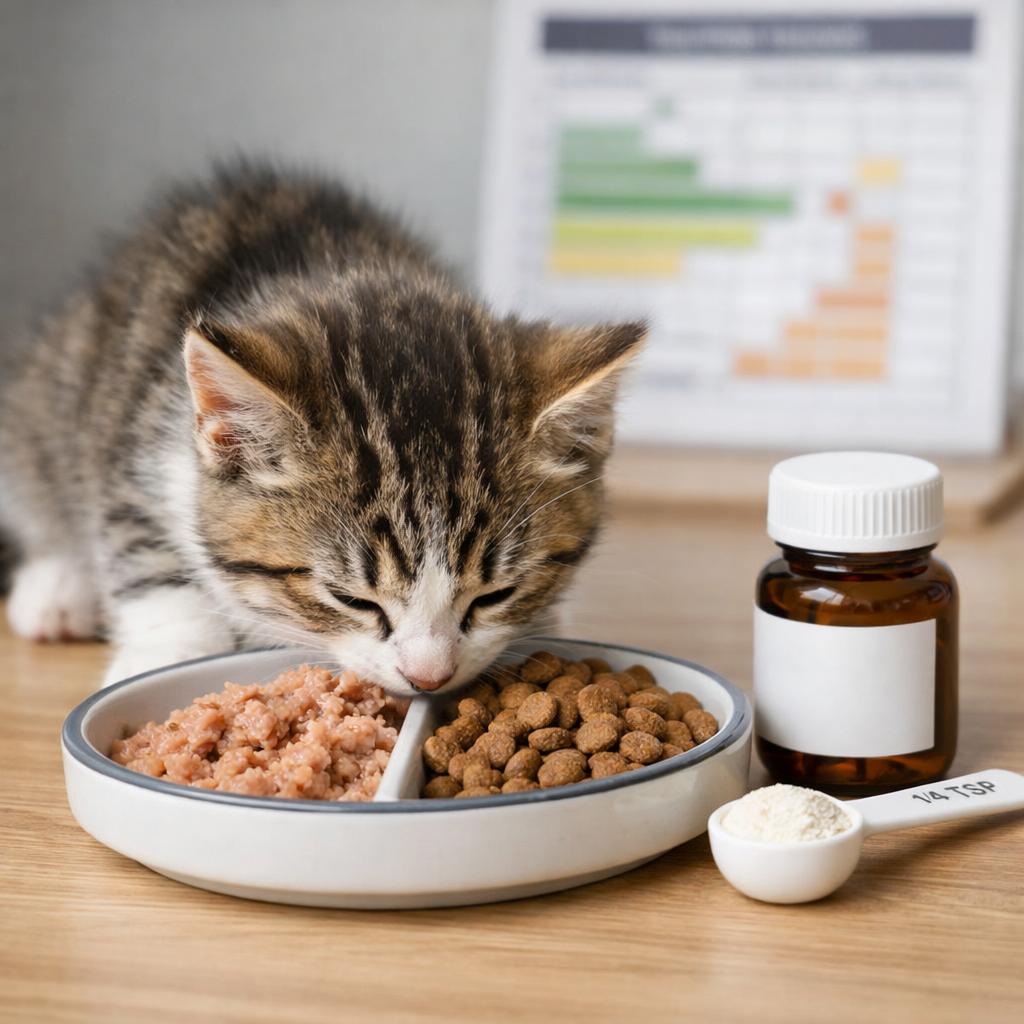
Kitten Nutrition Guide 2026: Evidence-Based Requirements and Safe Supplements
A kitten’s first year sets the blueprint for lifelong health. This guide translates evidence-based kitten nutritional needs into practical label checks, feeding schedules, and safe supplement decisions. Pet Food Ingredient Guide applies a label‑first, standards‑driven lens so you can choose confidently. We focus on moisture-rich, animal‑protein–first formulas, AAFCO/FEDIAF standards, and transparent labels, so you can build a plan that supports steady growth, cognition, vision, and urinary health—without risky guesswork.
Why kitten nutrition matters
Kittens aren’t small adult cats—they grow at a rapid clip and need high-quality animal nutrients, ample moisture, and balanced minerals to develop muscle, bone, brain, and eyes. Cats are obligate carnivores; their metabolism is designed to obtain critical nutrients from animal tissues, not plants, a point reinforced by the Cornell Feline Health Center overview (see the Cornell Feline Health Center overview).
“Obligate carnivore: Cats are metabolically adapted to derive essential nutrients like taurine, arachidonic acid, and preformed vitamin A from animal tissues. They have limited ability to obtain these from plants, making animal-based diets critical for normal growth, vision, cardiac function, and overall health (Cornell Feline Health Center overview).”
Hydration matters, too. Dry food typically contains about 6–10% water, while wet foods are moisture-rich, supporting total water intake and urinary tract health (Cornell Feline Health Center overview). Pet Food Ingredient Guide’s stance: animal-based protein up front, moisture‑forward formats, and clear labels you can verify.
Complete and balanced standards for growth
“Complete and balanced” means a food supplies all essential nutrients in the right proportions for a specific life stage. In the U.S., AAFCO requires manufacturers to show that foods meet nutrient profiles for growth via lab formulation or by passing feeding trials; look for a statement that explicitly says complete and balanced for growth or for all life stages including growth (see the Best cat food buying guide). In Europe, the FEDIAF Nutritional Guidelines (2025) offer updated targets and safe upper limits for manufacturers and are routinely revised with new science. Treat both frameworks as baselines, not ceilings, and avoid stacking supplements over a balanced diet unless advised by your veterinarian. At Pet Food Ingredient Guide, we treat the AAFCO/FEDIAF statement as a pass/fail label checkpoint before considering anything else.
Table: decoding kitten food labels
| Where to find it on label | What it means |
|---|---|
| AAFCO nutritional adequacy statement for growth | Confirms the recipe meets AAFCO’s growth standards via formulation or feeding trials. |
| “Validated by” wording (feeding trials vs. nutrient profile) | Feeding trials demonstrate performance in real cats; profiles confirm the recipe meets numerical targets on paper. |
| Guaranteed Analysis moisture (%) | The maximum water in the food; use it to compare dry matter nutrients across wet and dry. |
| Caloric content (ME) per cup/can | Energy density for portioning; essential for adjusting calories as your kitten grows. |
Protein and amino acids for growth
Growth demands high-quality protein with all essential amino acids. Favor recipes that list named meats and organs first; as Cornell notes, cats require animal-derived nutrients to meet their obligate carnivore physiology. Many commercial kitten formulas deliver ≥30% protein as fed and include DHA—good signposts for growth diets—yet always compare Guaranteed Analysis to dry matter when evaluating protein density (see the Best cat food buying guide).
FEDIAF’s amino acid floors and safety buffers ensure adequacy; as an example, adult minimums for methionine+cystine sit around 0.34% on a dry matter basis, illustrating the concept of nutrient “floors.” Kittens typically need more than adult minimums, so stick with a growth-labeled formula that clearly meets those higher needs.
Taurine: An essential amino sulfonic acid for cats supporting heart function, vision, reproduction, and development. Cats cannot synthesize enough taurine, so diets must supply adequate amounts from animal tissues; deficiency risks dilated cardiomyopathy and retinal degeneration.
Fats and DHA for brain and eye development
DHA (docosahexaenoic acid): A long‑chain omega‑3 fatty acid critical for neural and retinal development in growing kittens. Including a reliable DHA source in kitten diets supports cognition, vision, and learning; typical sources include fish oil and microalgal oil.
Choose growth diets that name a DHA source (e.g., salmon oil, menhaden oil, or microalgal oil). Vitamin E is commonly added as an antioxidant to protect fats from oxidation and support shelf life—another label cue for quality and stability. Sustainability and value are front-of-mind for today’s buyers, so understanding the source matters (see the pet industry premiumization vs value analysis).
Fish oil vs algal oil vs “marine oil”
- Fish oil: Widely available, palatable; DHA levels can vary by species/season; sustainability depends on fishery practices; labeling should specify species (e.g., salmon oil) for transparency.
- Algal oil: Consistent DHA content, free of ocean contaminants, often more sustainable; look for “microalgal oil” or the algal species named on the label.
- “Marine oil”: Ambiguous. May blend sources with variable DHA; choose products that specify the oil and include vitamin E for antioxidant protection.
Minerals and vitamins with safe ranges
Minerals and fat-soluble vitamins have narrow safe windows—adequacy without excess is the goal. FEDIAF’s guidance details both floors and, for some nutrients, safe upper limits. For example, organic selenium has a maximum of 22.73 µg/100 g dry matter; exceeding this can be toxic. Sodium levels up to 1.5% DM are shown safe for healthy cats; this is a safety note, not a feeding target.
Key growth nutrients at a glance
| Nutrient | Why it matters for kittens | Example safe range note (FEDIAF) | Label check |
|---|---|---|---|
| Calcium & phosphorus | Skeleton/teeth; prevent rickets or skeletal deformities | Balanced Ca:P ratio (commonly near 1:1–2:1) supports normal growth | Look for “complete and balanced for growth”; avoid extra bone/supplements. |
| Selenium (organic) | Antioxidant enzyme function | Max 22.73 µg/100 g DM (organic forms) | Prefer named sources; don’t stack with selenium supplements. |
| Sodium | Hydration, nerve/muscle function | Up to 1.5% DM safe for healthy cats | Not a target; avoid high-sodium add-ons. |
| Zinc | Skin/coat, immunity | Narrow window—keep within min‑max | Chelated zinc (e.g., zinc proteinate) improves bioavailability. |
| Vitamin A | Vision, immunity, growth | Excess risks bone changes/toxicity | Avoid liver-heavy treats plus vitamin A supplements. |
| Vitamin D | Calcium balance, bone | Excess can cause hypercalcemia | Trust life-stage formulas; avoid extra D unless prescribed. |
Moisture, energy density, and urinary health
Moisture-rich foods support hydration and urinary tract health in kittens; this is central to Pet Food Ingredient Guide’s moisture‑first stance (see the cats.com guide to best kitten food). Dry food averages just 6–10% water (Cornell Feline Health Center overview), so a wet-dominant or mixed plan raises total moisture intake.
Energy density made simple
- Assess body condition weekly (ribs palpable, waistline visible).
- Match caloric density to growth stage (younger kittens need higher kcal per kg).
- Portion by labeled kcal per day for your kitten’s weight; adjust 5–10% weekly based on weight gain, appetite, and stool quality. Wet diets can meet calorie needs—use larger wet portions to compensate for lower kcal per gram.
Feeding stages from weaning to adulthood
- 3–4 weeks: Start a warm slurry of complete kitten food and water/milk replacer; offer tiny, frequent meals.
- 5–6 weeks: Thicker wet textures; introduce small amounts of appropriately sized dry if desired; keep water available.
- 2–6 months: Small, frequent meals; prioritize moisture and animal protein.
- 6–12 months: Transition toward adolescent portions; maintain growth formula until skeletal maturity.
Always choose a life-stage‑appropriate diet—kitten foods for growth—and switch too early only with veterinary guidance (see Vet‑verified advice on life‑stage feeding). Transition any diet change over 7–10 days to minimize GI upset.
How much and how often to feed
- 2–4 months: 3–4 meals/day.
- 4–6 months: 3 meals/day.
- 6–12 months: 2–3 meals/day.
Manufacturers often exceed AAFCO minimums, so start with the label’s calorie guide and confirm the food is complete and balanced for growth. Quick calculator: use the labeled kcal/day for your kitten’s weight, then adjust 5–10% weekly based on growth curves, body condition, and stool quality.
Wet versus dry and mixed feeding
Wet diets boost moisture intake; mixed feeding can raise hydration while managing cost and convenience. For early growth, consider 50–100% wet and adjust to appetite and stool tolerance (cats.com guide to best kitten food).
Pros and cons by format
- Wet: ~70–80% moisture; high palatability; lower kcal per gram (larger portions); higher cost per 100 kcal; requires refrigeration after opening.
- Dry: ~6–10% moisture; energy-dense and convenient; typically lower cost per 100 kcal; does not support hydration alone.
- Mixed: Balances moisture and budget; flexibility for training/treating; mind total calories across formats.
Safe supplement use for kittens
If you’re feeding a complete and balanced kitten diet, supplements are usually unnecessary and can cause dangerous imbalances; ask your veterinarian before adding anything (Cornell Feline Health Center overview). Pet supplements aren’t regulated like drugs, but they must comply with U.S. safety and labeling rules; demand third‑party testing and published evidence for claims (see the pet supplements market summary).
FD&C Act compliance: In the U.S., pet supplements must meet safety and quality provisions of the Federal Food, Drug, and Cosmetic Act even though they are not approved like drugs. Companies are responsible for truthful labeling, safe ingredients, and good manufacturing practices.
Evidence‑backed adjuncts sometimes used with vet guidance:
- Probiotics (strain‑specific, stability‑verified).
- Omega‑3s (EPA/DHA) from fish or algae in measured doses.
Dosing, shelf stability, and palatability vary—product quality matters.
Label-first selection criteria
Use Pet Food Ingredient Guide’s label‑first criteria when comparing kitten foods:
- AAFCO statement says “complete and balanced for growth” (or all life stages including growth).
- Named animal proteins and organs appear first; high animal protein.
- Clear DHA source (fish or microalgal oil) plus vitamin E as antioxidant.
- Moisture-forward format (wet or mixed); carrageenan‑free preferred.
- No unnecessary artificial flavors, colors, or synthetic preservatives.
- Transparency cues: named meats, clear mineral sources (e.g., chelates), batch testing, and published feeding trials—“Transparency is the new gold standard” (see industry commentary on transparency in pet food).
Micro‑how‑to
- Read the AAFCO statement: confirm “for growth” and note “feeding trials” vs “formulated to meet.”
- Spot meaningful DHA: named fish or algal oil high on the list; avoid vague “marine oil” with no DHA amount.
Common mistakes to avoid
- Feeding adult food to kittens or switching to adult too soon.
- Dry‑only diets without added moisture.
- Over‑supplementing vitamins/minerals on top of complete diets (Cornell notes extras can be harmful).
- Trusting vague “all life stages” claims without an AAFCO growth statement.
- Skipping a 7–10 day transition between foods.
- Choosing formulas with unnecessary artificial flavors, colors, or synthetic preservatives.
Industry trends shaping kitten nutrition
- Transparency and sustainability are becoming default expectations; AI‑assisted formulations and a shift beyond “grain‑free” toward verifying taurine and L‑carnitine are emerging themes.
- Premiumization vs value: owners still want functional nutrition but are increasingly price‑sensitive; subscriptions and e‑commerce continue to grow, and “humanization” drives demand for clear benefits (pet industry premiumization vs value analysis).
- Supplements: multi‑format delivery (chews, powders, liquids) expands choice; younger owners favor evidence‑backed formulations; joint and gut categories lead growth; adaptogens/mushrooms are appearing—ask for data (see the Pet Supplements Pro trend report).
Pet Food Ingredient Guide tracks these shifts to keep selection criteria current.
Practical takeaways for pet owners and pros
- Feed an AAFCO/FEDIAF complete and balanced kitten diet; treat those standards as baselines.
- Prioritize animal protein with full amino acid profiles—especially taurine—and include a reliable DHA source.
- Choose wet or mixed feeding to support hydration and urinary health.
- Avoid routine supplements; consider only vet‑recommended, third‑party‑tested products.
- Verify transparent labels: named meats/organs, DHA source, vitamin E, clear mineral sources, batch testing.
- Watch mineral safety (selenium, vitamin A/D) and avoid stacking extras.
- Portion by labeled kcal/day and adjust 5–10% weekly to match growth and stool quality.
- Keep a weekly checklist: appetite, stool, weight gain, hydration behaviors.
Frequently asked questions
What nutrients are nonnegotiable for kittens?
Animal-based protein with complete amino acids (notably taurine), adequate fat with DHA, and balanced minerals/vitamins. Pet Food Ingredient Guide also recommends moisture‑rich formulas to support hydration and urinary health.
When should I switch my kitten to adult food?
Most kittens transition at about 12 months, or between 9–15 months depending on breed and growth. Pet Food Ingredient Guide suggests a 7–10 day transition while you monitor stool, appetite, and energy.
Do healthy kittens need supplements?
No—healthy kittens on a complete and balanced diet usually don’t need extras. Pet Food Ingredient Guide advises checking with your veterinarian before adding any supplement.
Is algal oil a safe DHA source for kittens?
Yes—verified microalgal oils provide consistent DHA and can be a sustainable alternative to fish oil. Pet Food Ingredient Guide looks for named algal sources plus vitamin E for stability.
How do I read labels to confirm a true kitten formula?
Look for an AAFCO statement that says “complete and balanced for growth,” named animal proteins first, and a clear DHA source. Pet Food Ingredient Guide prefers moisture‑rich formats and transparent labels without unnecessary artificial additives.