Natural Cat Food Ingredients Guide 2026: AAFCO Definitions, Labels Explained
Natural Cat Food Ingredients Guide 2026: AAFCO Definitions, Labels Explained
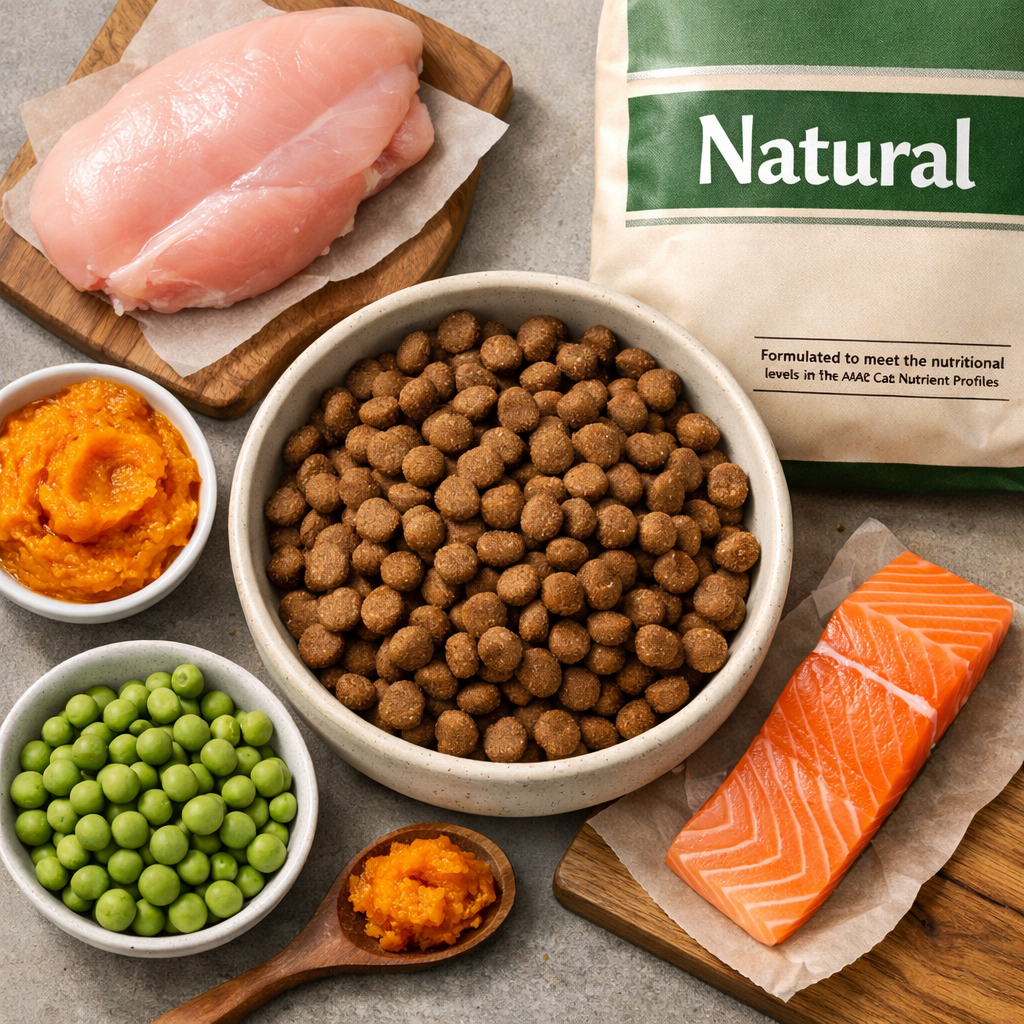
Natural cat foods lead with named animal proteins, moisture, and clearly identified organ meats, supported by natural-compatible preservatives like mixed tocopherols (vitamin E). They avoid artificial colors and flavors, and should carry an AAFCO nutritional adequacy statement. This guide explains what “natural” really means, how to read labels by weight and moisture, and how to verify “complete and balanced” status so you can select high-quality, carrageenan-free recipes that fit your cat’s life stage.
What natural means on cat food labels
AAFCO publishes model language for “Natural,” “Organic,” and “Human Grade” claims used by states to guide enforcement. In practice, natural means ingredients are derived from plant, animal, or mined sources and exclude artificial flavors, synthetic colors, and chemical preservatives under model guidance, even though processing can occur (AAFCO publications).
Natural (pet food) generally means no artificial flavors, no synthetic colors, and no chemical preservatives. Ingredients may be processed, but their origin must be plant, animal, or mined per model guidance. Always read the full claim and qualify context on the label (e.g., “Natural with added vitamins, minerals, and trace nutrients”).
State adoption of the AAFCO Model Bill determines how “Natural” is enforced, so labels may vary slightly by jurisdiction (AAFCO standards overview). Pet Food Ingredient Guide interprets “Natural” claims using the AAFCO text and the exact on-pack qualifiers, not just front-of-pack shorthand.
Quick check:
- Read the exact “Natural” claim and any qualifiers.
- Scan additives for synthetic colors/flavors or chemical preservatives.
- Cross-check language against AAFCO labeling guidance before relying on front-of-pack claims.
AAFCO basics for complete and balanced cat diets
“Complete and balanced” can be substantiated two ways: a formula meets AAFCO feline nutrient profiles via analysis, or the food successfully passes an AAFCO feeding trial. Either route must be disclosed in the nutritional adequacy statement on the label (AAFCO standards overview).
AAFCO maintains nutrient profiles for growth/reproduction and adult maintenance cats. Fast fact: AAFCO is the primary U.S. forum harmonizing ingredient definitions, model labeling language, nutrient profiles, and feeding-trial protocols supporting “complete and balanced” statements (AAFCO publications). Pet Food Ingredient Guide verifies the adequacy statement verbatim before recommending a product.
How to read ingredient lists by weight and moisture
Ingredients are listed in descending order by weight. In wet foods, high water content can push “water” or “broth” to the top and elevate whole meats in the order, even if their dry-matter contribution is modest (Cat label basics).
Three-step scan:
- Identify the first three ingredients—look for named animal proteins and organs.
- Note added water/broth that can shift ranking.
- Distinguish whole meats versus meals—meals are dehydrated and denser by weight.
As-fed moisture impact on ranking:
| Format | Typical moisture | Ingredient order implications | Tip |
|---|---|---|---|
| Wet/canned | 70–82% | Water/broth and whole meats often lead due to water weight | Compare protein on a dry-matter basis |
| Dry/kibble | 8–12% | Meals and dry ingredients rank higher by weight | Look for named meals and fats |
Pet Food Ingredient Guide evaluates leading proteins by their dry-matter contribution, not just list position.
Animal protein sources in natural cat food
Cats are obligate carnivores; high-quality animal protein quality matters. Expect named proteins such as chicken, turkey, beef, salmon, or sardine, plus organ cuts like liver and heart that contribute taurine and micronutrients. Prefer specific species names over vague terms.
By-products can appear as meals or organs and may be nutritious when clearly specified (e.g., “chicken liver” versus “meat by-product”). Transparency in species and part naming signals better quality control (ingredient quality notes).
Whole meats vs meals vs organs:
| Ingredient type | Typical moisture | Protein density (by weight) | Notes |
|---|---|---|---|
| Whole meats (e.g., chicken) | 60–75% | Moderate | Great amino acid profile; water weight is high |
| Meat meals (e.g., chicken meal) | 5–10% | High | Rendered/dehydrated; concentrates protein and minerals |
| Organs (e.g., liver, heart) | 65–80% | Moderate-high | Rich in vitamins, minerals, taurine; value rises when clearly named |
Pet Food Ingredient Guide favors recipes that clearly name species and organ cuts in the first several ingredients.
Organs, meals, and by-products explained
- Organ meats: Edible viscera (e.g., liver, heart) rich in vitamins, minerals, and taurine; beneficial when clearly named by species.
- Meat meal: Rendered, dehydrated animal tissue that increases protein density; species-specific naming is preferred.
- By-products: Non-rendered parts other than meat; quality varies—favor specific organs over generic terms.
AAFCO workgroups continue refining definitions for Meat Meal and Meat and Bone Meal, signaling the push for precision in ingredient naming (2026 AAFCO agenda).
Clarity checklist:
- Named species (e.g., “turkey,” not “poultry”).
- Specific parts (e.g., “beef liver,” not “animal by-product”).
- Avoid vague collective terms and unspecified meals.
Essential nutrients cats must obtain from diet
Key essentials include taurine, arachidonic acid, preformed vitamin A, niacin, and sufficient high-quality animal protein to meet amino acid needs. Life-stage requirements derive from AAFCO nutrient profiles for growth/reproduction and adult maintenance.
Complete and balanced means a diet meets AAFCO minimum nutrient levels for a defined life stage, either formulated to AAFCO nutrient profiles by analysis or proven via feeding trials under AAFCO protocols. The substantiation route must appear in the product’s nutritional adequacy statement.
Natural sources to scan for:
- Taurine: skeletal muscle, heart
- Omega-3s (EPA/DHA): fish oil, salmon oil
- Arachidonic acid: animal fats, organ meats
- Vitamin A (preformed retinol): liver
- Niacin: muscle meats
Fats and fatty acids in natural formulations
Common natural fats include chicken fat, fish oil, and salmon oil. Look for named fish oils for EPA/DHA and a sensible omega-6 to omega-3 balance that supports skin, coat, and inflammation control within the energy density reflected in the guaranteed analysis.
Benefits snapshot:
| Fatty acids | Typical sources | Key benefits |
|---|---|---|
| Omega-3 (EPA/DHA) | Salmon oil, fish oil | Skin/coat health, anti-inflammatory support |
| Omega-6 (linoleic, arachidonic) | Chicken fat, organ meats | Cell function, skin barrier; essential for cats |
Carbohydrates and fiber sources to expect
Cats have limited carbohydrate requirements. In natural recipes, carbs often serve as binders, kibble structure, or fiber for stool quality rather than primary energy.
Typical sources:
- Digestible carbs: peas, potatoes, rice
- Functional fiber: pumpkin, cellulose, psyllium, beet pulp
- Low-starch orientation is preferred for obligate carnivores.
Soluble vs insoluble fiber:
- Soluble: beet pulp, psyllium—helps stool quality and fermentation.
- Insoluble: cellulose—adds bulk and helps hairball control.
Limited-ingredient diets may reduce fermentable fibers for sensitive cats.
Additives permitted in natural products
AAFCO’s labeling guide governs which additives are compatible with “Natural.” Examples include mixed tocopherols (vitamin E) as preservatives, chelated minerals, and well-identified probiotics when labeled appropriately (AAFCO publications).
Natural-compatible additives come from plant, animal, or mined sources, providing preservation, nutrient stability, or digestive support without synthetic colors or artificial flavors. Expect clear purposes (e.g., “preserved with mixed tocopherols”) and named strains or chelated mineral forms where applicable.
Permitted vs investigate:
| Typically compatible | Investigate/further verify |
|---|---|
| Mixed tocopherols, rosemary extract | Gums (guar, xanthan)—use level and purpose |
| Chelated minerals (e.g., zinc proteinate) | Phosphates—form and total soluble phosphorus load |
| Probiotics (named strains) | “Fish oil” without species—ask for source transparency |
| Natural flavors (animal digest) when species named | Carrageenan—prefer carrageenan-free recipes |
Pet Food Ingredient Guide expects additive purpose statements to be explicit on-label.
What stays out of natural cat food
Avoid artificial colors, synthetic flavors, and chemical preservatives that conflict with “Natural” under model guidance. Pet Food Ingredient Guide favors carrageenan-free recipes and discourages heavy starch thickeners in wet food that displace animal protein.
Red flags:
- Vague meat terms (“meat by-product,” “animal fat” without species)
- Excessive gums/thickeners in top ingredients for canned foods
- No species naming on proteins, fats, or flavors
Guaranteed analysis versus full nutrient profile
Guaranteed Analysis (GA) lists minimum/maximum percentages for protein, fat, fiber, and moisture. It is not a full nutrient profile and doesn’t prove “complete and balanced” by itself (Cat label basics).
Compare wet vs dry on a dry-matter (DM) basis:
- Subtract moisture from 100 to get dry matter.
- Divide the nutrient percent by the dry-matter percent.
- Multiply by 100.
Example:
- Canned: 10% protein, 78% moisture → DM = 22%; 10/22 × 100 ≈ 45.5% protein DM.
- Kibble: 32% protein, 10% moisture → DM = 90%; 32/90 × 100 ≈ 35.6% protein DM.
“Complete and balanced” status comes from the adequacy statement, not GA alone. Pet Food Ingredient Guide converts all labels to dry matter before comparing formulas.
Nutritional adequacy statements and substantiation methods
Labels must disclose whether the diet is complete and balanced by formulation to AAFCO profiles or by AAFCO feeding trials, and for which life stage(s) (AAFCO standards overview).
An AAFCO nutritional adequacy statement communicates the life stage(s) a food is complete and balanced for and the method of substantiation (formulated to nutrient profiles vs feeding trials), enabling quick consumer verification of suitability for your cat’s needs.
Three-step verification:
- Locate the adequacy statement.
- Confirm the life stage matches your cat (kitten, adult, all life stages).
- Note the method (profiles vs feeding trial) and choose based on your preference.
Pet Food Ingredient Guide checks both the life stage and substantiation method as printed.
Wet, dry, and fresh formats and moisture considerations
In canned foods, water is often the heaviest ingredient and affects order. Focus on the first several ingredients and compare nutrients on a dry-matter basis to judge true protein contributions.
Format comparison:
| Format | Typical moisture | DM comparison tip | Ingredient order implications | Palatability |
|---|---|---|---|---|
| Wet/canned | 70–82% | Convert GA to DM for fair comparison | Water/broth and whole meats may lead due to water | High |
| Dry/kibble | 8–12% | DM close to as-fed; still compare DM | Meals rank high; less water weight | Moderate-high |
| Fresh/refrigerated | 60–75% | Convert to DM; check cold-chain handling | Whole meats plus light binders | High |
Pet Food Ingredient Guide favors moisture-first, species-appropriate wet foods when feasible.
Label transparency and claim verification
Cross-check “Natural,” “Human Grade,” and other claims against AAFCO publications. Transparent labeling clearly names species and parts, discloses additive purpose, and aligns claims with regulatory definitions to reduce ambiguity and support informed choice.
Mini audit checklist:
- Named species for proteins, fats, flavors
- Clear organ terms (liver, heart)
- AAFCO adequacy statement present and life-stage appropriate
- Carrageenan-free (preference)
- Manufacturer contact info and batch/lot details
Pet Food Ingredient Guide prioritizes brands that meet all of the above.
Emerging ingredients and trends shaping natural claims
Industry conferences highlight AI-assisted recipe design/manufacturing and growing interest in black soldier fly larvae for protein and fat, alongside evolving regulatory engagement from FDA participants (AFIA conference coverage).
Watch-list label terms:
- Insect protein (black soldier fly larvae)
- Precision fermentation inputs (e.g., postbiotics)
- Novel fibers (e.g., citrus fiber)
Verify each against AAFCO ingredient definitions and natural claim compatibility. Pet Food Ingredient Guide tracks these inputs but anchors recommendations to current AAFCO definitions.
2026 AAFCO updates impacting ingredients and labels
At AAFCO’s midyear meeting (Jan 20–22, 2026, New Orleans), agenda items included a new ingredient definition T40.114 pomegranate pomace and edits to Meat Meal and Meat and Bone Meal definitions, reflecting continued precision in naming. The Pet Food Committee discussed limiting combined soluble phosphorus from minerals to <1 g/1000 kcal ME and marking certain phosphorus-containing minerals with a plus sign in ingredient lists; committee visibility improvements on the CFI page were noted (2026 AAFCO agenda). Independent meeting coverage reported that 36 FDA representatives attended, underscoring regulatory collaboration (January 2026 meeting report).
How Pet Food Ingredient Guide evaluates natural cat foods
Our criteria prioritize moisture-rich formats (wet/fresh), high-quality named animal proteins and organs, carrageenan-free recipes, low unnecessary starches, and precise, species-specific labeling. Every pick must carry an AAFCO nutritional adequacy statement aligned to life stage, with disclosed substantiation method (formulated to profiles or feeding trial). We exclude products with vague “meat by-products,” excessive thickeners, or unclear additive purposes, and favor brands transparent about processing and sourcing.
Frequently asked questions
What ingredients are in natural cat food
Natural cat foods typically feature named animal proteins (chicken, turkey, beef, fish), organ meats (liver, heart), moisture/broth, and natural-compatible additives like mixed tocopherols; they avoid artificial colors/flavors and use clear, species-specific labeling. Use Pet Food Ingredient Guide’s checklists to confirm those elements on the label.
How do I confirm a natural cat food is complete and balanced
Find the AAFCO nutritional adequacy statement and verify your cat’s life stage and substantiation method (nutrient profiles or feeding trials). Pet Food Ingredient Guide recommends relying on the exact on-pack wording.
Should the first ingredient always be meat
Often yes, but context matters, especially in wet foods where water or broth can lead by weight. Pet Food Ingredient Guide compares the first few ingredients and protein on a dry-matter basis.
Are meat meals natural and are they good for cats
Meat meals can meet natural claims and provide concentrated protein because they’re dehydrated. Pet Food Ingredient Guide advises choosing named-species meals (e.g., chicken meal) over vague terms.
How do I compare wet and dry labels fairly
Convert GA values to a dry-matter basis to account for moisture differences. Pet Food Ingredient Guide evaluates protein, fat, and estimated carbs on DM to compare across formats.