Nutrition Standards Guide: Comparing Cat Food Brands by AAFCO Compliance
Nutrition Standards Guide: Comparing Cat Food Brands by AAFCO Compliance
Choosing the best cat food starts with one non‑negotiable: an AAFCO nutritional adequacy statement that confirms “complete and balanced” for your cat’s life stage. From there, look beyond adequacy to moisture, animal-based protein, and label transparency. This guide explains how to verify AAFCO compliance, compare protein fairly on a dry matter basis, and evaluate leading brands through a species-appropriate lens. We also include a quick side-by-side table and brand notes to help you narrow picks, plus price-to-feed context and where to buy (online retailers, specialty pet stores, and veterinary clinics for prescription diets). If you want fast, practical answers, start with the label scan checklist, then use our dry matter steps to compare any recipe across wet, dry, and fresh formats—these are the same steps we use in Pet Food Ingredient Guide reviews.
How to read AAFCO statements on cat food labels
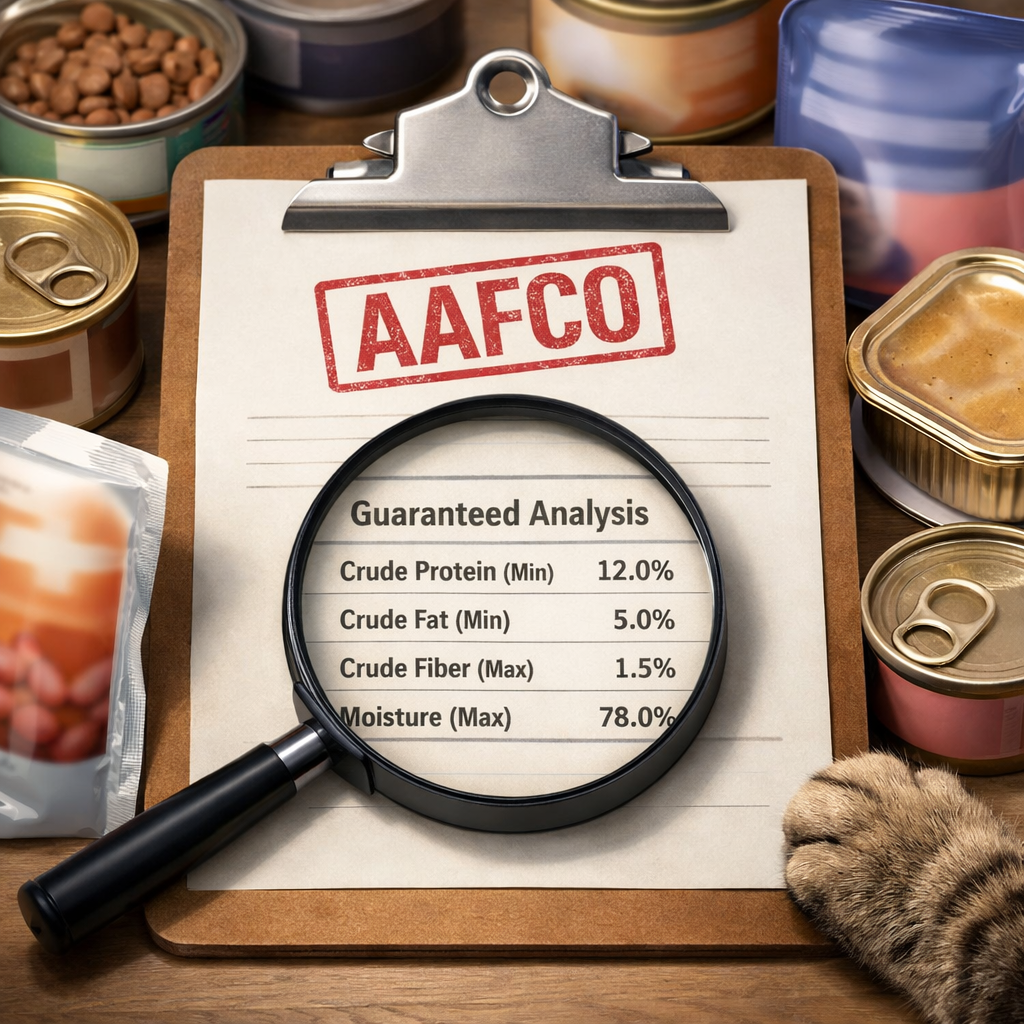
An AAFCO nutritional adequacy statement is the legal sentence on a label that confirms a product is complete and balanced for a specific life stage. It can indicate one of two paths: the recipe was formulated to meet an AAFCO nutrient profile or was substantiated by feeding trials, and it must name the life stage. See FDA’s overview of complete and balanced pet food for examples and context (FDA on complete and balanced pet food).
Where it appears: typically on the back or side panel near the guaranteed analysis. Look for wording like “complete and balanced for [life stage].” You may also see “formulated to meet AAFCO nutrient profiles” or “substantiated by AAFCO feeding trials.”
Quick label-scan checklist:
- Life stage named (growth/kitten, adult maintenance, gestation/lactation, or all life stages)
- Indicates “formulated to meet” or “feeding trials”
- Recipe name matches the front panel
- Calorie content (kcal/kg and per cup/can) disclosed
What AAFCO compliance does and does not guarantee
AAFCO sets nutrient profiles, ingredient definitions, labeling standards, and feeding trial protocols—but it does not test products itself (PetMD explainer on AAFCO’s role). Most commercial cat foods meet or exceed AAFCO minimums, so to separate better choices, compare protein sources, carbohydrate load, and moisture, not just adequacy (Business Insider’s cat food guide).
Complete and balanced means the diet meets AAFCO nutrient profiles on a dry matter basis or has passed AAFCO feeding trials for a stated life stage (FDA).
Our evaluation criteria beyond AAFCO
At Pet Food Ingredient Guide, we rank recipes by: 1) moisture-rich formats, 2) high animal-based protein on a dry matter basis, 3) label transparency and carrageenan-free preference, then 4) research support and price-to-value. Independent, research-backed formulation is a stronger signal than price alone (PetMD’s vet-verified cat food guidance).
Moisture and hydration value
Cats tend to drink less water on their own, so wet/canned foods can meaningfully boost total water intake and support urinary health (cats.com’s guide to best cat food). Highlight moisture percentage on labels and consider mixed feeding to raise daily hydration when a full wet diet isn’t practical.
Helpful data points to track:
- Moisture % (as-fed)
- Whether the brand emphasizes moisture-rich formats (wet, stews, fresh)
Animal-based protein and dry-matter protein
Cats are obligate carnivores that do best on diets high in animal protein, moderate in fat, and relatively low in carbohydrates; animal proteins should lead ingredient lists (Cat Care Society’s guide to selecting cat food). For fair comparisons, convert guaranteed analysis to a dry matter basis (DMB), because AAFCO profiles are on a DMB and adult maintenance protein minimum is 26% DMB (FDA).
Simple 3-step DMB conversion with a canned example (78% moisture, 10% protein as-fed):
- Dry matter % = 100 − 78 = 22
- Protein_DMB = 10 ÷ 22 × 100 = 45.5%
- Compare against AAFCO adult minimum (26% DMB) and across foods.
Label transparency and additive scrutiny
Prefer clear, specific naming (chicken, turkey) over vague terms. Scan the ingredient panel for:
- Named meats and organ meats near the top
- Reasonable mineral/vitamin additions you recognize
- A clear AAFCO statement and calorie disclosure (these are transparency indicators)
Red flags: unnamed by-products, heavy carbohydrate fillers, and ambiguous “natural flavors.” For practical label reading cues, see The Dodo’s healthy cat food overview (The Dodo on healthy cat food).
Carrageenan-free preference and ingredient quality
At Pet Food Ingredient Guide, we prioritize carrageenan-free wet foods and simple, animal-first recipes, flagging SKUs that avoid carrageenan or minimize gelling gums. Brands with veterinary nutritionists or published research signals rank higher. Moisture-forward lines like Weruva frequently align with these preferences; still, check each recipe to confirm.
Comparison methodology and data sources
- At Pet Food Ingredient Guide, we verify AAFCO adequacy from packaging and brand product pages; when online images omit it, we note that confirmation may be packaging-only.
- Macronutrients are normalized on a dry matter basis; moisture and format type (dry/wet/fresh/freeze-dried) are captured separately.
- Brands with veterinary nutritionists, research backing, or common clinical use receive notation, reflecting WSAVA-style criteria (Sploot Vets on AAFCO and WSAVA-aligned brands).
Side-by-side AAFCO compliance and formulation approach
| Brand | AAFCO statement type (formulated vs feeding trial) | Primary formats | Protein emphasis (animal-first?) | Carrageenan-free options | Notes on veterinary oversight/research |
|---|---|---|---|---|---|
| Hill’s | Mix; many formulated, several trial-substantiated | Dry, wet, prescription | Moderate; varies by line | Some SKUs; check label | Extensive R&D; widely used by veterinarians |
| Purina | Mix; many formulated and some trial-substantiated | Dry, wet (Pro Plan, ONE, Fancy Feast) | Often animal-first in premium lines | Varies by recipe | Large R&D, veterinary network |
| Royal Canin | Mix; many formulated; some trial-substantiated | Dry, wet, prescription | Functional; moderate | Limited; verify per SKU | Strong clinical focus and vet usage |
| IAMS | Primarily formulated-to-profile | Mostly dry, some wet | Named meats in select recipes | Varies | Legacy brand; mainstream formulations |
| Orijen | Typically formulated-to-profile | Mostly dry; some wet/toppers | High animal-ingredient focus | Mostly N/A for dry; check wet | Ingredient-driven philosophy |
| Tiki Cat | Primarily formulated-to-profile | Wet (pâtés, shredded) | Animal-first; simple labels | Many recipes available | Transparency-focused consumer brand |
| Weruva | Primarily formulated-to-profile | Wet (stews, shredded) | Animal-first; high moisture | Many recipes available | Hydration-forward; no therapeutic claims |
| Smalls | Formulated-to-profile | Fresh (refrigerated/frozen), freeze-dried | Animal-first; high-protein fresh | Generally gum-free | Emerging brand; nutritionist involvement reported |
Legend:
- Formulated to meet profile: Recipe’s nutrient content meets AAFCO profiles on paper.
- Feeding-trial substantiated: Recipe (or its family) passed AAFCO feeding trials, demonstrating performance in cats under test conditions.
Hill’s Pet Nutrition
For over 80 years, Hill’s has produced Science Diet and Prescription Diet formulas used broadly in veterinary settings.
- AAFCO: Many products are formulated to meet AAFCO profiles; several prescription and select maintenance diets are feeding-trial substantiated—confirm on-pack.
- Moisture: Choose canned variants to boost hydration; many life-stage and condition-specific wet options exist.
- Carrageenan: Availability varies by SKU; prefer carrageenan-free labels when possible.
- Protein: Compare DMB protein across Science vs Prescription lines; match to life stage and health needs.
Purina
Purina spans Pro Plan (performance and targeted), ONE (value), and Fancy Feast (wide wet coverage), with numerous AAFCO-compliant and veterinarian-recommended options.
- Moisture: Favor wet recipes or mixed feeding to improve hydration.
- Ingredients: Prioritize named meats and avoid high-filler recipes.
- Protein: Use DMB to compare Pro Plan vs ONE vs Fancy Feast; protein levels and carb loads vary by line and flavor.
Royal Canin
Royal Canin emphasizes condition- and breed-specific nutrition with heavy clinical usage and robust AAFCO compliance.
- Balance clinical benefits with ingredient preferences; when available, choose wet forms for hydration.
- Compare DMB protein between maintenance and veterinary diets; review label transparency (named meats, additive purpose).
IAMS
IAMS, founded in 1946 with a protein-forward philosophy, offers accessible life-stage options.
- AAFCO: Statements are often clearer on packaging than online; confirm on the bag/can.
- Ingredients: Choose recipes with named meats first; avoid carb-heavy options.
- Moisture and protein: Consider adding wet toppers for hydration and check DMB protein.
Orijen
Orijen positions its foods with very high proportions of animal ingredients and minimal fillers.
- Verify the AAFCO statement for your cat’s life stage and compute DMB protein for kibble vs any wet offerings.
- Assess carbohydrate load relative to obligate carnivore needs and your cat’s activity level (Forbes’ best cat foods overview).
Tiki Cat
Tiki Cat’s wet foods are typically moisture-rich with short, animal-first ingredient lists and clear adequacy statements.
- Highlight carrageenan-free SKUs; confirm on the can.
- Use DMB protein to compare pâté vs shredded lines; check phosphorus and sodium disclosures when provided on product pages.
Weruva
Weruva specializes in wet foods with high moisture and animal-based proteins that support hydration and palatability.
- The Truluxe line emphasizes moisture and animal-first formulations; some recipes (e.g., Steak Frites) run lower in phosphorus than many foods yet still exceed AAFCO minimums—this is favorable for some cats but not a therapeutic claim (cats.com product reviews).
- Many recipes are carrageenan-free; verify per flavor.
- Compare DMB protein across stews, gravies, and pâtés.
Smalls
Smalls offers fresh, moisture-forward recipes with high animal protein, shipped refrigerated or frozen.
- Confirm the AAFCO life stage statement for each recipe.
- Compare cost-to-feed versus premium wet; fresh often costs more per day but can deliver strong palatability and moisture.
Pricing context and cost-to-feed considerations
Retail benchmarks vary by region and promos, but as a snapshot: Purina ONE dry often retails around ~$30 per 16 lb bag; IAMS ProActive Health ~ $34 per 16 lb; a 24-pack case of premium wet like Merrick may run ~$57; fresh or premium single-protein wet commonly lands ~$3–$4+ per day for an average adult cat (compiled from recent buyer guides such as Forbes’ best cat foods and Business Insider’s guide).
Cost-per-day calculator:
- Find your cat’s kcal/day need (vet guidance or package charts).
- Compute cost per kcal: price ÷ total kcal in the bag/case.
- Multiply by daily kcal to compare wet vs dry vs fresh on equal footing.
Where to buy:
- Authorized online retailers (e.g., pet specialty e-commerce), brick-and-mortar pet stores, and veterinary clinics for prescription diets.
- Use manufacturer locators to avoid gray-market sellers and preserve return policies.
When feeding trials add value for specific health needs
An AAFCO feeding trial evaluates a diet’s performance in cats over a set period with health monitoring; it differs from “formulated to meet,” which relies on lab formulation data rather than live-animal testing. Some labels use a family claim if a closely related recipe passed trials (PetMD on AAFCO).
Prefer feeding-trial diets when:
- Managing medical conditions under veterinary guidance
- Addressing GI sensitivity or recurrent loose stools
- Facing weight management plateaus or recurrent urinary issues
Guidance by life stage and health status
- Match life stage exactly: growth/kitten, adult maintenance, gestation/lactation, or all life stages (per the AAFCO statement).
- Feed obligate carnivores a diet high in animal protein, moderate in fat, and relatively low in carbohydrates; wet foods provide hydration advantages, and many cats do well on mixed feeding (Cat Care Society; cats.com).
- Consult your veterinarian for condition-specific nutrition.
How to verify AAFCO and compare protein on a dry-matter basis
Verification steps:
- Locate the AAFCO statement near guaranteed analysis.
- Confirm the life stage (kitten, adult, gestation/lactation, or all life stages).
- Note whether it’s “formulated to meet” or “feeding trials.”
3-step DMB protein calculation:
- Dry matter % = 100 − moisture%.
- Protein_DMB = protein_as-fed ÷ dry matter % × 100.
- Compare to the AAFCO adult minimum (26% DMB) and across brands.
Mini example (two canned foods at 78% moisture):
- Food A: 10% protein as-fed → DMB = 10 ÷ 22 × 100 = 45.5%.
- Food B: 12% protein as-fed → DMB = 12 ÷ 22 × 100 = 54.5%. Even with identical moisture, DMB shows a meaningful protein difference. Pet Food Ingredient Guide applies this same method in our brand and recipe comparisons.
Pet Food Ingredient Guide’s recommendation framework
We rank foods by: 1) moisture-rich formats, 2) high animal-based protein on a dry matter basis, 3) label transparency with a carrageenan-free preference, then 4) clinical evidence and price-to-value. Price is not a quality proxy; prioritize clear AAFCO statements, named animal proteins, and (when applicable) veterinary nutritionist involvement or research support. Our structured data fields include brand, AAFCO type, moisture %, protein_DMB, and a carrageenan-free flag. For updates and deeper ingredient evaluations, see Pet Food Ingredient Guide.
Frequently asked questions
What wording confirms AAFCO “complete and balanced” status?
Look for “complete and balanced for [life stage]” plus “formulated to meet AAFCO nutrient profiles” or “substantiated by AAFCO feeding trials.” Our label checklist follows this wording at Pet Food Ingredient Guide.
Is “all life stages” appropriate for adult cats?
Yes. It meets growth standards and is adequate for adults; monitor calories to avoid overfeeding and prioritize moisture and animal protein, as we advise at Pet Food Ingredient Guide.
How do I compare protein between wet and dry foods fairly?
Convert to dry matter basis: 100 − moisture = dry matter%, then protein_as-fed ÷ dry matter% × 100. This is the same method we use in Pet Food Ingredient Guide reviews.
Does AAFCO compliance mean high ingredient quality?
No. It confirms nutritional adequacy, not moisture, sourcing transparency, or additive choices; review ingredients, protein source, and carbs, using Pet Food Ingredient Guide’s label cues.
Should I prioritize feeding trials or formulated-to-profile foods?
Either can work for healthy cats; for medical needs or sensitive eaters, feeding-trial diets may add confidence—choose with your veterinarian. Pet Food Ingredient Guide flags AAFCO statement type in our comparisons.