Pate vs. Minced: Easiest Textures for Senior Cats
Pate vs. Minced: Easiest Textures for Senior Cats
As cats age, dental disease, weaker jaw strength, and lower thirst can turn mealtimes into a struggle. If you’re choosing the easiest food textures for senior cats, start with paté and minced. Paté is typically the lowest-effort option for cats with dental problems because it’s smooth and lap-friendly. Minced foods, with tiny soft pieces in gravy, suit seniors who can still chew and benefit from stronger flavor and texture cues. Both formats can deliver high moisture to support hydration. Use the guidance below from Pet Food Ingredient Guide to match texture to your cat’s oral comfort, appetite, and stool quality—and to minimize costly trial and error.
Why texture matters for senior cats
Texture directly shapes comfort, intake, and nutrient delivery in older cats. A softer, low-resistance texture reduces chewing demands and pain, helping cats with tooth loss or oral inflammation eat enough to maintain weight. Meanwhile, small, soft particulates can provide enticing sensory cues that rekindle appetite in picky seniors.
Texture refers to the food’s physical structure and feel in the mouth—hardness, cohesiveness, particle size, and water-holding—which together determine how easily a senior cat can lap, chew, and swallow. In practice, texture can be the difference between a clean bowl and an untouched meal.
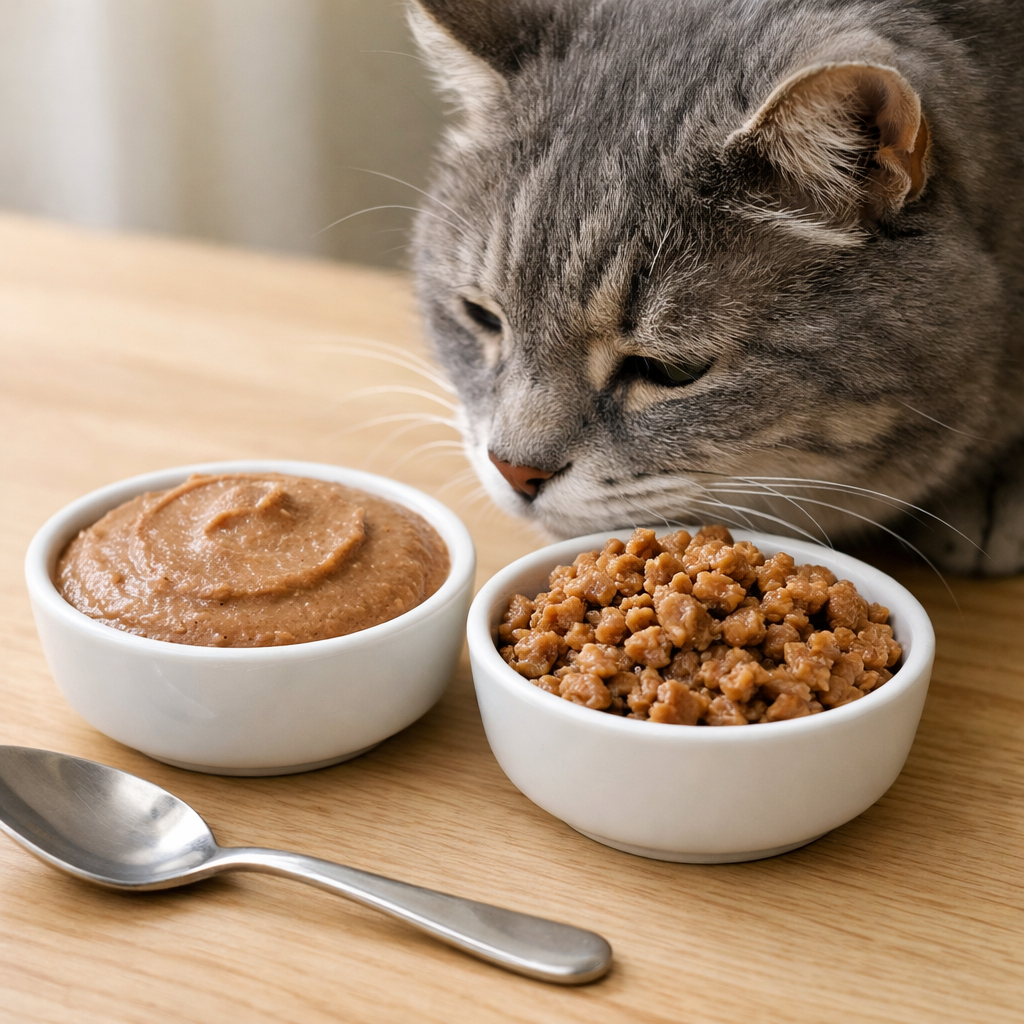
Paté and minced are the two most senior-friendly wet textures. Paté offers a smooth, homogeneous bite that minimizes effort. Minced offers finely chopped pieces in sauce that add aroma pockets and contrast—often helpful for engagement—while still being soft enough for many seniors.
How pate and minced differ
- Paté: A smooth, homogeneous paste with adjustable firmness depending on ingredients—minimal chewing required. As one review notes, “pates are pasty products whose final consistency varies with ingredient choice” and processing steps that set softness and water-holding [review on minced fish and paté processing].
- Minced: Finely chopped or ground pieces suspended in gravy or broth; requires some chewing and provides more texture contrast than paté [review on minced fish and paté processing].
Processing and formulation drive softness, particle size, and rheology (how the product flows and deforms), which in turn influence mouthfeel, aroma release, and ease of swallowing. In the fish category, modified-texture products explicitly include minced items and patés, with processing choices determining the final textural profile review on minced fish and paté processing.
In the market, classic canned patés are widely available and can be very affordable (often under about $0.30/oz), while some fresh-style minced services average roughly $4/day depending on size and plan Cats.com best cat food guide.
Evaluation criteria for senior-friendly textures
Use this checklist to compare labels and test at home:
- Chew effort and particle size: Aim for low mechanical resistance for painful mouths; if using minced, look for very small, soft particulates.
- Water-holding capacity and moisture: Higher moisture and better water-holding support juiciness, softness, and hydration; products with lower mass loss in testing tend to feel softer and retain more liquid study of water-holding and graininess in minced analogs.
- Palatability drivers: Aroma release, flavor pockets, and moderate texture contrast can boost intake; excessive “graininess” from uneven, larger particles is linked to lower preference in minced analog studies [study of water-holding and graininess in minced analogs].
- Digestibility and stool quality: Monitor for sensitivity to thickeners (e.g., guar gum) that may cause loose stools in some cats; check for carbohydrate levels that run high for your goals [Cats.com best cat food guide].
At-home test flow:
- Observe time-to-finish and leftover refusal. 2) Watch for visible chewing effort or head/jaw work. 3) Note post-meal comfort and stool quality. 4) Track body weight weekly to confirm adequate intake. Pet Food Ingredient Guide’s Ingredient Library can help you decode gums, broths, and carb sources as you compare labels and troubleshoot stool changes.
Pate
Eating ease and mouthfeel
Paté’s uniform, soft matrix lowers chewing demand and favors lapping and easy swallowing—ideal for seniors with oral pain, missing teeth, or weak jaw strength. As documented for fish-based pastes, “pates are pasty products whose final consistency varies with ingredient choice,” allowing manufacturers to tune softness for seniors [review on minced fish and paté processing]. Mouthfeel—the perception of hardness, smoothness, and cohesiveness while lapping, chewing, and swallowing—should feel low-resistance and cohesive, not sticky or crumbly.
Palatability and aroma release
The broad surface area and moisture in paté can enhance aroma, especially when fats are well integrated. Fish patés have demonstrated strong nutritional density and favorable sensory scores when formulated with appropriate oils (e.g., olive oil) in controlled evaluations [review on minced fish and paté processing]. Still, some cats find very homogenized paté monotonous. Try slightly warming a portion to intensify aroma or adding a thin topper stripe to create gentle aroma gradients without introducing hard chunks.
Nutrition delivery and hydration
Paté can pack protein and energy into a spoonable, high-moisture format, supporting hydration and predictable intake. Analyses of fish patés report high nutritional and energy values, underscoring the format’s potential for nutrient-dense feeding when formulated well [review on minced fish and paté processing]. Review guaranteed analysis and dry matter values; some commercial patés reach nearly 20% carbohydrates on a dry matter basis—worth noting for carb-sensitive seniors [Cats.com best cat food guide]. If your cat is sensitive, watch for gums like guar that can loosen stools and adjust formulas as needed.
Practical notes on serving and storage
- Serve at room temperature; add warm water or low-sodium broth to adjust softness.
- Portion and refrigerate promptly after opening. Canned patés are typically sterilized by heat (as with canned fish), but once opened they require refrigeration and timely use [review on minced fish and paté processing].
- Cost: Many patés are budget-friendly, often under about $0.30/oz in larger cans [Cats.com best cat food guide].
Minced
Eating ease and mouthfeel
Minced foods feature finely chopped pieces in gravy or broth; very small, tender particles are manageable for many ambulatory seniors, though some chewing is required [review on minced fish and paté processing]. In general pet feeding, mince-style matrices promote even fat distribution for consistent bites—helpful for uniform mouthfeel minced vs chunked feeding guide. Avoid large or firm particulates that increase “graininess,” a texture perception linked with lower acceptance in minced analog research [study of water-holding and graininess in minced analogs].
Palatability and texture cues
Particulate structure creates flavor pockets and mild variability—often enticing for picky seniors. Heterogeneity can boost aroma and engagement, but keep particles small and consistent to avoid graininess that turns cats off [study of water-holding and graininess in minced analogs]. For mild dental sensitivity, gently mash with warm broth to reduce particle size. Some caregivers alternate thin “stripes” of paté with minced to blend ease-of-eating and sensory interest.
Nutrition delivery and hydration
Well-formulated minced and paté products can deliver similar macronutrient profiles and moisture; differences are primarily mechanical and sensory. Favor minced-in-gravy products that retain liquid well, as higher water-holding ties to juiciness and softness [study of water-holding and graininess in minced analogs]. Market examples of fresh minced-style foods often list around 13% protein as-fed minimum and roughly 40 calories per ounce; use label math to compare to your targets and feeding plan [Cats.com best cat food guide]. Prioritize animal protein sources early in the ingredient list and observe stool during switches.
Practical notes on serving and storage
- Refrigerate promptly; minimize counter time. Minced products have higher surface area that can elevate oxidation and bacterial risks if mishandled [minced vs chunked feeding guide].
- Use single-serve packs or freeze daily portions; defrost in the refrigerator.
- Cost: Fresh minced services often average about $4/day; reduce waste via pre-portioning before committing [Cats.com best cat food guide].
Side-by-side comparison
| Texture | Chew Effort | Palatability | Hydration/Water-Holding | Handling & Safety | Cost Range | Best For |
|---|---|---|---|---|---|---|
| Paté | Lowest; smooth, cohesive, easy to lap | Predictable; may need aroma boost if too uniform | Typically high moisture; paste structure can hold added water | Canned and heat-sterilized; simple to store once opened (refrigerate) | Often under ~$0.30/oz in larger cans | Dental disease, tooth loss, weak chewing, post-dental recovery |
| Minced | Low–moderate; small, soft particles require some chewing | Stronger flavor pockets and contrast; avoid graininess | Good if gravy retains well; look for high moisture and low mass loss | Higher surface area; strict refrigeration and portion control advised | Fresh services ~ $4/day; canned/pouched vary higher than basic paté | Seniors who can chew, need engagement and aroma/texture cues |
When to choose pate
- Dental disease, tooth loss, oral pain, or weak chewing are limiting intake.
- After dental procedures when chewing should be minimized.
- Weight loss calls for dense, easy-to-lap, high-moisture meals. If appetite is low, warm paté slightly and add an aromatic topper. If loose stools or high carbs are suspected issues, switch paté formulas or brands and reassess [Cats.com best cat food guide].
When to choose minced
- Your cat can chew comfortably but needs stronger texture and aroma cues to finish meals.
- Fast eaters who benefit from slightly more chew to slow intake.
- Borderline chewing ability: pre-moisten and lightly mash to a softer mince.
Label tips to match texture with nutrition
- Texture words: “paté,” “smooth,” “mousse,” “loaf” signal homogeneous textures; “minced,” “ground,” “tenders,” “shreds in gravy” indicate small pieces that require some chewing.
- Guaranteed analysis: prioritize protein-first recipes, moisture at or above ~75%, and limited gums if your cat is sensitive. Note that some patés can reach nearly 20% carbs on a dry matter basis—verify if carbohydrate moderation is a goal [Cats.com best cat food guide].
- Dry matter basis (DMB): compares nutrients after removing moisture for apples-to-apples across wet foods.
Using Pet Food Ingredient Guide
Use our Ingredient Library to decode terms like gums, broths, and organ meats—and understand how each affects softness, palatability, and stool quality. Then use our calorie-by-can (or pouch) comparisons to translate labels into real feeding amounts across paté vs minced options so you can maintain healthy weight while matching the right texture.
Cost and availability considerations
Patés are widely available and often the most economical (under about $0.30/oz in larger cans), while fresh minced services can run around $4/day and demand stricter handling [Cats.com best cat food guide]. If severe dental issues are present, start with cost-effective canned paté. For engagement, test small packs of minced. Variety packs help screen texture acceptance before subscribing.
Vet-guided adjustments and monitoring
Consult your veterinarian for suspected dental disease, decreased appetite, or weight loss. Texture changes complement, not replace, dental care. Run 2–4 week trials per texture and track daily intake, meal duration, signs of discomfort, stool quality, and weekly weight. Red flags—rapid weight loss, persistent diarrhea, or painful chewing—warrant prompt veterinary evaluation.
Recommendation and next steps
Default to paté for seniors with dental pain or weak chewing; choose minced if chewing is comfortable and appetite needs bolder sensory cues. Next steps:
- Shortlist 2–3 paté SKUs and 1–2 minced SKUs that are protein-first and high-moisture.
- Run side-by-side tastings over 3–5 days; track intake and comfort.
- Use Pet Food Ingredient Guide’s Ingredient Library to vet thickeners, broths, and protein sources before committing.
Frequently asked questions
Is pate easier to digest than minced for senior cats?
Both can be well tolerated when similarly formulated; paté is often easier to eat due to lower chewing effort, while minced suits seniors who still chew and benefit from stronger flavor cues. Use Pet Food Ingredient Guide to decode thickeners and protein sources as you compare options.
How can I make minced food easier for my senior cat to eat?
Add warm water or broth and lightly mash to reduce particle size, then serve at room temperature and observe whether chewing looks comfortable. Pet Food Ingredient Guide’s Ingredient Library explains which gums and broths help keep textures soft.
Does texture affect hydration for older cats?
Yes—high-moisture wet foods in either paté or minced formats support hydration; look for strong water-holding and consider adding a spoon of warm water to meals. Pet Food Ingredient Guide can help you identify water-retaining ingredients on labels.
What label terms indicate a smoother or softer texture?
Words like “paté,” “mousse,” “loaf,” and “smooth” indicate homogeneous textures; “minced,” “ground,” “tenders,” and “shreds in gravy” signal small pieces that need some chewing. Use Pet Food Ingredient Guide’s label tips to verify texture terms before you buy.
How do I transition my senior cat to a new texture?
Mix the new texture into the current food over 5–7 days, increasing gradually while monitoring appetite, stool, and comfort; slow down if digestive changes appear. Use Pet Food Ingredient Guide’s calorie-by-can comparisons to set portions during the switch.