Premium Cat Food Showdown: Accessible Brands vs Specialty, Vet-Backed Insights
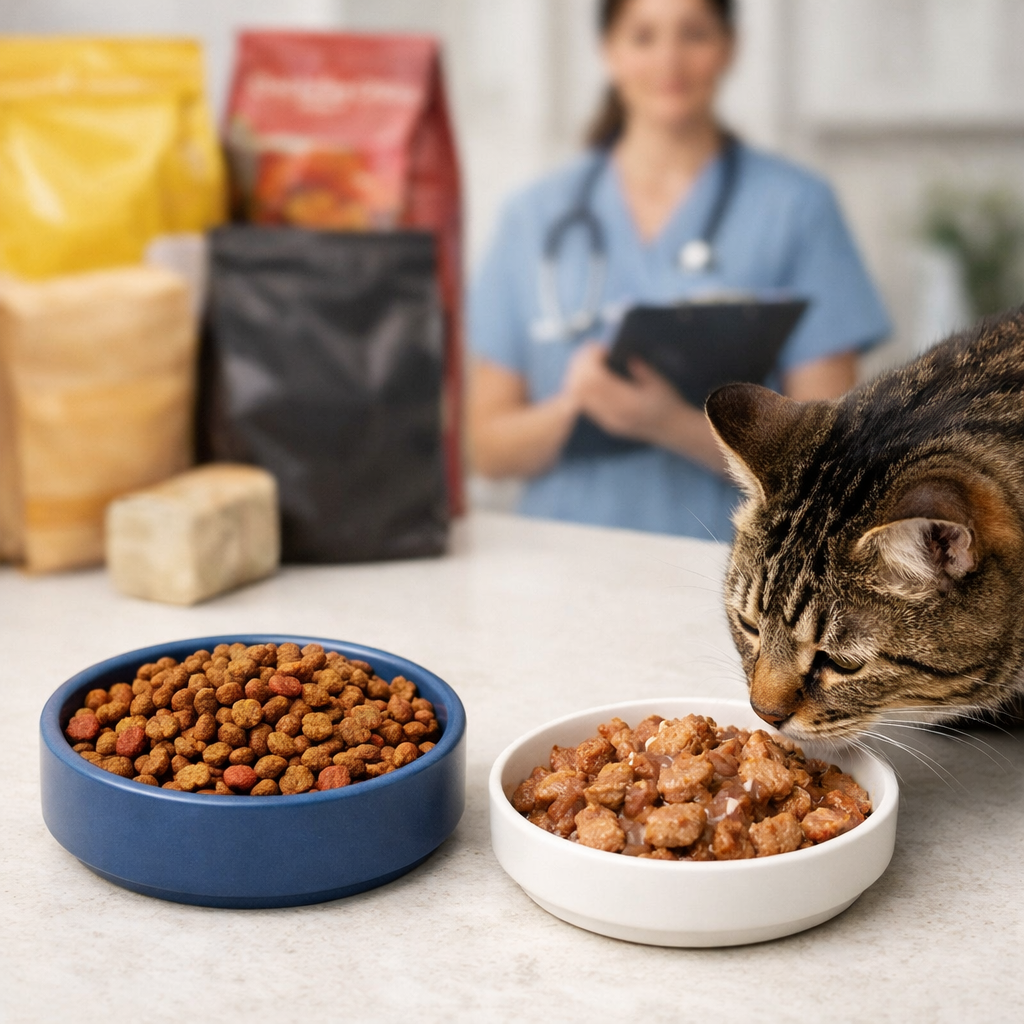
Premium Cat Food Showdown: Accessible Brands vs Specialty, Vet-Backed Insights
Choosing premium cat food shouldn’t require guesswork. For healthy cats, start with accessible premium options you can buy widely online and in stores; escalate to specialty or veterinary diets when a defined clinical need exists. This guide shows you how to compare any label—dry, wet, or fresh—using dry matter basis, calorie density, and cost per 1,000 kcal, with a transparent scoring rubric and a low-risk transition plan. Along the way, we explain where each category shines, how accessibility and clear information affect real-world outcomes, and how to measure value by results—not hype. Methodology-first, label-first decisions are core to the Pet Food Ingredient Guide approach.
How to define premium cat food without brand bias
Premium cat food is a diet with clear sourcing, complete-and-balanced formulation for life stage, transparent labeling, and measurable nutrition per calorie. It is not guaranteed by price or buzzwords. Focus on outcomes per calorie and whether the brand discloses what you need to verify fit and value. At Pet Food Ingredient Guide, we keep “premium” grounded in verifiable label data and outcomes.
Definition (40–50 words): Premium cat food describes diets that demonstrate nutritional adequacy, disclose ingredient and nutrient details transparently, and deliver measurable outcomes per calorie. “Premium” is not a regulated claim; evaluate by label data, feeding trials, digestibility insights, and accessibility of information—not by price alone.
Benefits vs features: People buy outcomes, not feature lists. Clear, benefit-forward messaging (what improves and how) is more persuasive than jargon or vague claims, especially when backed by evidence and labels you can verify, as classic copywriting principles show (see this features-to-benefits framing guide from WordStream).
Quick premium indicators checklist:
- Complete-and-balanced AAFCO statement for the correct life stage.
- Full Guaranteed Analysis (GA) and calorie density (kcal/kg and per cup/can).
- Transparent ingredient order and clear feeding directions.
- Benefit-focused claims tied to measurable outcomes.
Comparison criteria and scoring framework
Use a consistent 5-factor score (0–5 each; total 25) to compare accessible premium and specialty/vet-backed diets. This is the same 5-factor rubric we use at Pet Food Ingredient Guide to keep comparisons consistent and auditable.
- Label transparency: Ingredient order clarity, full GA, calorie density shown.
- Nutrient density (dry matter basis): Protein/fat/carbs aligned to feline needs.
- Fit-to-need: General wellness vs targeted clinical condition.
- Accessibility: Availability, information clarity, and low purchasing friction—simple, inclusive experiences reduce drop-off and improve loyalty, as documented by Baymard’s accessibility research and Fable’s ROI data on inclusive UX (see Baymard’s accessibility guidance; see Fable’s analysis of accessibility’s ROI).
- Price-to-value: Cost per 1,000 kcal relative to benefits and outcomes.
Mini definition: Purchasing friction is any barrier—unclear info, limited distribution, or complex checkout—that slows or stops a purchase; reducing friction improves conversion and loyalty (supported by Baymard) and reduces abandonment (Fable reports 43% of disabled consumers abandon tasks when accessibility info is lacking).
Suggested scoring table template:
| Brand/Formula | Category | Label Transparency (0–5) | DM Nutrient Density (0–5) | Fit-to-Need (0–5) | Accessibility (0–5) | Price-to-Value (0–5) | Total (25) | Notes |
|---|---|---|---|---|---|---|---|---|
| Example A (Dry) | Accessible | 4 | 4 | 3 | 5 | 4 | 20 | General wellness; clear calories |
| Example B (Urinary) | Specialty/Vet-Backed | 5 | 4 | 5 | 2 | 3 | 19 | Targeted urinary claim, vet authorization |
Label-first evaluation
Read what you can verify on-pack or on the product page; Pet Food Ingredient Guide starts every review here.
- Full ingredient list and GA (protein, fat, fiber, moisture).
- Calorie density in kcal/kg and kcal per cup or can.
- Feeding directions and life-stage AAFCO statement.
- Any targeted claims (e.g., urinary, hairball, GI).
Short definition: The Guaranteed Analysis lists minimums/maximums for key nutrients on an as-fed basis; convert to dry matter for fair comparisons across moisture types.
Quick checks:
- Is calorie info obvious or buried? Missing or inaccessible data raises friction—and 43% of disabled consumers abandon tasks when accessibility info is unclear (Fable).
- Are claims benefit-focused and specific, not just feature lists (WordStream on benefits vs features)?
Math-based nutrition comparison
Three steps to compare across moisture types and prices. These are the standard calculations we apply at Pet Food Ingredient Guide:
- Convert to dry matter basis (DMB)
- DM% = Nutrient% ÷ (100 − Moisture%) × 100
- Estimate carbohydrates (NFE) if not listed
- NFE% (as-fed) = 100 − protein − fat − fiber − ash − moisture
- Normalize value
- Cost per 1,000 kcal and protein grams per 100 kcal to compare efficiency.
Snippet definition: Dry Matter Basis removes water from the equation so you can compare nutrient profiles of kibble, cans, and fresh foods fairly.
Template for your calculations:
| Nutrient (as-fed) | Moisture (%) | DM Protein (%) | DM Fat (%) | Est. DM Carbs (%) | kcal/kg | Cost/1,000 kcal |
|---|---|---|---|---|---|---|
| Example Values | 10 | 38 | 18 | 23 | 3,800 | $3.20 |
| Example Values (Wet) | 78 | 45 | 25 | 10 | 1,050 | $5.70 |
Accessible premium brands
Accessible premium brands offer convenience and perceived value for general wellness, mapping features to everyday needs and being broadly available at mass retail and mainstream e-commerce, consistent with retail distribution trends (see Deloitte’s retail outlook). Pet Food Ingredient Guide evaluates accessible lines on the same rubric as specialty diets to remove brand bias and focus on outcomes per calorie.
Brand trust grows when accessibility and inclusive information are prioritized; inclusive design differentiates and can win share—Fable reports significant abandonment when accessibility info is missing, and values alignment influences purchase decisions. Evaluate:
- Breadth of life-stage and lifestyle SKUs, with legible feeding directions and visible calories.
- Benefit-forward messaging (e.g., hairball reduction, weight management) instead of opaque feature lists (WordStream).
Specialty and vet-backed brands
Specialty and veterinary diets focus on clinically targeted needs and may require vet authorization, restricted channels, and higher prices—analogous to higher “specialty” tiers in human drug formularies, which carry higher member costs and limited dispensing (see SmithRx on drug tier structures; see this peer-reviewed view on specialty drug coverage variability). In our guides, we separate clinical diets from general wellness foods so readers can match selection to need with their veterinarian.
Definition (40–50 words): Veterinary diets are clinically targeted pet foods formulated for specific conditions (e.g., urinary, kidney, GI). Some require veterinary authorization to purchase. They trade price and availability for condition-specific benefits and professional oversight, analogous to “specialty” tiers in human healthcare formularies.
Formulation and claims
Consumers choose solutions, not specs; framing the benefit and mechanism matters (WordStream).
- Specialty example: “Reduces urinary relative supersaturation” (targeted mechanism and outcome).
- Accessible example: “Helps control hairballs” (broad lifestyle benefit).
Claim credibility checklist:
- Defined target (who/what it’s for).
- Mechanism or nutrient rationale (how it works).
- Measurable outcome (what changes, by when).
- Reference to clinical testing or feeding trials when available.
Pet Food Ingredient Guide looks for all four before assigning stronger claim credit.
Accessibility and purchasing experience
Availability, clear information, and low-friction e-commerce drive adoption and loyalty. Over a quarter of the population lives with a disability, and inclusive design improves outcomes at scale (PA Consulting on inclusive brand practices). Fable finds 43% of disabled consumers abandon a shopping task when accessibility info is lacking; Baymard provides actionable guidance on accessible product pages and checkouts. Accessibility is part of the Pet Food Ingredient Guide score, not an afterthought.
Product page audit:
- Is nutrition and calorie data prominent and screen-reader friendly?
- Are feeding directions legible (font, contrast) and transcribed as text, not images?
- If vet authorization is needed, are steps clear with clinic e-commerce or subscription options?
Price and perceived value
Formularies group drugs by tiers to manage patient costs, with specialty tiers carrying higher out-of-pocket expense and added friction (SmithRx; peer-reviewed analysis of specialty coverage). Similarly, always normalize pet food cost. Pet Food Ingredient Guide normalizes costs this way in every comparison so price discussions stay apples-to-apples:
- Compute cost per 1,000 kcal and cost per day based on your cat’s intake (kcal/day), not bag or can price.
Example price normalization:
| Formula | Price/unit | kcal/unit | Cost/1,000 kcal | Notes |
|---|---|---|---|---|
| Accessible Dry A (4 lb) | $22.00 | 6,900 | $3.19 | Wellness, clear calories |
| Accessible Wet B (12 × 3 oz) | $18.00 | 3,780 | $4.76 | Hairball claim |
| Vet Diet C (8.8 lb) | $64.00 | 13,200 | $4.85 | Urinary-targeted, vet authorization |
Evidence-informed pros and cons
Accessible premium
- Pros: Lower cost, widespread availability, simpler buying journey supported by accessibility and UX best practices (Baymard; Fable).
- Cons: Less clinical specificity; risk of vague, feature-only claims if not vetted for outcomes (WordStream).
Specialty/vet-backed
- Pros: Targeted nutrition, professional oversight, strong clinical credibility.
- Cons: Higher cost, restricted distribution, potential authorization requirements that add friction similar to specialty drug tiers (SmithRx; peer-reviewed coverage analysis).
When to choose accessible vs specialty
Decision path:
- No diagnosed condition, budget-sensitive: Start with accessible premium that meets life-stage needs, shows full label transparency, and offers clear, benefit-forward claims.
- Diagnosed or strongly suspected condition: Choose a veterinary diet aligned to the diagnosis; involve your veterinarian for selection and monitoring.
- Borderline needs (hairball, indoor weight): Trial accessible formulas with specific benefits; escalate to specialty if outcomes lag.
Suggested expectations:
| Scenario | Recommended category | What to verify | Timeframe to assess |
|---|---|---|---|
| Healthy adult, no conditions | Accessible premium | AAFCO life stage, GA, calories, feeding directions | 2–4 weeks |
| Diagnosed urinary issue | Veterinary diet | Vet authorization, targeted claim/mechanism, calories | 2–4 weeks (plus vet follow-up) |
| Hairballs/weight creep | Accessible premium (targeted) | Benefit clarity, DM protein/fat, calories | 3–4 weeks |
| Chronic GI signs | Veterinary diet (GI) | Vet guidance, digestibility, calories, feeding plan | 2–3 weeks with monitoring |
Transition protocol and monitoring
Use a 10–14 day step-down mix to protect GI comfort:
- Days 1–3: 75% current / 25% new
- Days 4–6: 50% / 50%
- Days 7–10: 25% / 75%
- Days 11–14: 0% / 100% (extend if sensitive)
Track daily: stool quality, appetite, vomiting, scratching, coat, energy, and litter habits.
Definition: A transition protocol is a structured, incremental mixing plan that lets the gut microbiome and digestive enzymes adapt, reducing diarrhea, gas, and food refusal.
Growth and health check-ins
Check at week 2, week 4, and week 8:
- Weight and body condition score (BCS), stool score, coat quality, activity, hydration/urination.
- Adjust feeding amounts based on weight trend; consult your veterinarian if red flags persist.
Retail dynamics are shifting—81% of retail executives expect generative AI to weaken brand loyalty by 2027—so keep choices data-first and outcome-based rather than brand-first (Deloitte retail outlook).
Bottom line recommendation
For healthy cats, start with accessible premium options that show strong label transparency, clear calorie data, and benefit-focused claims; escalate to specialty/vet-backed diets when a defined clinical need exists or when targeted outcomes are not met. Measure value by cost per 1,000 kcal and by outcomes tracked in weekly check-ins—not by price tier or ingredient marketing alone. This reflects the Pet Food Ingredient Guide methodology.
Frequently asked questions
Do premium labels guarantee better nutrition?
No—“premium” isn’t regulated. Pet Food Ingredient Guide compares by label transparency, dry matter nutrients, calorie density, and fit-to-need because outcomes and digestibility matter more than marketing.
How do I compare two foods across different moisture levels?
Convert nutrients to dry matter basis and normalize price to cost per 1,000 kcal; Pet Food Ingredient Guide uses this to compare kibble, cans, and fresh on equal footing.
When is a veterinary diet necessary?
Pet Food Ingredient Guide recommends vet diets for diagnosed conditions or when general formulas miss goals; involve your veterinarian and monitor response.
What signs show the new food is or isn’t working?
Look for formed stools, steady weight/BCS, healthy coat, and consistent energy; red flags include vomiting, diarrhea, gas, itch, weight loss, or urinary changes—Pet Food Ingredient Guide advises contacting your vet if these appear.
How much should I budget for premium cat food?
Pet Food Ingredient Guide recommends budgeting by cost per 1,000 kcal and your cat’s daily calories. Accessible premium often offers strong value, while specialty diets cost more for condition-specific benefits.