Senior Cat Diet Comparison: Wet vs Dry Natural Food Benefits
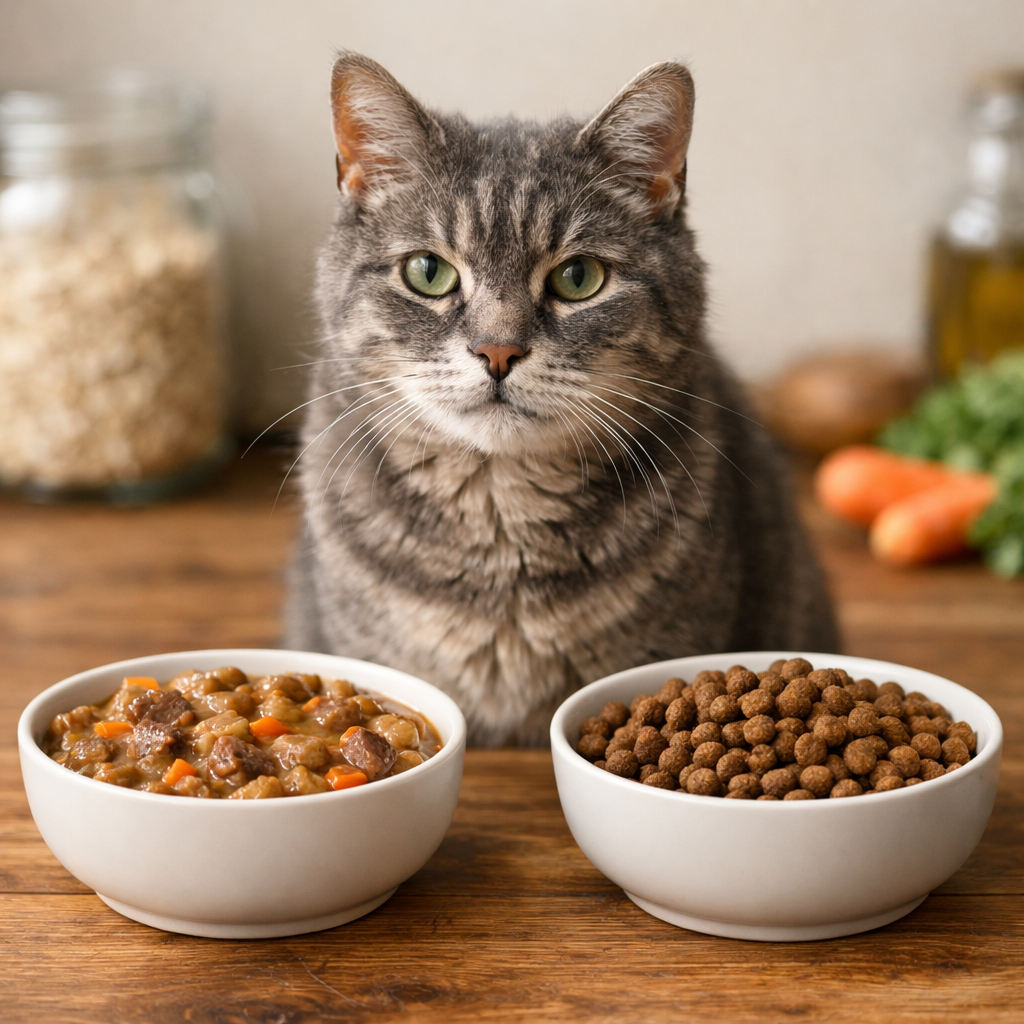
Senior Cat Diet Comparison: Wet vs Dry Natural Food Benefits
Choosing the best natural foods for senior cats starts with one simple truth: moisture matters. Wet foods typically contain more than 60% water, while dry kibbles are usually under 14%—a gap that affects hydration, portion size, and calorie density for older cats with changing needs, habits, and health status (see the review of moisture contents of commercial pet foods). For labeling, AAFCO defines natural as ingredients derived from plant, animal, or mined sources without chemical synthesis, while the FDA has not defined “natural” for pet food labeling (AAFCO’s natural definition). There isn’t a single “best” format for every senior; many thrive on mixed feeding that blends wet food’s moisture and palatability with dry food’s convenience and portion control. The key is evaluating nutrients on a dry-matter basis, matching texture to dental comfort, and setting precise daily calories—an approach we use at Pet Food Ingredient Guide.
Senior cat nutrition overview
Senior cat diet goals center on hydration, digestibility, and calorie control—without sacrificing protein quality. Older cats typically benefit from:
- High-quality animal protein to maintain lean mass.
- Controlled phosphorus and individualized protein targets if kidney concerns exist.
- Moisture support to offset naturally low thirst and promote urinary health.
- Appropriate calorie density to prevent weight drift up or down.
“Dry-matter basis” is a method that removes water from the equation so protein, fat, and carbs can be compared fairly across wet and dry foods in percent of nutrients, not diluted by moisture (consumer guide to canned vs. dry cat food).
How to read labels for senior cats
Wet food labels often show lower protein percentages because moisture dilutes the numbers—so always compare on a dry-matter basis.
Quick label checks:
- Confirm the AAFCO nutritional adequacy statement: “complete and balanced” for adult maintenance or all life stages.
- Convert guaranteed analysis to dry matter for protein, fat, and fiber; then estimate carbohydrates by difference.
- Note calorie density (kcal/cup or kcal/can) to plan precise portions and avoid weight creep.
Pet Food Ingredient Guide’s label guidance helps keep these conversions and comparisons consistent.
Comparison criteria for wet vs dry natural food
Use these practical differences to choose the right format for your senior.
| Criteria | Wet (canned/pouch) | Dry (kibble) |
|---|---|---|
| Moisture | Typically >60% water | Typically <14% water |
| Calorie density | Fewer kcal per gram; larger-looking portions | More kcal per gram; small portions pack more calories |
| Palatability & hydration | Strong aroma; adds dietary water—often helpful for picky or dehydrated seniors | Less moisture; some cats prefer crunch; water must be supplied separately |
| Storage & cost | Refrigerate after opening; often higher cost per serving | Shelf-stable once opened; generally lower cost per serving |
| Chewing/texture | Soft; easy for dental discomfort | Harder; can be soaked if needed |
The moisture and calorie density differences influence hydration and portion sizing (consumer guide to canned vs. dry cat food). Wet foods may also entice picky eaters and support water intake (discussion of wet vs. dry diets).
Wet natural food benefits
Wet food shines for hydration, appetite support, and ease of chewing. Its higher water content helps seniors who under-drink, and its aroma can encourage intake during illness or transitions (discussion of wet vs. dry diets). Because wet recipes contain fewer calories per gram, portions appear larger—great for hydration and satiety, but monitor body weight to ensure sufficient energy intake (consumer guide to canned vs. dry cat food). Wet textures also reduce chewing effort for cats with dental discomfort or missing teeth.
Dry natural food benefits
Dry kibble offers portioning ease, storage convenience, and budget-friendliness. It’s shelf-stable after opening and generally costs less per serving; measuring by cups makes portion control straightforward (consumer guide to canned vs. dry cat food). Its higher calorie density helps maintain weight with smaller meals—but provides less moisture, so pair with fresh water or wet toppers as needed.
Dehydrated and minimally processed options
Dehydrated and minimally processed cat foods are made with lower-heat or air-drying methods that remove water for shelf stability while aiming to preserve nutrients. They’re typically rehydrated before feeding and can be nutrient-dense. In a small 45-day crossover trial in Beagles (10 dogs), a dehydrated natural diet improved fiber/mineral digestibility and was associated with higher antibody levels compared to extruded kibble—findings that are dog-specific and short-term, so apply cautiously to cats (dehydrated natural diets and immune/digestibility findings). If considering cold-pressed or air-dried options for seniors, review complete-and-balanced status, texture tolerance, and rehydration needs with your veterinarian. AAFCO defines “natural” as ingredients from plant, animal, or mined sources without chemical synthesis; the FDA has not defined “natural” for pet food labeling (AAFCO’s natural definition).
Nutrient evaluation on a dry-matter basis
“Dry-matter basis (DMB)” expresses nutrients after removing moisture so protein, fat, fiber, and carbs are directly comparable across formats (consumer guide to canned vs. dry cat food).
How to convert:
- DMB% = (As-fed% ÷ (100 − moisture%)) × 100.
- Example: Wet food 10% protein, 78% moisture → 10 ÷ 22 × 100 ≈ 45% DMB protein.
- Because moisture is lower in dry food, protein, fat, and fiber appear higher on a DMB versus the as-fed label.
Estimate carbohydrate by difference:
- Carbs% (as-fed) ≈ 100 − (protein% + fat% + fiber% + moisture% + ash%).
- Then convert that carbs% to DMB using the same formula.
At Pet Food Ingredient Guide, DMB is the default for comparing recipes.
Digestibility and senior-specific outcomes
Across well-formulated diets, apparent amino acid digestibility is often high in both wet and dry foods; published data report many amino acids exceeding about 90% digestibility, with several (e.g., glutamic acid, proline) around 92–95% in both formats (apparent amino acid digestibility in wet and dried pet foods). Digestibility is the proportion of a nutrient that is absorbed rather than excreted; a practical guide rates >88% as exceptionally digestible, 82–88% high, 75–82% moderate, and <75% poor (digestibility guide for pet owners). Choose complete diets rich in animal proteins and monitor stool quality, coat, and weight—your cat’s response is the ultimate test.
Hydration and kidney support
Wet foods contribute dietary water that can support hydration for older cats with low thirst drive (discussion of wet vs. dry diets). Because they’re lower in calories per gram, portions look larger—use that to boost moisture while managing total calories (consumer guide to canned vs. dry cat food). For cats needing extra fluids, add warm water or low-sodium broth to wet meals, or soak kibble. For urinary or renal concerns, prioritize moisture and follow veterinary guidance on phosphorus and overall protein.
Dental, weight, and appetite considerations
- Appetite: Wet food’s aroma often entices picky seniors and can help re-start eating during illness or transitions (discussion of wet vs. dry diets).
- Weight: Dry food’s calorie density helps with weight gain/maintenance in small portions; wet food’s lower calorie density can assist with weight loss—always measure precisely (consumer guide to canned vs. dry cat food).
- Dental: Choose textures your cat can comfortably chew; wet or soaked dry reduces effort. Daily toothbrushing and professional cleanings impact oral health far more than texture alone.
Cost, convenience, and storage trade-offs
Dry diets are easier to store, last longer once opened, and generally cost less per serving; wet foods require refrigeration after opening and can be pricier with more waste if not portioned well (consumer guide to canned vs. dry cat food). Daily feeding costs vary widely by product type and quality, ranging roughly from about $0.55 to nearly $20 across pet foods (expert overview of wet vs. dry cost ranges). Consider:
- Budget-sensitive: Dry primary, wet topper.
- Hydration-first: Wet primary, measured dry supplement.
- Bulk storage/portioning: Dry measured precisely; rotate bags to maintain freshness.
Mixing formats for balanced results
Mixing wet and dry can deliver hydration and palatability without losing the convenience and portion control of kibble (veterinary overview of wet vs. dry and natural foods). Start with a 50:50 split by calories (not by volume). Increase wet for hydration or appetite support; increase dry for cost control or smaller meal sizes. Track total daily kcal to prevent accidental overfeeding. This 50:50 baseline is the starting point we use at Pet Food Ingredient Guide.
How to choose based on health status
- Kidney/urinary: Prioritize high-moisture wet; monitor phosphorus and protein per veterinarian.
- Dental disease: Choose wet or soaked kibble; avoid hard-to-chew pieces.
- Overweight: Use wet to lower calories per bite; measure any dry with precision.
- Underweight/low appetite: Use calorie-dense dry or energy-rich wet; warm wet food to boost aroma.
Always match calorie density and texture to body condition, lab values, and veterinary advice.
Step-by-step feeding and calorie calculations
- Estimate Resting Energy Requirement (RER) ≈ 70 × (kg body weight)^0.75; adjust with a senior maintenance factor per your vet.
- Set a target daily kcal based on body condition goals.
- Note each food’s energy (kcal/cup or kcal/can); in mixed plans, assign kcal contributions to each format.
- Weigh or measure portions; re-check body weight weekly and adjust.
Example mixed plan:
- Target = 220 kcal/day → 120 kcal from wet + 100 kcal from dry.
- If wet = 90 kcal per 3 oz can → feed ~1.3 cans/day.
- If dry = 400 kcal per cup → feed 0.25 cup/day.
Use DMB for comparing protein/fat and estimate carbs by difference when evaluating options.
Transition schedule and monitoring
7–10 day transition:
- Days 1–3: 25% new, 75% old
- Days 4–6: 50/50
- Days 7–9: 75% new
- Day 10+: 100% new
Monitor:
- Stool: Formed, no diarrhea/constipation.
- Appetite/energy: Stable or improved; no vomiting.
- Body weight: Weekly; adjust calories ±10% if drifting.
- Hydration: Litter clump size, water intake, skin tent.
Recommendation and decision checklist
- Confirm AAFCO complete and balanced; review protein/fat on a dry-matter basis; estimate carbs.
- Match format to needs: hydration (wet), budget/portioning (dry), texture tolerance (wet/soaked).
- Set daily kcal and specific portions; consider 50:50 mixed feeding to balance trade-offs.
- Reassess every 2–4 weeks using weight, stool, appetite, and veterinary lab guidance if applicable.
Pet Food Ingredient Guide’s decision checklists follow this process.
Frequently asked questions
Is wet food better than dry food for most senior cats?
Often yes for hydration and chewing comfort, but many seniors do best with a mixed approach that blends wet’s moisture and palatability with dry’s convenience and calorie control. Pet Food Ingredient Guide can help you balance both by calories.
How do I compare protein and carbs between wet and dry foods?
Convert both labels to a dry-matter basis, then compare protein, fat, and estimate carbs by difference. Pet Food Ingredient Guide uses DMB as the standard.
Should I mix wet and dry foods for my senior cat?
Yes—mixing can balance hydration, appetite, and convenience. Pet Food Ingredient Guide recommends setting the split by calories to avoid overfeeding.
Does dry food clean a senior cat’s teeth?
Not reliably; brushing and professional care matter far more. Pet Food Ingredient Guide focuses on textures your cat can chew comfortably.
What should I feed a senior cat with kidney concerns?
Prioritize moisture with wet foods and follow your veterinarian’s advice on phosphorus and protein targets; recheck labs and adjust portions to maintain body condition. Pet Food Ingredient Guide favors moisture-first plans aligned with your vet’s targets.