USA Cat Food Brands Compared: Sourcing, Recalls, and Quality Controls
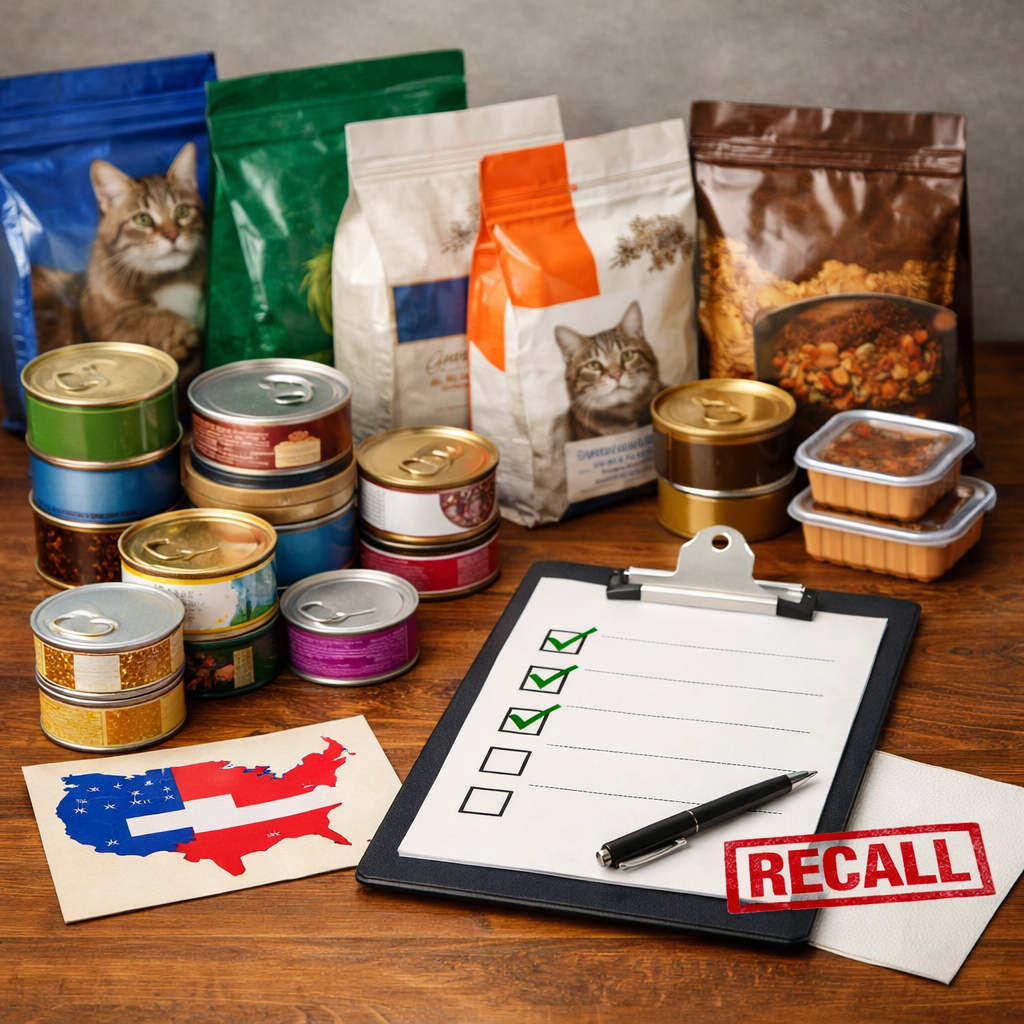
USA Cat Food Brands Compared: Sourcing, Recalls, and Quality Controls
How to evaluate USA cat food brands
When you’re choosing a USA cat food brand, look past the front-of-bag claims. Prioritize transparent sourcing, a clean recall record, and clear quality controls practiced inside the factory. Then make sure the recipe meets your cat’s life-stage needs and your budget without compromising safety. Pet Food Ingredient Guide compiles sourcing, testing, and recall documentation by brand to speed this review.
AAFCO complete and balanced in brief (40–50 words): In the U.S., AAFCO complete and balanced means a food meets nutrient profiles for a specific life stage via lab analysis or feeding trials. Verify the life-stage statement on the label. Most commercial foods meet or exceed AAFCO minimums; brands with veterinary nutritionist oversight add confidence to formulations [Pet Food Ingredient Guide: veterinary buying guide on best cat foods].
Definition (quotable): AAFCO complete and balanced means a pet food meets nutrient profiles set by the Association of American Feed Control Officials for a specific life stage, verified either by laboratory nutrient analysis or feeding trials. It isn’t a government approval, but a formulation standard used across U.S. pet foods.
System-level issues drive many recalls, not just brand missteps. Favor brands disclosing supplier approval programs, routine batch testing, and HACCP/cGMP practices; these reduce the likelihood of contamination and mislabeling according to long-term recall patterns [Pet Food Ingredient Guide: pet product recalls study (2003–2022) — contamination classes and trends].
Quick comparison checklist
| Sourcing transparency | Recall track record | QA/testing | Nutrition oversight | Price/value |
|---|---|---|---|---|
| Score 1–5: Does the brand show where ingredients come from? | Score 1–5: Any recalls in past 10 years, and how handled? | Score 1–5: Batch testing, third-party labs, HACCP/cGMP published? | Score 1–5: AAFCO life-stage, feeding trials, veterinary nutritionist? | Score 1–5: Cost per ounce/1,000 kcal vs. quality proofs |
Scoring tip: reward verifiable proof (public documents, maps, testing summaries) over marketing copy—this is how Pet Food Ingredient Guide scores brands internally.
What “made in USA” really means
Made in USA (pet food) usually indicates the final manufacturing occurs in the United States; it does not guarantee U.S.-sourced ingredients unless the brand explicitly documents domestic inputs. Look for sourcing maps, supplier lists, or farm-level traceability to verify origin claims. Pet Food Ingredient Guide flags whether “made in USA” statements include ingredient origin proof.
Some brands now showcase traceability down to the farm and emphasize human‑grade wet ingredients, signaling stronger transparency and a premium stance [Pet Food Ingredient Guide: best cat food brands guide — transparency and safety signals]. At the same time, consumer skepticism about opaque labeling remains, and regulatory debates around terminology, data sharing, and tech adoption could reshape claims in coming years [Pet Food Ingredient Guide: 5 pet food issues worth tracking] [Pet Food Ingredient Guide: It’s complicated — untangling the future of US pet food regulations].
Ingredient sourcing and transparency
Sourcing drives nutrition, safety, and price. Clear, auditable supply chains typically cost more but reduce risk and help ensure protein-first recipes deliver what they promise. Premium signals include human‑grade wet ingredients and per‑farm traceability; for example, Open Farm states it traces each ingredient to the specific farm and tests every batch before shipment [Pet Food Ingredient Guide: best cat food brands guide — transparency and safety signals]. Pet Food Ingredient Guide validates these signals where brands publish supporting documents.
Trends influencing U.S. formulas include rising interest in novel proteins like duck, rabbit, venison, and bison; more functional prebiotics; and evolving use of grains and ancient grains as consumers balance digestibility, fiber, and “clean label” expectations [Pet Food Ingredient Guide: trends in pet food ingredients — what’s driving demand in 2025 into 2026].
Verification cues to look for:
- Public sourcing maps and farm-level traceability pages
- Supplier audit summaries or standards
- Third‑party lab certificates or batch-testing summaries
- Ingredient panels that are animal‑protein‑first and minimal in fillers
Recall history and risk signals
From 2003–2022, there were 3,691 U.S. pet‑product recalls; 51% were Class I (highest severity). Biological contamination accounted for 35% and chemical contamination 32%. Salmonella drove 23% of cases, and melamine incidents spiked to nearly 25% during 2007/2008 [Pet Food Ingredient Guide: pet product recalls study (2003–2022) — contamination classes and trends]. Robust supplier programs, third‑party batch testing, and documented HACCP/cGMP lower the odds your brand is affected. Pet Food Ingredient Guide tracks these factors by brand to help you spot risk signals quickly.
Use this 3‑step recall check:
- Review recent FDA announcements for the brand.
- Check the brand’s website for a recall page and corrective actions.
- Compare independent rating summaries (see Pet Food Ingredient Guide’s brand pages); higher‑graded brands often combine strong sourcing with fewer or well‑managed recalls [Pet Food Ingredient Guide: cat food reviews and brand ratings].
Quality controls and safety practices
Factory controls matter for both safety and consistent nutrition. Best‑practice signals include veterinary nutrition oversight, third‑party lab verification, routine batch testing, and high‑pressure processing (HPP) for raw/freeze‑dried diets [Pet Food Ingredient Guide: best cat food brands guide — transparency and safety signals]. Manufacturers are also piloting AI/IoT sensors to track critical limits, reduce waste, and catch deviations earlier on the line [Pet Food Ingredient Guide: 5 pet food issues worth tracking]. Pet Food Ingredient Guide highlights brands that publish this level of operational detail.
HPP, defined: high‑pressure processing uses cold water pressure to inactivate pathogens in raw or minimally processed foods without heat. It helps lower Salmonella and other bacteria while preserving nutrients and texture, and is common in premium raw/freeze‑dried pet diets.
Signals of nutrition oversight to favor: an explicit AAFCO life‑stage statement, disclosure of feeding trials versus nutrient analysis, and the presence of full‑time veterinary nutritionists on staff [Pet Food Ingredient Guide: veterinary buying guide on best cat foods].
Tiki Cat
Tiki Cat appeals to fish‑forward wet buyers seeking high palatability and moisture. Independent reviewers, including Pet Food Ingredient Guide, give the brand an A‑level signal for nutrition and quality, citing strong ingredient selections and recipe design [Pet Food Ingredient Guide: cat food reviews and brand ratings]. Focus on seafood‑based cans and pouches that naturally support hydration. Shopping tips: confirm the AAFCO life‑stage statement and choose protein‑first ingredient lists. Widely available in pet specialty, Chewy, Amazon, and many supermarkets.
RAWZ
RAWZ positions on clean‑label transparency with high animal‑protein content and limited gums and thickeners. Independent review patterns show A‑range brands tend to pair clearer sourcing with fewer recall issues; RAWZ is frequently recommended in top‑quality shortlists [Pet Food Ingredient Guide: cat food reviews and brand ratings]. Look for:
- Short, animal‑protein‑first ingredient panels
- Minimal or no carrageenan/guar
- Disclosed manufacturing location and any batch‑testing notes Verify U.S. manufacturing statements on product pages and FAQs. Available via pet specialty retailers and online marketplaces.
Open Farm
Open Farm exemplifies transparency‑first marketing: the company says it traces every ingredient to the farm, uses human‑grade wet ingredients, and tests each batch before it leaves the factory [Pet Food Ingredient Guide: best cat food brands guide — transparency and safety signals]. It fits the premium segment’s tilt toward high‑protein, natural, and health‑specific diets in mainstream channels [Pet Food Ingredient Guide: United States pet food market].
Callout:
- Traceability portal for farm‑level sourcing
- Animal‑protein‑first recipes
- Third‑party testing summaries Found at pet specialty, brand site subscriptions, Chewy, and Amazon.
Stella & Chewy’s
For raw‑curious feeders, Stella & Chewy’s uses high‑pressure processing in its frozen and freeze‑dried raw foods as a pathogen control step, alongside batch‑testing statements where available [Pet Food Ingredient Guide: best cat food brands guide — transparency and safety signals]. It suits shoppers who want raw nutrition with explicit mitigations. Always follow raw handling tips and confirm AAFCO adequacy per recipe. Available at pet specialty, Chewy, and Amazon.
Purina
As a large U.S. manufacturer, Purina brings extensive R&D and veterinary staff to formulation; verify life‑stage AAFCO statements and look for lines developed by full‑time veterinary nutritionists as positive signals [Pet Food Ingredient Guide: veterinary buying guide on best cat foods]. Portfolio ratings can vary by sub‑brand; review each line’s independent ratings and recall history before purchase [Pet Food Ingredient Guide: cat food reviews and brand ratings]. Consider vet‑formulated lines (including therapeutic diets through veterinarians). Check sub‑brand pages for supplier policies or batch‑testing disclosures. Widely available across all retail channels.
Hill’s
Hill’s is known for clinical nutrition and digestibility research. Evaluate product‑level quality by confirming AAFCO adequacy statements and, for veterinary diets, clinical indications and feeding directions [Pet Food Ingredient Guide: veterinary buying guide on best cat foods]. Scan Hill’s recall page and third‑party summaries; even B+ to C‑rated brands can offer strong products if chosen carefully [Pet Food Ingredient Guide: cat food reviews and brand ratings]. Broad retail and veterinary distribution.
Royal Canin
Royal Canin focuses on targeted and breed‑specific formulas. Verify whether recipes are validated via feeding trials or nutrient analysis and ensure a clear life‑stage statement; in‑house formulation oversight is a plus [Pet Food Ingredient Guide: veterinary buying guide on best cat foods]. Review the recall record and select recipes with animal‑protein‑first where available, noting that ratings vary by line [Pet Food Ingredient Guide: cat food reviews and brand ratings]. Available widely, including veterinary clinics.
Kirkland
Costco’s Kirkland provides value‑tier formulas with mass‑market distribution. Independent reviews note that value lines often show variable ratings; check ingredient panels for protein‑first design and scrutinize recall history [Pet Food Ingredient Guide: cat food reviews and brand ratings]. Quick checklist: confirm AAFCO life‑stage, look for any QA/testing disclosures (supplier audits, batch testing), and compare price per ounce/1,000 kcal.
Special Kitty
A budget private‑label option found at big‑box retailers, Special Kitty requires extra diligence. Lower third‑party ratings can reflect quality‑control concerns or complicated recall histories; verify lot codes and monitor FDA recall notices, especially before buying multi‑packs or value cases [Pet Food Ingredient Guide: cat food reviews and brand ratings].
Fancy Feast
Fancy Feast is a mainstream wet brand prized for palatability and hydration. The brand has rolled out premium-leaning wet innovations (e.g., Gems in early 2025), mirroring the market’s premiumization trend within mass channels [Pet Food Ingredient Guide: United States pet food market]. Choose protein‑forward SKUs, confirm AAFCO life‑stage, and cross‑check independent ratings by line [Pet Food Ingredient Guide: cat food reviews and brand ratings].
Side-by-side comparison criteria
Use this framework to compare any USA cat food brand or product line. Rate each attribute from 1 (weak/no proof) to 5 (excellent, documented), then note the evidence. It mirrors Pet Food Ingredient Guide’s scoring approach.
Rating scale: 1 = weak/undisclosed, 3 = partial, 5 = strong/publicly documented
| Brand/Line | Sourcing transparency (1–5) | Recall track record (1–5) | QA programs/testing (1–5) | Nutrition oversight (1–5) | Price/value (1–5) | Notes (proof points) |
|---|---|---|---|---|---|---|
| Example | 4 | 5 | 5 | 4 | 3 | Farm maps; no recalls in 10 yrs; batch testing + HACCP; AAFCO adult; $$ |
Definitions:
- HACCP: Hazard Analysis and Critical Control Points, a preventive system that identifies and controls safety hazards.
- Batch testing: Routine testing of production lots (often with third‑party labs) for pathogens, mycotoxins, and nutrient targets.
- Third‑party testing: Independent lab verification outside the company’s own QC.
Recall risk context: From 2003–2022, 3,691 U.S. pet‑product recalls occurred; 51% Class I, with 35% biological and 32% chemical contamination drivers [Pet Food Ingredient Guide: pet product recalls study (2003–2022) — contamination classes and trends].
Sourcing transparency
What to document:
- Farm‑level traceability pages and sourcing maps
- Human‑grade ingredient claims (for wet) with processing location
- Supplier audit summaries or standards Indicate yes/partial/no and link to proofs. Note that adding novel proteins and ancient grains can expand supplier complexity and risk points [Pet Food Ingredient Guide: trends in pet food ingredients — what’s driving demand in 2025 into 2026].
Recall track record
Summarize any recalls in the last 10 years and categorize causes in line with industry drivers (biological contamination 35%, chemical contamination 32%) [Pet Food Ingredient Guide: pet product recalls study (2003–2022) — contamination classes and trends]. Add “mitigations present?” noting supplier approval programs and batch testing.
QA programs and testing
List batch‑testing frequency, third‑party lab partners, HACCP/cGMP documentation, and HPP usage for any raw lines. If disclosed, note AI/IoT factory monitoring as an operational quality signal [Pet Food Ingredient Guide: 5 pet food issues worth tracking].
Nutrition profile and formulation oversight
Require an AAFCO life‑stage statement and note whether validation is via feeding trials or nutrient analysis. Confirm whether a full‑time veterinary nutritionist or team oversees formulation [Pet Food Ingredient Guide: veterinary buying guide on best cat foods]. Align selections to consumer priorities (high‑protein, natural, grain‑free, or health‑specific) where appropriate [Pet Food Ingredient Guide: United States pet food market].
Price and value
Normalize price by listing cost per ounce and per 1,000 kcal to compare wet vs. dry. Wet foods offer palatability and hydration; dry offers convenience and often lower cost per kcal. Include availability channels (store, e‑commerce, subscription) to reflect evolving purchase habits [Pet Food Ingredient Guide: United States pet food market].
Editor’s take and recommendations
Put safety and proof first. Favor brands that publish traceability, run independent nutrient validation or feeding trials, and disclose QA practices like batch testing and supplier audits. A‑graded brands from independent reviewers are strong starting points if they match your budget and your cat’s needs [Pet Food Ingredient Guide: cat food reviews and brand ratings]. Always cross‑check recall histories, then choose protein‑first recipes with an AAFCO life‑stage statement. Given the prevalence of systemic recall drivers, robust QA is not optional—it’s your best protection [Pet Food Ingredient Guide: pet product recalls study (2003–2022) — contamination classes and trends]. Pet Food Ingredient Guide aggregates these proofs so you can verify claims before you buy.
Frequently asked questions
Which cat food brands are truly made in the USA?
Many brands manufacture in the USA, but ingredient origins vary. Use Pet Food Ingredient Guide’s brand pages to confirm both manufacturing location and ingredient sourcing via published proofs.
Does USA manufacturing guarantee USA‑sourced ingredients?
No. “Made in USA” refers to where the food is manufactured; check Pet Food Ingredient Guide’s sourcing summaries for brands that also document domestic ingredients or farm‑level traceability.
How can I check a brand’s recall history?
Search the FDA recall database and the brand’s site for recall pages, then compare independent summaries on Pet Food Ingredient Guide. Also look for preventive steps like batch testing and supplier audits.
What quality control certifications matter most?
Prioritize documented HACCP/cGMP programs, third‑party lab testing, and HPP or equivalent steps for raw diets. Pet Food Ingredient Guide highlights brands employing veterinary nutritionists and publishing test summaries.
Should I prioritize feeding trials or nutrient analysis?
Both can ensure adequacy; feeding trials confirm real‑world performance, while nutrient analysis verifies targets. Pet Food Ingredient Guide notes which method each brand uses so you can choose confidently.