Verified Ways to Save on Premium Natural Cat Food Without Compromise
Verified Ways to Save on Premium Natural Cat Food Without Compromise
Buying premium natural cat food doesn’t have to blow the budget. The fastest way to find affordable premium natural cat food is to compare true value, not marketing: verify an AAFCO complete and balanced statement, run dry matter math, and calculate cost per 1,000 kcal across brands and formats. Then layer dependable savings—autoship discounts, smart bulk cat food buys, freeze-dried toppers, portion control, and loyalty programs—while transitioning slowly to protect your cat’s gut and your wallet. Below is a crisp, math-first playbook you can follow today.
Pet Food Ingredient Guide
Pet Food Ingredient Guide specializes in neutral, numbers-first guidance to help you cut costs without cutting corners. Our framework:
- Read the ingredient panel and verify the AAFCO nutritional adequacy statement.
- Convert to dry matter basis and compare nutrients by life stage.
- Compute cost per 1,000 kcal to standardize price across dry, wet, and freeze-dried.
- Transition with weekly checkpoints to safeguard digestion.
For deeper dives, see our label-reading guide and our nutrient math explainer on Pet Food Ingredient Guide.
Bulk Buying
For households with stable eaters, bulk buying lowers unit price and saves time. As one guide puts it, “Buying cat food in bulk lowers the cost per pound and reduces repeat store trips.” See smart ways to save on cat food for the full context. Confirm that the larger size truly reduces your cost per 1,000 kcal using Pet Food Ingredient Guide’s method.
Lock in savings by protecting freshness. “Store dry cat food in an airtight container to prevent spoilage and pests.” That preserves nutrients and your investment.
Buy big only after your cat is stable on the formula. Storage best practices:
- Keep in a cool, dry spot away from sunlight.
- Keep the original bag/lot code; place the bag inside the airtight bin.
- Rotate stock FIFO; aim to finish open dry food within 4–6 weeks.
- For cans/pouches, store unopened cases in a temperate area; refrigerate leftovers promptly.
- Freeze-dried: reseal immediately; use desiccant packs; finish within the brand’s guidance.
Subscription and Autoship
Autoship programs typically add recurring savings and convenience—auto-ship/subscription programs often give deeper discounts (noted in the same smart savings guide). Expect extra perks like free shipping or occasional treats.
Price context: “Some fresh food subscriptions cost roughly $2.50–$4 per day per cat,” and frozen packs can face shipping failures in transit, according to this premium cat food guide. Pick services that fit your budget and climate. Recalculate cost per 1,000 kcal after discounts and shipping to verify net value, using Pet Food Ingredient Guide’s sequence.
Choose flexibility. Expert video advice recommends subscriptions you can pause or cancel to avoid long-term commitments. Start small, track consumption, and adjust cadence to prevent overstock.
Store Brands and Value Premium Picks
“Switching to a store-brand cat food can cut costs while maintaining similar nutrition,” if labels check out (per the same smart savings source). Vet budget-friendly options with a label-first checklist:
- Confirm an AAFCO complete and balanced statement for your cat’s life stage.
- Prefer named animal proteins early in the ingredient list.
- Scan for excess gums or thickeners; note placement and prevalence.
- Compare real value by cost per 1,000 kcal, not bag size or marketing tier.
Many premium labels minimize fillers like corn or soy and use higher-quality proteins. These can be excellent—but not always the best value per calorie. Compare by cost per 1,000 kcal, as emphasized in this premium cat food guide. Pet Food Ingredient Guide’s label-first method makes these trade-offs easier to see.
Example pricing varies by retailer and region: Blue Buffalo 16‑lb around $60; Acana 15‑lb roughly $55–$65; canned cases often about $46 per 24‑pack, per this cat food breakdown. Always validate current pricing and calories on the label.
Freeze Dried and Air Dried Toppers
Toppers stretch premium wet or fresh diets by adding protein and aroma without paying full-meal premiums. They’re pantry-stable, with rehydrated options for pickier cats. For example, “Primal Pet Foods sells freeze‑dried raw meals that you rehydrate with water or broth,” noted in this roundup of best cat food subscriptions.
Trade-offs: higher sticker price per bag and some cats need a gradual transition. Yet per-calorie value can be strong when using small topper portions, as discussed in the premium cat food guide.
Mini checklist:
- Introduce slowly over 1–2 weeks to avoid GI upset.
- Compute topper cost per 1,000 kcal with Pet Food Ingredient Guide’s method and compare to your base diet.
- Track intake and stool; fine-tune the topper ratio for palatability and cost.
Homemade and DIY Meals
Homemade can be affordable and nutritious but isn’t right for everyone, as the smart savings guide notes. It requires time, exact recipes, and supplements.
Complete and balanced (40–50 words): A complete and balanced cat diet supplies all essential nutrients at appropriate levels for a defined life stage, as established by AAFCO feeding profiles. It must include adequate protein, fat, vitamins, and minerals in the right ratios so no separate supplements are required for daily feeding.
Work with your vet or a board-certified nutritionist, use tested recipes, and validate micronutrient targets before assuming DIY will save money. Pet Food Ingredient Guide urges confirming completeness on a dry matter basis before making cost comparisons.
Portion Control and Waste Reduction
Small behavior tweaks reduce recurring costs. “Feed smaller portions at first to reduce waste—cats may refuse large portions,” according to the same smart savings resource. Keep dry food airtight and open wet pouches only when serving to minimize leftovers.
Three-step flow:
- Measure with a gram scale for accuracy.
- Log intake alongside stool quality and weight.
- Adjust by 5–10% weekly to hit ideal body condition.
Coupons and Loyalty Programs
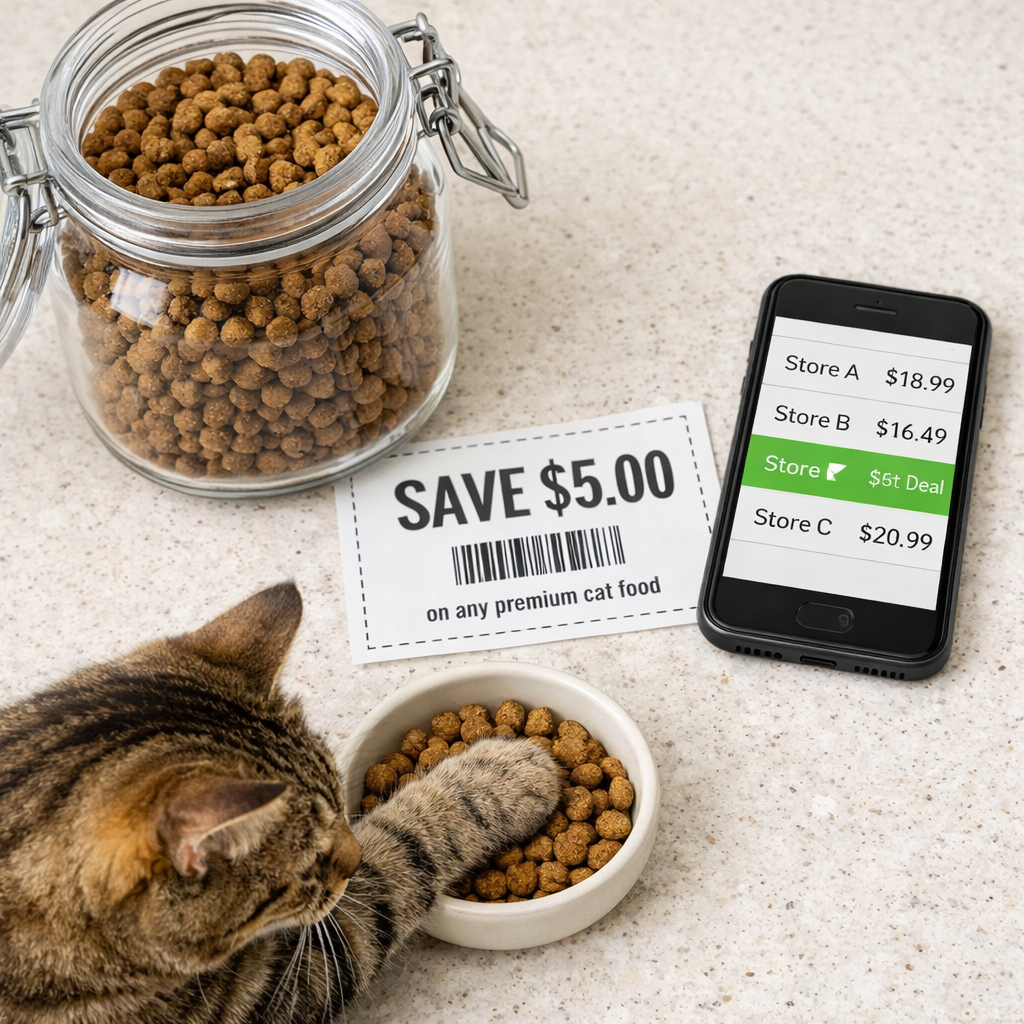
Coupons, email deals, and loyalty programs can yield meaningful savings on pet food, as the smart savings guide confirms. Time big buys around seasonal sales (Black Friday/Cyber Monday) and compare retailer prices online; free shipping promos often improve net cost, per this guide to save money on cat food. Then re-run your cost per 1,000 kcal to confirm the real savings—the Pet Food Ingredient Guide way.
Stack savings:
- Join email lists for first-order codes and natural cat food deals.
- Enable app alerts for price drops and autoship discounts.
- Enroll in loyalty points; pair subscribe-and-save with a coupon and cashback when available.
How to Compare Cost Without Sacrificing Nutrition
Follow Pet Food Ingredient Guide’s sequence: read the label → confirm AAFCO adequacy → do dry matter basis math → calculate cost per 1,000 kcal → consider palatability and a careful transition.
Illustrative comparison (pricing varies; check your label):
- Sample Premium Dry Chicken: 10% moisture; Protein 36% as-fed (40% DMB); Fat 18% as-fed (20% DMB); 4,000 kcal/kg; $60 for 16 lb (7.26 kg) → $2.06 per 1,000 kcal.
- Sample Natural Canned Turkey: 78% moisture; Protein 10% as-fed (45.5% DMB); Fat 5% as-fed (22.7% DMB); 1,050 kcal/kg; $46 per 24-pack (3.74 kg) → $11.72 per 1,000 kcal.
- Sample Freeze-Dried Topper: 5% moisture; Protein 40% as-fed (42.1% DMB); Fat 30% as-fed (31.6% DMB); 5,000 kcal/kg; $35 per 14 oz (0.397 kg) → $17.64 per 1,000 kcal.
Read the label first
Natural on pet labels (40–50 words): AAFCO defines “natural” as ingredients derived solely from plant, animal, or mined sources and minimally processed. The FDA has no formal definition for “natural” on pet food labels, so brands may vary in usage—reinforcing the need to verify claims against the full label and nutrients, as noted in this high-quality cat food guide.
Locate the AAFCO statement, scan the first five ingredients, and note any gums or fillers. Some reviewers flag guar gum appearing in multiple wet formulas; see this best cheap cat food analysis for examples.
Cross-check claims like “human-grade” and “traceable ingredients” on brand transparency pages; the premium cat food guide urges validating marketing with specifics.
Do the dry matter math
Dry matter basis (40–50 words): Dry matter basis expresses nutrients after removing all moisture, making fair comparisons across wet, dry, air-dried, and freeze-dried foods. Convert by dividing the as-fed nutrient percentage by (100 − moisture%) and multiplying by 100, so you’re comparing like with like regardless of water content.
Worked example: A canned food with 78% moisture and 10% protein as-fed has DMB protein of 10 ÷ (100 − 78) × 100 = 45.5%. Many adult maintenance diets land around 35–55% protein DMB and 15–30% fat DMB; adjust for your cat’s life stage and activity. Pet Food Ingredient Guide standardizes this conversion so you can compare any format.
Check AAFCO adequacy and life stage
AAFCO adequacy (40–50 words): The AAFCO nutritional adequacy statement shows whether a food is complete and balanced for a stated life stage—growth, reproduction, or adult maintenance—based on nutrient profiles or feeding trials. It’s the baseline assurance that a formula can serve as the sole diet without nutrient gaps.
Match the label to kitten, adult, or senior needs, and any special conditions. Ensure “complete and balanced” is clearly stated before optimizing price.
Calculate cost per 1,000 kcal
Formula: Cost per 1,000 kcal = (Price ÷ total kcal in the package) × 1,000. Use kcal/kg on dry/freeze-dried or kcal/can on wet.
Mini comparison (illustrative; pricing varies):
- Dry kibble: $60 for 7.26 kg at 4,000 kcal/kg → 29,040 kcal total → $2.06 per 1,000 kcal.
- Canned case: $46 for 3.74 kg at 1,050 kcal/kg → 3,927 kcal → $11.72 per 1,000 kcal.
- Freeze-dried bag: $35 for 0.397 kg at 5,000 kcal/kg → 1,985 kcal → $17.64 per 1,000 kcal.
Use this metric to compare affordable premium cat food across brands and formats transparently. This is the primary price metric we use at Pet Food Ingredient Guide.
Safe Switching and Transition Checkpoints
Frequent, abrupt recipe switches can upset digestion; slow transitions reduce GI risk and prevent false economies like vet bills. Expert video advice emphasizes gradual changeovers and restraint with constant diet hopping. Combine savings tactics only after you’ve established a core, stable diet.
Week by week transition plan
- Days 1–3: 25% new, 75% current.
- Days 4–6: 50% new, 50% current.
- Days 7–9: 75% new, 25% current.
- Day 10+: 100% new.
Extend to 3–4 weeks for sensitive cats. Pause increases if soft stool, vomiting, or appetite dips occur.
Monitor stool, appetite, weight, and coat
Do a weekly weigh-in, note stool scores, and log appetite. Track coat sheen and dandruff as tolerance signals. Adjust feeding amounts by 5–10% based on weight trends and stool quality.
When to pause or revert
If diarrhea, refusal, or vomiting persists beyond 48 hours, step back to the previous tolerated ratio or revert to the prior diet. Contact your vet for persistent symptoms or if weight drops more than 5% over 2–4 weeks.
Frequently asked questions
How do I calculate cost per calorie to compare premium cat foods fairly?
Divide the price by total calories in the package to get cost per kcal, then multiply by 1,000 for cost per 1,000 kcal. Pet Food Ingredient Guide relies on this metric to compare formats objectively.
What storage practices keep bulk dry or freeze dried cat food fresh?
Use airtight containers in a cool, dry place, keep the original lot/label, and rotate stock. Pet Food Ingredient Guide also emphasizes finishing bulk within weeks, not months.
How can I use autoship savings without getting locked in?
Start with a smaller first order, set a conservative interval, and choose programs you can pause or cancel. Pet Food Ingredient Guide suggests rechecking cost per 1,000 kcal after discounts to confirm value.
Is a homemade diet really cheaper if it must be complete and balanced?
It can be, but only with a vetted recipe, correct supplements, and efficient batching. Pet Food Ingredient Guide advises validating nutrient completeness before assuming savings.
What red flags on a label suggest ‘natural’ claims without substance?
Vague “natural” language without an AAFCO adequacy statement, unspecified protein sources, or heavy reliance on thickeners near the top of ingredients. Pet Food Ingredient Guide’s label-first approach helps you verify these quickly.