Wet Cat Food Feeding Guidelines: Exact Portions By Age And Weight
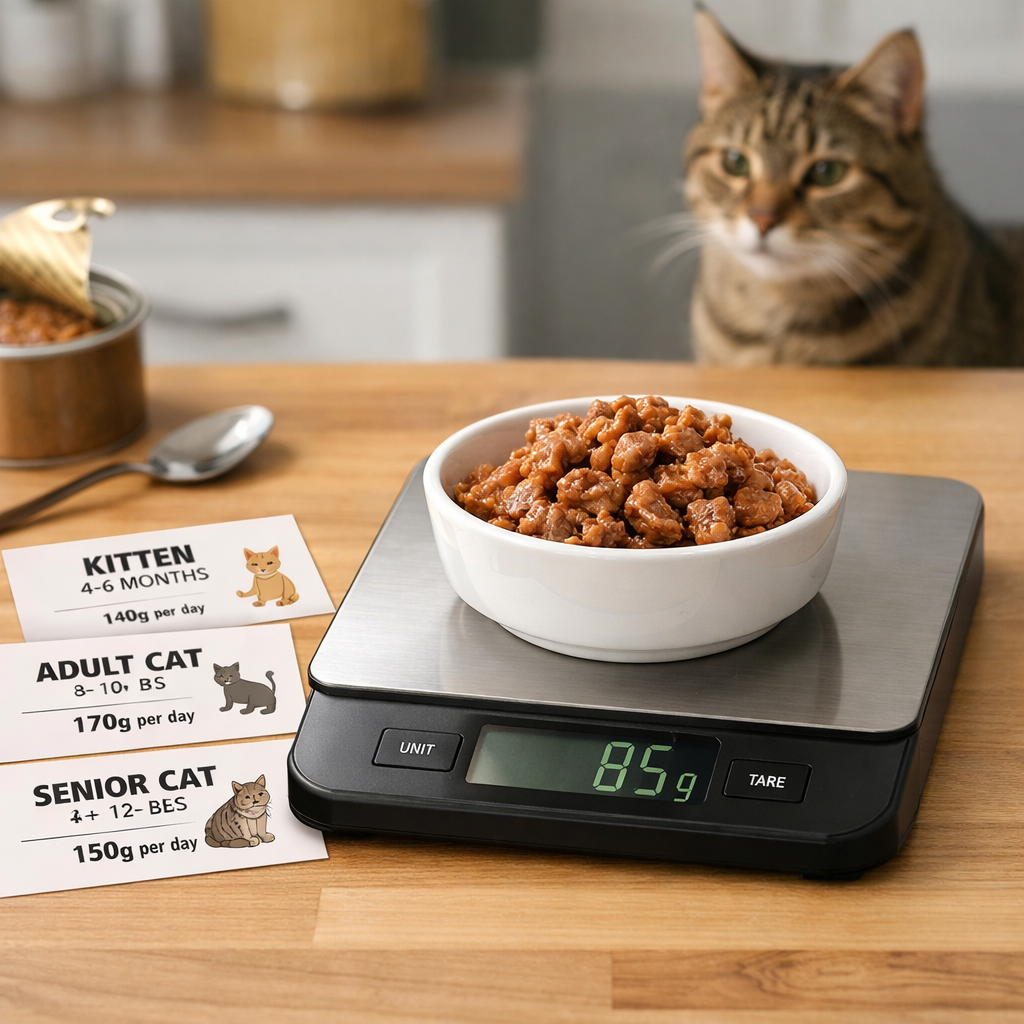
Wet Cat Food Feeding Guidelines: Exact Portions By Age And Weight
Getting wet cat food portions right starts with calories, not can counts. Begin by estimating daily calories for your cat’s ideal weight, then translate that number using the can’s kcal. For many healthy, neutered 10‑lb adults, a practical starting point is about 260 kcal/day, which often equals about three 3‑oz cans depending on calorie density per can. From there, split the total into 2–3 meals, watch body condition, and adjust every two weeks. Use a trusted calorie calculator for cats, verify “complete & balanced” on the label, and fine‑tune portions to your individual cat’s needs (World Pet Obesity Initiative calculator). For label clarity and ingredient context, Pet Food Ingredient Guide’s Ingredient Library can help you decode terms as you match calories to cans.
Start with daily calories for your cat’s ideal weight
Calorie needs are the backbone of precise feeding because wet foods vary widely in kcal per can. Reputable calculators estimate daily energy from ideal body weight, life stage, and activity; treat them as a starting point, not a final prescription. Many 10‑lb adult cats maintain well around 235–285 kcal/day; a common estimate is about 260 kcal/day split into meals (see the World Pet Obesity Initiative calculator).
Spayed/neutered cats frequently need around 20–30% fewer calories than intact cats, and treats should stay at or below 10% of daily calories (Association for Pet Obesity Prevention calculator).
Definition — Ideal body weight: The target weight your veterinarian believes is healthiest for your cat based on body condition, frame, and muscle mass. Always calculate portions from this number (not the current weight) to avoid overfeeding excess fat or underfeeding cats with muscle loss.
Read the label for calories per can or per 100 g
To convert calories into portions, you need one label number: metabolizable energy (ME), shown as kcal per can, per pouch, or per 100 g. Wet foods commonly range about 70–100 kcal per 3‑oz can, and many feeding charts assume roughly 90 kcal per 2.5‑oz can (see Nulo’s typical ranges in its cat feeding guide).
Context matters: wet foods are roughly 75–80% moisture, while dry is often under 10%, making dry far more calorie‑dense by volume (Texas A&M VetMed guidance on selecting cat food).
Mini checklist before you portion:
- Locate kcal per can or per 100 g under “Metabolizable Energy (ME).”
- Note the can size (3 oz, 5.5 oz, 6 oz); bigger cans are not always more kcal per ounce.
- Confirm the AAFCO life stage is appropriate and “complete & balanced” (see the AAFCO section).
Convert calories to exact wet food portions
Use a simple three‑step formula:
- Daily kcal target ÷ kcal per can = cans per day.
- Or daily kcal target ÷ kcal per gram = grams per day (use a kitchen scale).
- Split evenly into 2–3 meals for most cats.
Example: A 10‑lb adult targeting about 280 kcal/day often lands near 9 oz of wet food, or about three 3‑oz cans, though brands vary by kcal per can (Whisker’s feeding guide). All‑wet diets for a 10‑lb cat can range around 3–4 cans/day based on calorie density.
For step‑by‑step math and portioning tips, see the PetMD guide to calculating wet food portions.
Sample daily portions (assumes ~3‑oz cans; brand kcal/can will change the result):
| Cat type | Example daily kcal | Typical cans/day (3‑oz) | Notes |
|---|---|---|---|
| 10‑lb adult | ~260–280 | ~3 | Split into 2 meals; adjust ±10–20% to body condition. |
| 5‑lb kitten | ~320 | ~3 | 3–4 meals/day; use growth formula. |
| 10‑lb pregnant | ~390 | ~4 | Increase as gestation advances; monitor weekly. |
Numbers summarized from PetMD’s calculation approach and Whisker’s kcal-to-ounces examples.
Adjust for mixed feeding with dry food and treats
To mix wet and dry without overfeeding:
- Step 1: Set the daily kcal target for ideal weight.
- Step 2: Subtract calories provided by dry food. Dry is calorie‑dense by volume; measure carefully.
- Step 3: Convert the remaining calories to wet portions using the can’s kcal.
A common example in practice: 1/4 cup of dry twice daily with 1/4–1/2 can of wet as a topper or snack—but the exact amounts must fit your cat’s daily calorie budget, which depends on each brand’s calorie density. Keep treats at or below 10% of daily calories.
Set a feeding schedule by life stage
Calorie needs shift with age, activity, and reproduction. Kittens often need about twice the calories per pound as adults. Pregnant and nursing cats typically require about 25–50% more than maintenance, rising through late gestation and peak lactation (see the PetMD wet‑food calculation guide). Most adults do well on 2–3 meals/day; kittens and nursing queens benefit from more frequent meals. Mixed feeding can help balance hydration from wet with the kibble’s texture for light abrasion (Wellness guide on wet vs. dry).
Kittens portions and frequency
Kittens typically need roughly double the calories per pound versus adults. A 5‑lb kitten may need around 320 kcal/day, which can equal about 10 oz of wet food—or around three 3‑oz cans—depending on kcal per can. Offer 3–4 wet meals/day and ensure the AAFCO statement reads “complete & balanced for growth.”
Adult cats portions and frequency
Many 10‑lb adults maintain on about 235–285 kcal/day, and many calculators cite ~260 kcal/day. Split into two meals of roughly 120–145 kcal each. Depending on kcal per can, that often translates to about 9 oz of wet food, or around three 3‑oz cans per day.
Two meals/day work for most; some cats do well with two meals plus a small wet topper. Mixed feeding can enhance hydration and satiety while keeping total calories on target.
Senior cats portions and frequency
Senior cats may be less active and can benefit from the moisture and softer texture of wet foods. Keep a 2–3 meal schedule and adjust portions by about 10–20% based on body condition every two weeks. Choose “complete & balanced for adult maintenance” with adequate protein and a known kcal per can.
Pregnant and nursing cats portions and frequency
Increase daily calories by roughly 25–50% during pregnancy and lactation. A 10‑lb pregnant cat may need around 390 kcal/day—about 12 oz of wet food, or four 3‑oz cans, depending on calorie density. Feed 3–4+ meals/day or offer frequent small wet feedings, and weigh weekly to maintain ideal maternal condition.
Monitor body condition and refine every two weeks
Weigh your cat and check body condition every two weeks; nudge portions up or down by about 10–20% until weight and shape stabilize at ideal. Calculators are starting points; your cat’s response is the endpoint (see this feeding calculator quick guide). Pet Food Ingredient Guide encourages recording weight and BCS trends alongside exact kcal fed for more consistent adjustments.
Definition — Body Condition Score (BCS): A 1–9 scale assessing fat cover over ribs, waist, and abdominal tuck by look and feel. An ideal BCS is usually 4–5/9. Track BCS trends with weight to fine‑tune daily calories for maintenance or safe, gradual weight change.
Practical measuring, storage, and transition tips
- Use a true measuring cup for dry and a kitchen scale for wet; household scoops often overestimate portions (see Nulo’s portioning advice in its cat feeding guide).
- Transition foods or portion changes gradually over 7–14 days; reassess at the two‑week mark and adjust by 10–20% as needed.
- Refrigerate opened cans, cover them, and offer fresh portions at consistent mealtimes to support appetite and routine.
Ingredient and label checks for complete and balanced wet food
Confirm nutritional adequacy before you perfect portions. Look for an AAFCO “complete & balanced” statement for your cat’s life stage; AAFCO and the FDA govern how this appears on labels (Cornell’s Feline Health Center overview). Remember moisture differences when comparing calorie density across wet, dry, and semi‑moist foods.
AAFCO statement and life stage
Find the nutritional adequacy statement (e.g., “complete & balanced for growth,” “adult maintenance,” or “all life stages”). Choose growth/all life stages for kittens and pregnant/nursing cats.
Definition — AAFCO statement: A short label declaration showing a food meets nutrient profile levels or feeding‑trial standards for a specific life stage. It signals the recipe is designed to be nutritionally complete when fed as the sole diet for that stage.
Guaranteed analysis and calorie density
Record crude protein, fat, fiber, moisture, and—critically—kcal per can or per 100 g. Calorie density determines cans/day more than can size. Compare foods on a kcal‑per‑ounce or kcal‑per‑100 g basis, and split daily calories evenly across meals for consistency.
Ingredient list and functional additives
Scan for named meats high in the list; ingredients are ordered by weight. Beneficial extras can include omega‑3 sources, chelated minerals, prebiotics/probiotics, and antioxidants, while artificial colors add no nutritional value. For plain‑language profiles, see our Ingredient Library at petfoodingredientguide.com.
Definition — Functional additive: An ingredient not primarily supplying calories but added to support health or product quality, such as omega‑3s for skin and coat, prebiotics for gut health, or natural antioxidants for freshness. Judge inclusion level, source quality, and your cat’s specific needs.
Safety notes for weight loss and medical conditions
Avoid rapid or severe calorie restriction—cats are vulnerable to hepatic lipidosis if weight loss is too aggressive. Partner with your veterinarian for any weight‑loss plan, and seek guidance before diet changes for diabetes, kidney disease, GI disorders, pregnancy/nursing, or significant under‑ or overweight cases (principles echoed by Pet Obesity Prevention’s calculator).
Frequently asked questions
How much wet food should I feed my cat each day?
Start with a calorie target for ideal weight (many 10‑lb adults need about 260 kcal/day), then convert using the can’s kcal; for many 10‑lb adults that’s about three 3‑oz cans, adjusted to body condition and calorie density. For label terms and kcal, Pet Food Ingredient Guide’s Ingredient Library can help.
Can I feed only wet food if it says complete and balanced?
Yes—if the label includes an AAFCO “complete & balanced” statement for your cat’s life stage. Our Ingredient Library explains that wording; feed to your daily calorie target and recheck weight/BCS every two weeks.
How do I mix wet and dry without overfeeding?
Set a daily calorie target, subtract calories from dry food and treats, then convert the remainder to wet portions using the label kcal (our Ingredient Library explains those terms). Keep treats at or below 10% of daily calories and recheck weight/BCS every two weeks.
How often should I feed wet food meals?
Most adult cats do well with two meals per day; kittens, pregnant, and nursing cats often need 3–4+ meals. Split the daily calories evenly across meals.
How quickly should I change portions or switch foods?
Adjust portions gradually and reassess after about two weeks. When switching foods, transition over 7–14 days to minimize digestive upset, then fine‑tune by 10–20% based on body condition.