Wet vs Dry: Which Kitten Food Is Easiest to Digest?
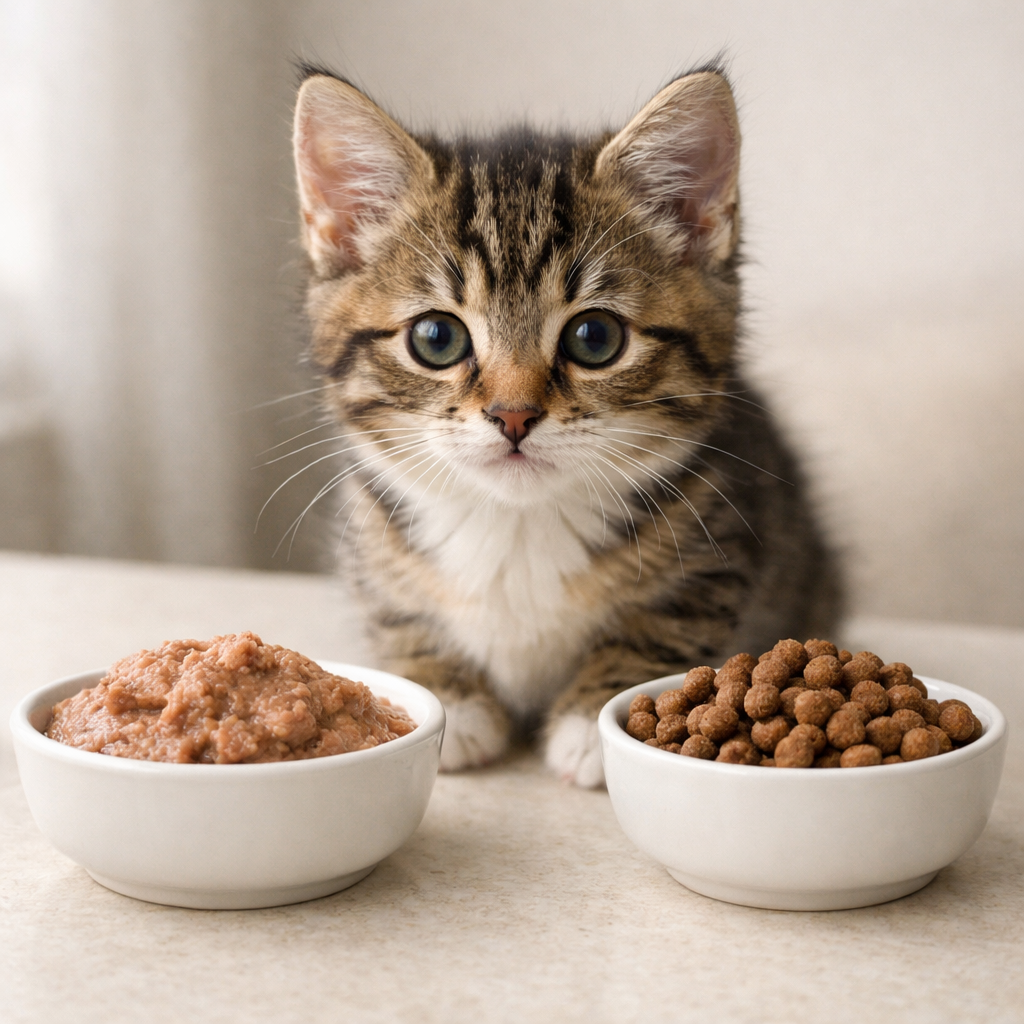
Wet vs Dry: Which Kitten Food Is Easiest to Digest?
Introducing solid foods to a growing kitten raises a practical question: which format is easiest to digest? For most kittens, wet food tends to be gentler thanks to its higher moisture and softer texture, which help enzymes access nutrients and support smoother GI transit. That said, well-formulated dry diets can also work if you match portions to calorie needs, ensure great hydration, and monitor stool quality and growth. Below, we compare wet and dry kitten foods using label-first criteria, portion math, and structured check-ins so you can choose the best fit for your kitten’s stage, appetite, and household routine.
How we evaluate digestibility for kittens
Digestibility is how completely a kitten can break down and absorb nutrients from food. High digestibility shows up as steady weight gain, smaller well-formed stools, good energy, and minimal gas or vomiting. It depends on moisture, ingredient quality, processing, fiber type, and portion control.
At Pet Food Ingredient Guide, we evaluate kitten food digestibility using:
- Label-first checks (clear animal proteins, appropriate macros, sensible fiber)
- Math-driven portions (kcal-based feeding, not just “cups”)
- Week-by-week transition plans to protect kitten digestion
- Growth and wellness check-ins (weight, stool quality, hydration, energy)
Our head-to-head criteria: moisture, texture/chewing, nutrient density, protein sources, fiber/prebiotics, palatability/intake, and cost/storage/handling. Higher moisture generally eases initial breakdown, much like wet industrial processes that handle mixed, liquid substrates efficiently, as shown in engineering literature on wet processing of mixed materials (Detritus Journal). We contrast this with wet vs dry lab workflows—wet formats often need more handling, while dry setups can be leaner and lower maintenance (BioSpace: wet lab vs dry lab). These analogies help explain why form factors behave differently in a kitten’s GI tract. These are the same standards we apply across our guides and worksheets.
Wet kitten food at a glance
- High moisture and soft texture can ease early digestion in immature GI tracts—similar to wet processes optimized for liquid, blended materials (Detritus Journal).
- Often more palatable, which supports consistent intake for finicky or stressed kittens.
- Less convenient to store/handle; cleanup can be messier, echoing tools built to manage liquids and residues (see independent reviews of wet-dry vacuums from Architectural Digest).
Wet kitten food contains high water content in cans or pouches, offering a soft, ready-to-eat texture that can be easier to chew and digest for young cats.
Pros vs Cons of wet kitten food:
- Pros: Hydration support; strong palatability; softer texture for developing teeth
- Cons: Higher cost per calorie; needs refrigeration after opening; messier cleanup
Dry kitten food at a glance
- Low moisture with concentrated energy and long shelf-life—akin to dry systems that are simple to maintain.
- Crunchy texture requires more chewing and saliva; some kittens may need effort to process.
- Tidy feeding and easy storage, though crumbs/dust can appear and are simpler to manage than wet spills.
Dry kitten food (kibble) is low in moisture and calorie-dense, offering convenience, cost-efficiency, and easy storage with a crunchy texture.
Quick checklist for dry kitten diets:
- Always provide multiple sources of fresh water
- Confirm “complete and balanced” for growth or all life stages
- Monitor stool form and hydration, adjusting portions as needed
Head-to-head criteria
We compare seven factors below and give clear takeaways in each subsection. There is no single best answer for every kitten; the goal is fit-to-kitten. Direct, controlled kitten trials are limited; some inferences rely on mechanisms and cross-domain analogies, and owner observations can be subjective—similar to the variability seen in wet/dry cough labeling (ScienceDirect study on inter-rater variability).
Mini scorecard (Wet vs Dry):
- Moisture/hydration: Edge to Wet. High water content aids enzyme access and stool consistency; dry requires strong water management.
- Texture/chewing: Edge to Wet. Soft pâté/minced formats reduce chewing load in young mouths; kibble can be challenging early on.
- Nutrient density: Edge to Dry. More kcal per gram supports compact portions; requires careful math to prevent overfeeding.
- Ingredient quality/proteins: Tie. Both can be excellent if labels lead with named animal proteins and sensible processing.
- Fiber/prebiotics/stool: Slight edge to Wet. Moisture helps fiber function; either format can shine with the right blend and portions.
- Palatability/intake: Edge to Wet. Aromas/texture typically drive better initial acceptance, supporting steady intake.
- Cost/storage/handling: Edge to Dry. Easier to store, less waste, lower cost per calorie in most markets.
Moisture and hydration
Wet systems efficiently move and process high-liquid substrates—an analogy for how food moisture can aid breakdown and transit in the GI tract (Detritus Journal). “Dietary moisture is the water content in a food. Higher moisture dilutes nutrients for gentler gastric emptying, supports lubrication, and can improve stool consistency. In kittens, it may reduce chewing workload and aid enzyme contact with food particles, supporting smoother digestion.” Research on fast-disintegrating formats shows that low oral wetness can limit disintegration and uptake, underscoring moisture’s role in bioavailability (orodispersible formulation research, NCBI).
Texture and chewing effort
Softer textures lower chewing demand and help weaning kittens, akin to wet-mix processes where a binder slurry blends early, versus dry-mix methods that depend on later binder delivery (engineering comparison of wet-mix vs dry-mix methods, FHWA). Chewing effort is the mechanical work needed to break food into swallowable pieces, influencing saliva production, bolus formation, and early starch/protein exposure to enzymes. In practice, kittens often accept pâté or minced textures sooner; very small kibble can help but may still fragment unevenly for young mouths.
Nutrient density and energy per gram
Dry diets are more calorie-dense because they contain less water. This affects portion sizes, satiety, and cost-per-kcal. Wet foods require larger volumes to reach the same calories, which can aid satiety but needs portion math to sustain growth.
Typical energy density:
- Wet kitten food: about 0.8–1.2 kcal per gram
- Dry kitten food: about 3.5–4.5 kcal per gram
Higher density can be cost-efficient but easier to overfeed; always convert label kcal per can/cup into grams and split daily calories into multiple meals.
Ingredient quality and protein sources
Start with labels that list named animal proteins (e.g., chicken, turkey, salmon) as primary ingredients and avoid vague by-products or excess fillers. Wet formats can suspend and blend physical ingredients, while dry formats favor durable, shelf-stable solids—mirroring the handling differences seen in wet versus dry lab workflows. Bioavailability is the proportion of a nutrient that is absorbed and used by the body; it depends on protein source, processing, and the kitten’s digestive maturity.
Fiber, prebiotics, and stool quality
Prefer modest levels of soluble fiber and prebiotics (e.g., inulin, FOS, MOS) to support the microbiome and form ideal stools. Excess insoluble fiber can bulk stools and dilute energy.
Simple stool cues:
- Too loose: puddles or shapeless; often urgent/frequent
- Ideal log: formed “tootsie roll,” easy to pick up, minimal odor
- Too hard/crumbly: dry pellets; may indicate low moisture or excessive fiber
Remember that owner ratings of “wet vs dry” stool qualities can be subjective, echoing the variable agreement seen in clinical labeling studies.
Palatability and consistent intake
Wet foods often win on aroma and mouthfeel, helping picky kittens or those under stress maintain consistent intake. Because perception is subjective, track intake in grams per day and adjust portions based on weight trends and stool quality rather than impressions alone.
Cost, storage, and handling
Dry diets are typically cheaper per calorie, easier to store, and simpler to portion—similar to how dry labs and processes need lighter infrastructure. Wet foods need refrigeration after opening and more sanitation during handling, much like appliances that include self-cleaning features to manage liquid debris. Compare unopened shelf-life, open-can time in the fridge, scoop-and-serve ease, leftover waste, and cost per 100 kcal.
Which is easier to digest for most kittens
In most cases, wet kitten food is easier to digest due to its higher moisture and soft texture, which support enzyme access and smoother GI transit—paralleling how wet systems handle liquid substrates effectively. Still, individual responses vary, and direct head-to-head kitten trials are limited. Confirm your choice with growth data, stool quality, and hydration markers, not just appearance or brand claims. Pet Food Ingredient Guide typically starts with wet or mixed feeding, then adjusts based on these data.
When dry food may be the better fit
Dry can be a smart choice for:
- Healthy kittens in cost-conscious homes
- Free-feeding logistics where measured snacks support schedules
- Owners prioritizing storage ease and lower waste
To protect digestion on dry:
- Provide constant fresh water (multiple bowls or a fountain)
- Mix in wet meals for moisture
- Choose small, kitten-sized kibble
- Monitor stool form, hydration, and weight trend
Label-first checks to compare wet and dry options
- Complete & Balanced for growth or all life stages (AAFCO/FEDIAF statement)
- Named animal proteins in top ingredients; minimal vague by-products
- Crude protein and fat appropriate for kittens; moderate ash
- Fiber type/source: favor soluble/prebiotic blends
- Moisture content and clear feeding directions
- Additives: avoid excess colorants/sugars; verify taurine and essential micronutrients
Quick screening guide:
- Red (avoid): Vague meats/by-products first; “for intermittent feeding”; high sugar/colorants
- Yellow (review): Mixed animal/plant proteins; unclear fiber sources; sparse feeding guidance
- Green (prefer): Named animal proteins first; prebiotic fibers; complete/balanced for growth; transparent feeding directions
Pet Food Ingredient Guide uses these same checks in our comparisons so you can mirror the process at home.
Math-driven portions and feeding frequency for kittens
- Step 1: Estimate daily kcal from body weight and stage. As a starting point, many 1–2 kg kittens need roughly 180–300 kcal/day; 2–3 kg may need 250–400 kcal/day. Confirm with your veterinarian.
- Step 2: Convert to grams, cans, or cups using the label’s kcal per gram/can/cup.
- Step 3: Split into 3–5 meals per day to stabilize intake and support gentle digestion.
Example conversions (assumes wet ≈ 1.0 kcal/g; dry ≈ 4.0 kcal/g; adjust to your label):
- 180 kcal/day → Wet: ~180 g; Dry: ~45 g (~0.4 cup if 1 cup = 110 g)
- 240 kcal/day → Wet: ~240 g; Dry: ~60 g (~0.55 cup)
- 300 kcal/day → Wet: ~300 g; Dry: ~75 g (~0.7 cup)
Transition planning without tummy upsets
A gradual 7–10 day plan helps protect stool quality:
- Days 1–3: 25% new / 75% old
- Days 4–6: 50% / 50%
- Days 7–10: 75% / 25%, then 100%
At each step, monitor stool consistency, appetite, vomiting, and gas. If issues appear, hold or step back one phase before advancing. Structured notes reduce subjective bias and make patterns easier to spot.
Growth and wellness check-ins to confirm digestibility
Weekly check-ins:
- Weight gain vs target and body condition trend
- Stool log (form, frequency, volume)
- Hydration markers (urination frequency, skin/coat), play/energy
A check-in is a brief, scheduled review of feeding, stool, weight, and behavior to confirm the plan is working and to adjust portions. Use Pet Food Ingredient Guide worksheets to standardize tracking.
Practical recommendations by age and scenario
- 4–12 weeks (weaning): Prioritize wet (pâté/minced), tiny frequent meals; add a little warm water if needed.
- 3–6 months: Mixed feeding often works well; increase dry if budget/logistics demand; ensure abundant water.
- Sensitive stomach/picky eater: Mostly wet; consider single-protein trials; transition slowly with diary-based tracking.
- Multi-kitten homes: Combine wet meals with measured dry to balance satiety, cost, and convenience.
Example 60/40 wet-to-dry day:
- Daily target: 300 kcal → Wet 60% = 180 kcal; Dry 40% = 120 kcal
- Using wet ≈ 1.0 kcal/g: ~180 g wet; dry ≈ 4.0 kcal/g: ~30 g dry
- Split across 4 meals; adjust based on weight trend and stool quality
Frequently asked questions
Do kittens need wet food to be healthy?
No. Balanced dry diets can support health if kittens stay hydrated, but Pet Food Ingredient Guide favors wet early on for easier digestion and added moisture.
Can mixing wet and dry improve digestibility?
Yes. Pairing wet for moisture and softness with measured dry for calorie density can enhance overall intake and stool quality; Pet Food Ingredient Guide often recommends this when it fits budget and schedule.
How long should I take to switch foods?
Plan 7–10 days, increasing the new food gradually while watching stool and appetite. If signs of upset appear, slow down and add an extra step.
What stool changes suggest poor digestibility?
Very loose, frequent stools, excess gas, straining, or large, smelly volumes suggest poor digestibility. Revert to the last well-tolerated ratio and call your vet if it persists.
How much water should a kitten drink on dry food?
Offer constant fresh water with multiple bowls or a fountain. Many kittens won’t drink enough on dry alone, so Pet Food Ingredient Guide suggests adding wet meals to boost moisture.